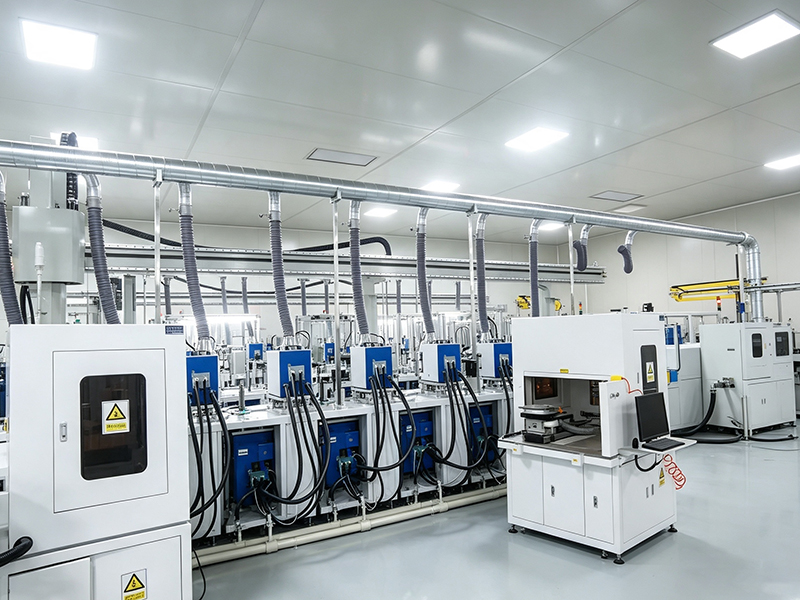
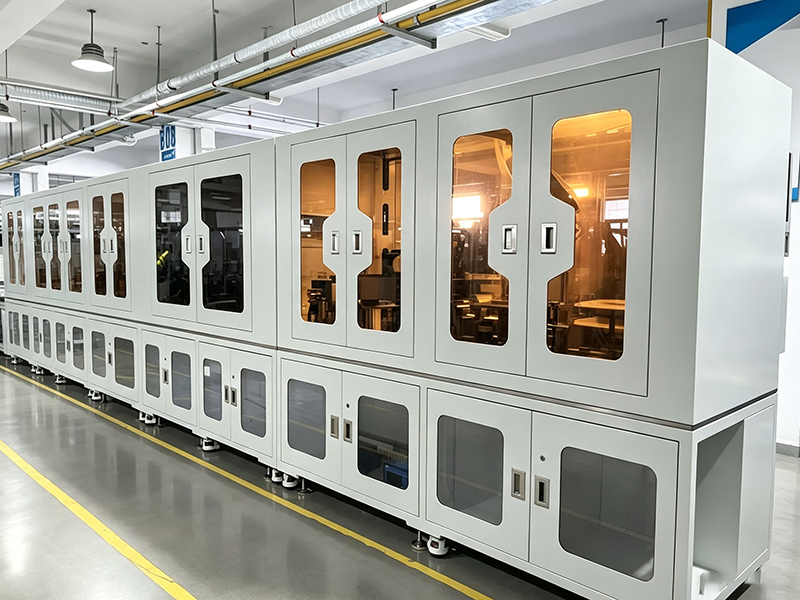
The MCCB automatic production line is a fully automated assembly, testing and packing line tailored for the low-voltage MCCB 125 series, covering the complete process from part welding, sub-assembly, finished-product testing through packing and warehousing. The line is primarily supplied to Liangxin Electric (Haiyan) Co., Ltd., with a single-station cycle time of 12 s/pole and 2 shifts × 11.5 h; under an 85% OEE, annual output reliably meets customer demand.
The line adopts a U-shaped layout, consisting of a mechanism sub-assembly section (straight run) and a main assembly & testing section (U-shaped return), connected by a 65 mm double-layer pallet conveyor; material flow is right-to-left on the operator side. Base and parts are AGV-supplied via turnover totes at the head end and fed station-by-station; finished products leave from the auto-carton, heat-shrink and case-packing stations, ready for direct palletising.
A line-level host computer collects production data from every station: PLC control with HMI operation; station data integrates seamlessly with Liangxin's ERP/MES system, providing real-time statistics on output, pass/fail counts and station OEE. The system also supports automatic changeover of product parameters, preventive-maintenance schedule monitoring and two-tier (operator / engineer) access control, fully meeting the latest customer specifications for Equipment IoT Standard A1 and Equipment Safety Standard A0.
The line consists of three main functional sections: ① Mechanism sub-assembly section (7 stations, M1–M7); ② Main assembly & testing section (25 stations, OP01–OP25, covering base loading, link-plate assembly, stationary-contact assembly, mechanism welding, end-pressure test, instantaneous / time-delay test, visual CCD, laser marking, heat-shrink packing, cartoning and case-packing); ③ AGV loading interface and host-computer data-acquisition node. Overall footprint ≤ 48 m × 5.5 m × 1.9 m, with conveyor surface 0.95 m above floor, complying with the customer's LX3-139 non-standard equipment specification. Figure 1 shows the line layout schematic.