As an automation equipment manufacturer, we are often involved throughout the entire project lifecycle—from requirement analysis and solution design to manufacturing, commissioning, acceptance, and production ramp-up.
One point has become increasingly clear:
Passing acceptance and achieving stable operation do not automatically mean that the full value of an automation project has been realized.
Factories invest in automation to achieve more than a functioning production line. They expect stable output, consistent quality, lower dependence on manual labor, and a measurable financial return.
Equipment delivery is therefore an important milestone, but not the end of the project. The real objective is to ensure that the equipment continues to create value throughout its operating life.
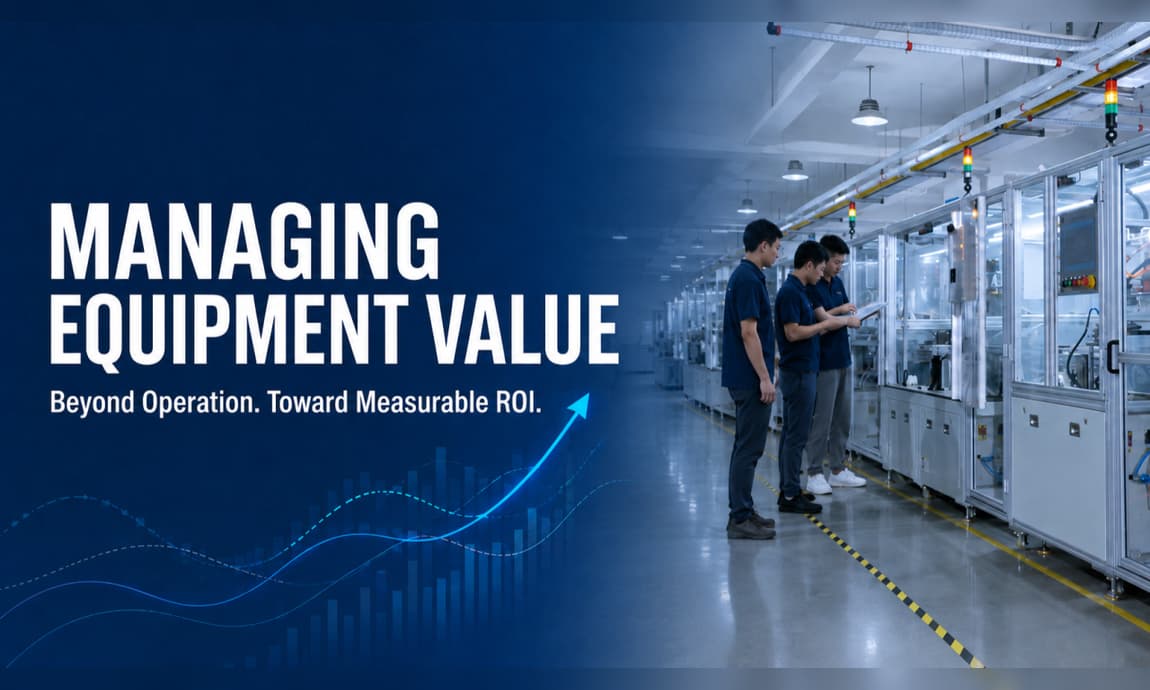
Stable Operation Is the Foundation
Reliability is a basic requirement for any automation system.
However, from an operational and financial perspective, confirming that the equipment is running without major faults is not enough. Maintenance managers and automation teams also need to ask:
Is the actual cycle time meeting the planned target?
How much of the available production time is truly productive?
How long does product changeover take?
How often is manual intervention required?
Are yield and testing consistency meeting expectations?
Can the equipment handle different product variants efficiently?
Is the installed capacity being converted into actual output?
A production line may be operational but still fail to deliver its expected value because of material shortages, lengthy changeovers, parameter adjustments, minor interruptions, or an imbalance between upstream and downstream processes.
The correct question is not simply:
“Is the equipment running?”
It is:
“How much value is the equipment creating while it is running?”
Equipment Performance Depends on More Than the Machine
Automated production is the combined result of equipment, products, materials, processes, operators, and production planning.
When production performance fluctuates, the cause may come from several areas.
1.Equipment conditions
Mechanical systems, electrical components, software, sensors, vision systems, and testing units must remain within their specified operating conditions.
2. Product and material conditions
Component dimensions, tolerances, appearance, and incoming material consistency must meet the requirements of automated handling, assembly, and testing.
3. Process conditions
Production parameters, cycle time, and quality standards must remain within a stable and reasonable process window.
4. Operation and maintenance
Loading, product changeover, cleaning, inspection, preventive maintenance, and abnormal-condition handling must follow clearly defined procedures.
5. Production organization
Material supply, staffing, production scheduling, and upstream and downstream processes must be aligned with the capacity of the automation line.
The equipment manufacturer is responsible for providing a reliable automation system and appropriate technical support. At the same time, the factory’s maintenance, automation, process, quality, and production teams need to evaluate performance using the same data.
The purpose is not to shift responsibility. It is to identify the actual constraint as quickly as possible and prevent the same loss from recurring.
Maintenance and Automation Teams Should Track Effective Output
Traditional equipment management often focuses on preventive maintenance completion, fault records, spare-parts inventory, and maintenance costs.
These indicators remain important, but they do not fully show how much business value the equipment is generating.
Maintenance managers and automation teams should also monitor:
Planned production time
Actual operating time
Actual versus designed cycle time
Product changeover time
Frequency of manual intervention
First-pass yield
Scrap and rework
Cost per unit produced
Performance before and after equipment improvement
These figures help answer a more important question:
Is the factory fully utilizing the equipment capability it has already purchased?
When maintenance and automation teams begin connecting equipment performance with output, quality, and operating cost, their role expands from technical support to equipment value management.
Automation Projects Should Not Be Evaluated by Purchase Price Alone
The initial quotation is only one part of the cost of an automation project.
The actual value of an automation system should be assessed across its full lifecycle, including:
Equipment purchase and implementation costs
Installation, commissioning, and training
Labor savings
Capacity improvement
Yield improvement
Energy consumption
Maintenance and spare-parts costs
Product changeover time
Expected operating life
Upgrade possibilities and future product compatibility
A lower purchase price does not necessarily mean a lower total cost. Similarly, a larger initial investment does not always mean a longer payback period.
The more meaningful comparison is how much stable output each solution can deliver over the same operating period—and what ongoing costs are required to maintain that output.
This is why an automation supplier needs to understand the customer’s product types, target capacity, working shifts, labor costs, quality requirements, and future changeover needs before finalizing a solution.
Use an ROI Calculator to Evaluate the Business Case
To help manufacturers conduct an initial assessment during project planning or equipment improvement, I developed an automation equipment ROI calculator.
By entering basic information such as equipment investment, labor cost, working time, production capacity, yield, and maintenance expenses, the tool can estimate:
Annual labor savings
Financial impact of additional capacity
Savings from improved yield
Annual operating and maintenance costs
Estimated annual net benefit
Payback period
Expected return on investment
Automation Equipment ROI Calculator
The result should not be treated as a guaranteed financial outcome. Actual returns will depend on order volume, capacity utilization, product mix, and operating conditions.
Its purpose is to turn the question of whether to automate from a general assumption into a data-based discussion that can be reviewed by engineering, operations, finance, and management.
It also helps the equipment manufacturer and the customer establish clearer and more consistent project targets from the beginning.
Equipment Value Should Be Reviewed After Acceptance
After an automation line has passed acceptance, the factory should periodically compare:
Planned cycle time versus actual cycle time
Expected labor savings versus actual staffing
Target yield versus actual yield
Estimated maintenance cost versus actual maintenance cost
Planned payback period versus current payback progress
If actual results do not meet the original targets, the next step is to identify whether the gap comes from equipment capability, product conditions, process parameters, material consistency, or production organization.
Completing this evaluation loop turns an equipment purchase into a production asset that can be continuously measured and improved.
From “The Equipment Is Running” to “The Equipment Is Creating Value”
Automation equipment does not generate its full return simply because installation has been completed.
The equipment manufacturer must deliver a stable, reliable system that matches the customer’s products and processes. Maintenance managers and automation teams must then continue monitoring equipment condition, effective output, quality performance, and operating cost.
The key questions are:
Is the equipment consistently meeting the target cycle time?
Has it reduced dependence on manual labor?
Has it improved product and testing consistency?
Can it support current and future product requirements?
Is the investment being recovered as planned?
Valuable automation is not only about replacing manual work with machines. It is about making capacity, quality, and cost more stable, measurable, and sustainable.