A customer calls and asks, "How many MCBs can your line make an hour?" The first instinct is to quote a nice round number. The honest answer is: let me look at the slowest station. On an MCB automatic assembly line, the line does not run at the average of the station times. It runs at the slowest one. Miss that and the capacity number you promise today becomes the overtime bill tomorrow. This is how we work out cycle time and UPH on an MCB automatic assembly line, the way we actually do it on the shop floor.
One station sets the beat for the whole line
Picture the line as a chain of stations: the base goes on, the mechanism is set, the terminals are torqued, the unit is tested. Each station takes a few seconds. Most finish in six or seven seconds. But if one station takes twelve, the whole line waits at that station. The conveyor moves, the fast stations idle, and the bottleneck decides the beat. On an MCB automatic assembly line, cycle time is not a sum, it is a maximum. That is the single thing most surprises on the shop floor come back to. Figure 1 shows where that bottleneck usually hides.
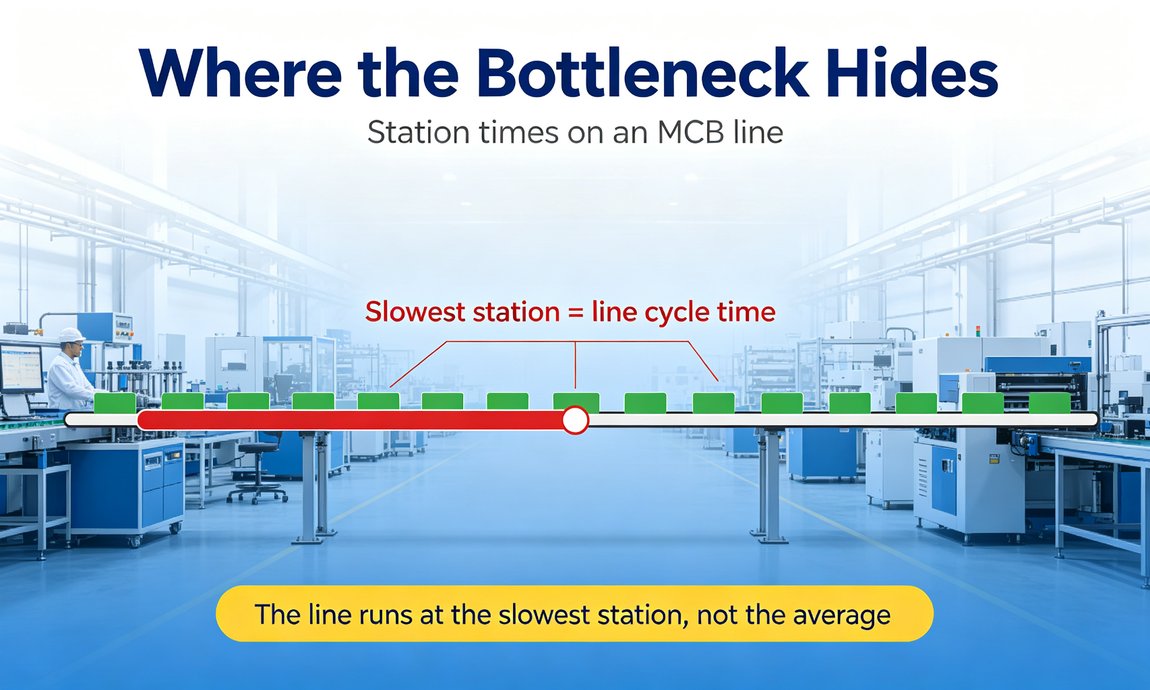
Figure 1. The slowest station sets the line cycle time; the others pace themselves to it.
UPH is a simple division once you have the cycle time
Once you know the bottleneck station time, UPH is just math. There are 3600 seconds in an hour. Divide 3600 by the cycle time and you get the theoretical output. A 12-second cycle gives 300 units an hour. But nobody runs at the theoretical number. You lose time to changeover, to a missing part, to a rejected unit that has to be reworked, to a jam on the upstream feeder. ACA Automation takes the theoretical UPH and knocks it down for those real losses before quoting, because the customer who gets the raw number will only find the shortfall on his own line. Figure 2 walks the steps.

Figure 2. From the bottleneck station time to a realistic UPH after downtime and changeover.
Where the slow station usually is
On most MCB builds, the slowest station is not the screw driving. It is the assembly step that has to position small parts by feel: the spring, the latch, the mechanism arm. A vision-guided pick helps, but if the parts are fed badly, the station slows down waiting for a good pick. That is why the feeder design matters as much as the robot. ACA Automation sizes the feeders first on an MCB automatic assembly line, because a feeder that starves the station turns a fast cycle into a slow one. The test station can also be the bottleneck if the trip or withstand test runs long, which is where the testing equipment station has to be parallelized rather than stacked inline, so the assembly side never waits on a single long test cycle.
Why we look at the bottleneck before we promise capacity
Say a customer wants 240 UPH. We check the station times. If the mechanism set is the bottleneck at 14 seconds, the line only makes 257 theoretical, and after changeover it lands around 220. The honest answer is to either speed up that station or split it into two parallel stations. Promising 240 anyway is how a line comes up short on the first production week. The line uses standard assembly equipment modules, so adding a second station at the bottleneck is a layout change, not a rebuild. Browse our products to see how the MCB automatic assembly line is sized around the slowest step, before anyone quotes a capacity number. On the MCB automatic assembly line, that bottleneck check is the first page of the spec, not a footnote.
What changeover does to the daily number
One line can run several MCB frame sizes. Each size change means different tooling, different feeders, different test limits. A fast changeover measured in minutes protects the daily output; a slow one eats an hour. ACA Automation builds the MCB automatic assembly line with recipes that swap the program and the jigs together, so the operator calls up the frame size and the line re-targets. The daily capacity is the hourly UPH times the effective running hours, minus the changeover time for the frames built that day. That is the number worth quoting, not the hourly peak, and it is what a plant manager actually plans around on the MCB automatic assembly line.
Send us your MCB frame sizes, the annual volume and the frames per day you want to run, and we will price the bottleneck stations and the changeover time on an MCB automatic assembly line before we quote UPH. No round numbers up front.
Frequently asked questions
Why is UPH not just the sum of all station times?
Because the line moves as one unit. The fastest station only waits for the slowest. The cycle time is the longest station, and UPH is 3600 divided by that number, not the sum divided by anything. Anyone who sums the station times is planning the wrong line and promising the wrong capacity.
Can we buy extra stations to raise UPH?
Only at the bottleneck. Adding a fast station does nothing; splitting the slowest station into two parallel ones raises the cycle time limit. That is where the budget goes on an MCB automatic assembly line.
Does the test station set the pace?
Often it does, if the test runs long. ACA Automation parallelizes the test so the assembly line keeps moving, because a slow inline test becomes the bottleneck and drags down the whole MCB automatic assembly line.