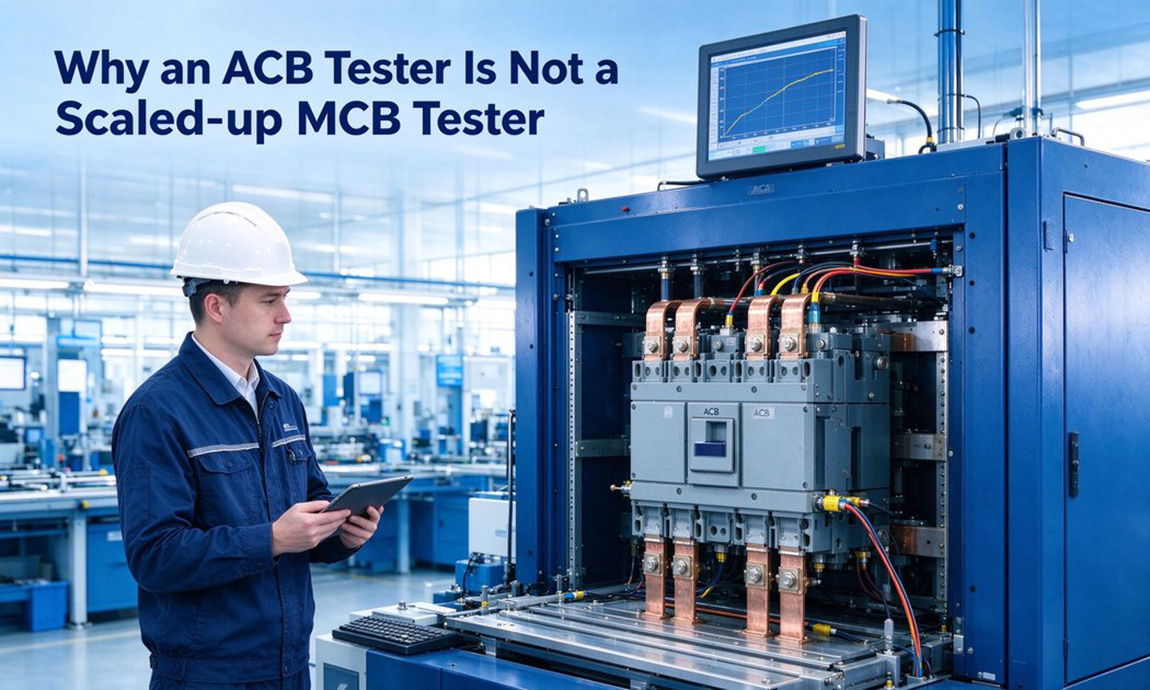
Walk into an MCB factory that still tests by hand and you see the same thing: a row of benches, each with a meter and a pushbutton, and one guy on each bench flicking a breaker on and off while he watches the dial. Slow, tired, and - if you really look at the numbers - drifting. That is usually the day the plant manager asks about an MCB automatic assembly line. The question is not whether it works. The question is what it actually does to the breaker on the line, unit after unit, and why that beats a bench.
Let me walk through it the way we build it. An MCB automatic assembly line does not just assemble the breaker; it tests the breaker as it goes down the line, so a bad unit gets caught at the station that makes it, not at the customer's shelf. That is the whole point of an MCB automatic assembly line.
The breaker comes in partly built
By the time a breaker reaches the test section of an MCB automatic assembly line, the mechanism is already assembled: the handle, the latch, the bimetal and the solenoid are all in the housing. What the test stations do is prove that mechanism actually does its job, over and over. There is no point building a breaker if the trip unit never trips, and that is what the line checks before the cover goes on. An MCB automatic assembly line that only assembles and skips the test is just a faster way to make bad breakers.
Mechanical operation first
The first station cycles the handle - on, off, on, off - a set number of times, the way an MCB automatic assembly line is set up to run it. It listens for a clean click, feels for a jam, and rejects anything that binds. On a hand bench, an operator might do a couple of cycles and call it good. On an MCB automatic assembly line, each breaker gets the same programmed number of cycles, same force, same speed. You can see the test side on testing equipment. Figure 1 shows the stations.

Figure 1. The test stations a breaker passes through on an MCB automatic assembly line.
The trip curve is the heart of it
This is the station people care about. The line injects a known current - say five to ten times rated for a C-curve breaker - and times how long it takes to trip. Too slow, the breaker is weak. Too fast, it is oversensitive. B, C and D curves each have their own window, and the line has to run that window on each unit. A bench test can do it, but the numbers are only as honest as the operator who wrote them down. On an MCB automatic assembly line, the current is fixed, the time is measured, and the result is logged to the serial. No one hand-writes a pass. A well-built MCB automatic assembly line makes that station the bottleneck only on paper, because the next breaker is being loaded while the current test runs.
Hipot and the drop test
Then comes the dielectric test: line to earth, a few kilovolts for a second or two, watching for a leakage spike. An MCB automatic assembly line runs that test in a guarded nest, so the voltage never sits on an exposed pin. After that, the line measures the voltage drop across the contacts at rated current, which tells you if the contact resistance is in spec. A drop outside the window is diverted right there on the MCB automatic assembly line. Skip either and you ship a breaker that either leaks voltage or runs hot under load. The build side is under assembly equipment. A good MCB automatic assembly line runs the hipot and the drop test in parallel nests, so neither one sets the beat of the line.
Why it beats doing it by hand
Faster, first off. One operator loads, the line runs the whole sequence in a single cycle, and the breaker comes out tested on both sides. A bench takes a person per unit; a line takes a person per shift. Then accuracy. The current, the voltage, the timing are all set by recipe, so the twelfth thousandth breaker is tested the same as the first. That consistency is what an MCB automatic assembly line buys you, and it is the thing a bench can never guarantee across a long shift. And the numbers are logged, which is what you want when a customer asks for traceability. Figure 2 lays the three advantages out.
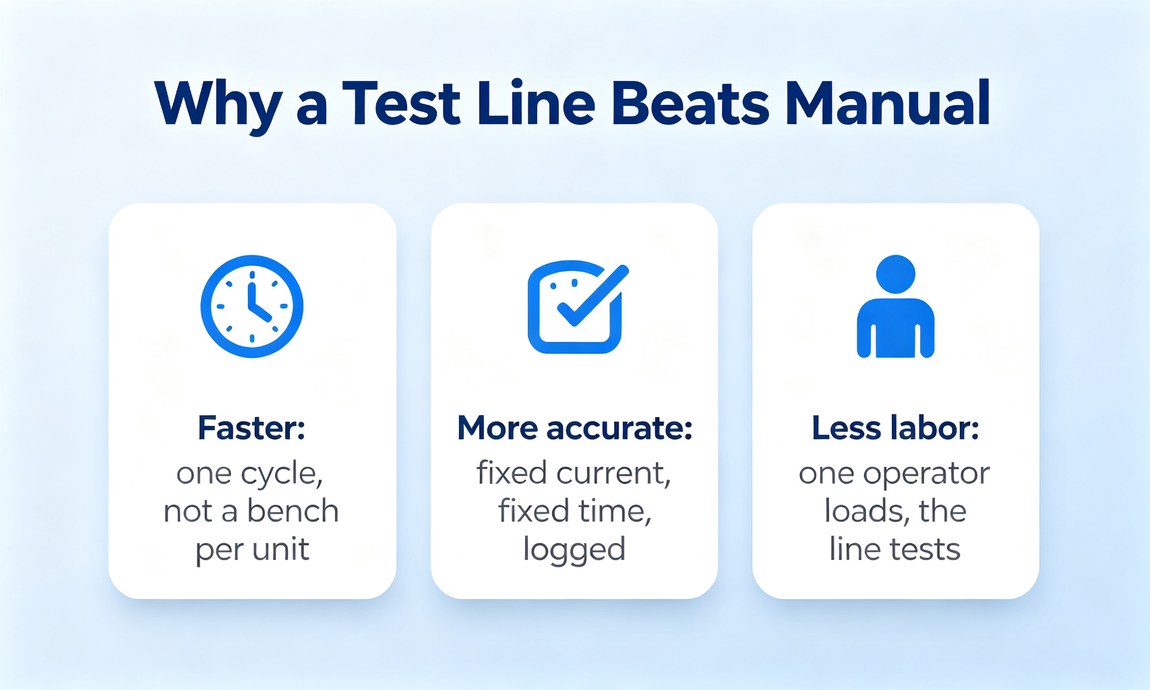
Figure 2. Faster, more accurate and less labor - the three edges an MCB automatic assembly line has over manual testing.
How we put one together
ACA Automation sequences the assembly and the test stations as one flow, so a breaker moves straight from assembly into the trip curve and hipot without a cart in between. That is the difference between a real MCB automatic assembly line and a few testers bolted onto a bench. Recipes recall per curve - B, C, D, any rating - and each result rolls up to the MES. The lineup is on products. The way I like to put it to customers: you are not buying faster testing, you are buying the same honest test on the ten-thousandth breaker as on the first one. That is what an MCB automatic assembly line is for. ACA Automation builds the line around your curves, not around a generic box.
FAQ
Does the line test each breaker?
Yes. The test stations run on each unit as it moves down the line, and a fail diverts the breaker at that station instead of letting it pass.
Can it handle B, C and D curves on one line?
Yes. The curve window is a recipe recalled by part number, so the same stations test a B breaker one minute and a D breaker the next.
Do we still need manual inspectors?
One operator loads and watches the line; the test itself is automatic. The manual bench per unit goes away, the loading operator stays.
Send ACA Automation your breaker ratings and target output for a test line layout - from concept to completion.