In high-volume RCCB and RCBO manufacturing, test accuracy is only one part of the challenge.
Manufacturers must also consider how products enter and leave each station, how long every test takes, how different models are changed over, how rejected products are controlled, and how test results are linked to individual products.
These factors determine whether a testing system can support continuous production.
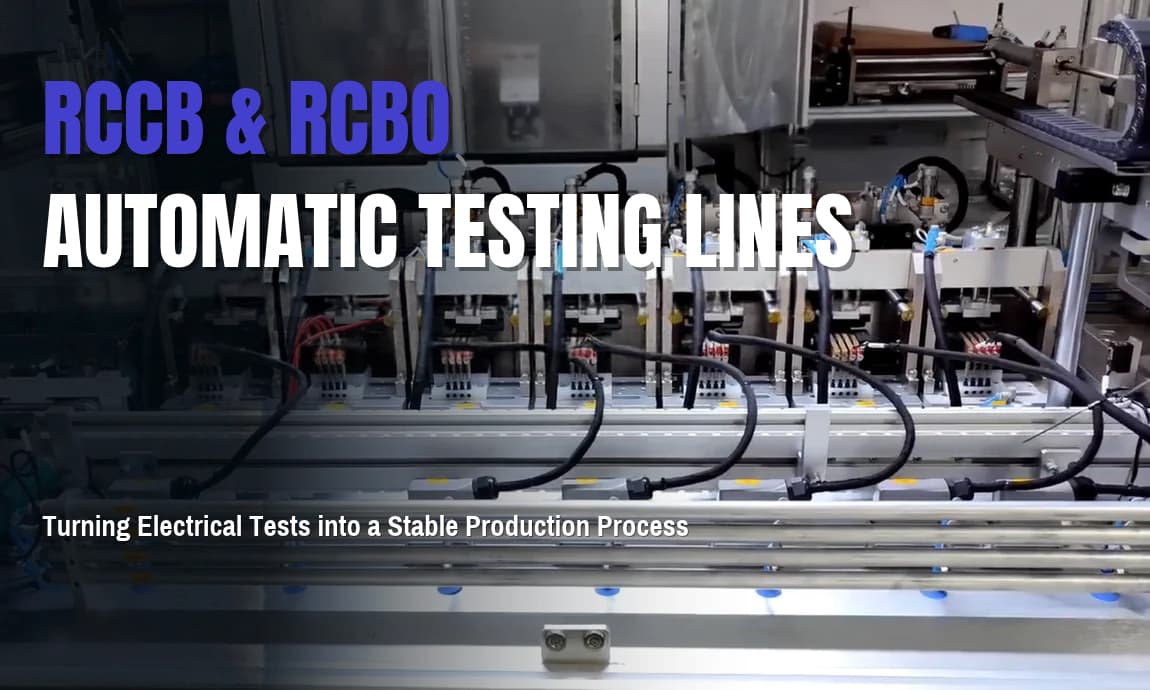
A production-ready automatic testing line is therefore more than a group of testing instruments connected by a conveyor. It must integrate product handling, positioning, electrical connection, test execution, result evaluation, NG separation, data traceability and safety control into one coordinated process.
1. Start with the complete production flow
The process begins when an assembled product enters the testing line.
The system identifies the product model, confirms its orientation and positions it in the correct station. The fixture clamps the product, and the test probes automatically connect to the terminals.
The control system then loads the correct test program and carries out the required sequence, which may include:
Continuity and wiring verification
Dielectric withstand testing
Residual-current operating tests
Operating-time measurement
Test-button function verification
Other product-specific functional checks
After testing, the system disconnects the probes and releases the product. Passed units continue to marking or packaging, while failed units are transferred to a controlled rejection area.
The objective is not simply to automate individual test actions. It is to reduce manual wiring, manual program selection and manual result recording throughout the complete process.
2. Station configuration must follow the required cycle time
The capacity of an automatic testing line cannot be determined only by conveyor speed or the duration of one test.
Actual throughput depends on several connected factors:
Loading and positioning time
Number of required test items
Test duration and repetition requirements
Number of poles and terminals
Probe connection and disconnection time
Product reset time
Handling of failed or interrupted tests
Some electrical tests may take longer than the target line cycle. In this situation, increasing conveyor speed will not solve the bottleneck.
A more practical solution is to use parallel testing stations. Multiple products can undergo the same or different tests simultaneously, while the PLC controls product entry, waiting, testing and discharge.
The required number of stations should therefore be based on a complete cycle-time analysis. Adding one station for every test item does not automatically create a balanced production line.
3. Automatic terminal connection affects test stability
During manual testing, an operator can adjust the wires or probes when a product is not positioned perfectly. An automatic line cannot depend on this type of correction.
The fixture and probe system must repeatedly achieve:
Accurate alignment with the terminals
Stable contact position and pressure
Reliable electrical connection
Controlled probe withdrawal after testing
Different RCCB and RCBO models may have different pole configurations, terminal positions and connection sequences. Fixture design must therefore consider not only the current product but also future changeovers, replacement of wear parts and maintenance access.
Unstable probe contact can produce inconsistent readings, false failures and repeated tests, even when the test instruments themselves are accurate.
For this reason, fixture repeatability and contact monitoring should be treated as part of the measurement system—not simply as mechanical details.
4. Flexible production requires synchronized changeover
A flexible line must do more than allow operators to replace a fixture.
The product model, test program, fixture configuration and acceptance limits must all correspond with one another.
When a product enters the line, its identity can be read from a QR code or another identification method. The control system then loads the corresponding recipe and verifies that the fixture, probe arrangement and equipment settings match the selected product.
If the software recipe and hardware configuration do not match, the line should prevent the test from starting and clearly indicate the cause.
This interlocking logic helps prevent:
Selection of the wrong test program
Use of incorrect acceptance limits
Testing with an incompatible fixture
Batch-level errors caused by an incomplete changeover
Good changeover design should also reduce the number of manual adjustments and make each required step easy to confirm.
5. Test data should support production decisions
The output of an automatic testing line should not be limited to a Pass or Fail signal.
Each product should be linked to a unique identification record containing relevant information such as:
Product model and serial information
Date and time of testing
Test recipe used
Results from each test item
Final judgment
Failure category or alarm information
The data can be stored locally or transferred to an MES or other production management system.
This creates value beyond basic recordkeeping. If the same failure begins to appear repeatedly, the production team can investigate whether it is related to product assembly, incoming components, fixture contact, test parameters or a particular station.
Without this level of traceability, engineers may know that products have failed but still be unable to determine where the problem started.
6. NG handling must be designed into the line
Detecting a failed product is not the end of quality control.
The testing line must also define:
Where the failed product will be transferred
Whether an automatic retest is permitted
How many retests are allowed
How repaired products re-enter the process
How unverified products are prevented from mixing with passed products
NG channels, isolation mechanisms and retest permissions should be established during the equipment design stage.
If the machine only generates an alarm and relies on an operator to remove the product manually, there is still a risk of incorrect removal, missed products or uncontrolled retesting.
A complete testing line must control both the test result and the product’s physical destination.
7. Safety must cover the full testing cycle
RCCB and RCBO testing may involve energized terminals, residual-current injection and dielectric withstand tests. The safety system must therefore be integrated with the testing sequence and machine movements.
Test power should only be enabled after the system has confirmed:
Correct product positioning
Complete fixture clamping
Reliable probe connection
Closed guards and active safety circuits
If a safety door is opened, an emergency stop is activated, a product is incorrectly positioned or the connection mechanism is not ready, the machine must prevent or stop the test according to the defined safety logic.
After testing, the system must also confirm that the test output has been disconnected and any remaining hazardous energy has been safely removed before the probes retract and the product leaves the station.
Safety cannot depend only on operating instructions. It must be built into the equipment’s electrical, mechanical and control design.
From electrical testing to production control
The value of an RCCB or RCBO automatic testing line is not limited to making one test faster.
Its real purpose is to turn separate manual operations and standalone testers into a controlled production process that can run continuously, accommodate multiple products and provide traceable results.
When evaluating a testing-line concept, manufacturers should focus on five questions:
Are the test results stable and repeatable?
Can the station configuration meet the required production cycle?
Can different models be changed over safely and efficiently?
Are failed products automatically controlled and traceable?
Can operators and maintenance teams quickly identify and recover from equipment faults?
Only when these requirements are considered together does an automatic testing system become a reliable part of manufacturing—rather than simply several test instruments connected by a conveyor.