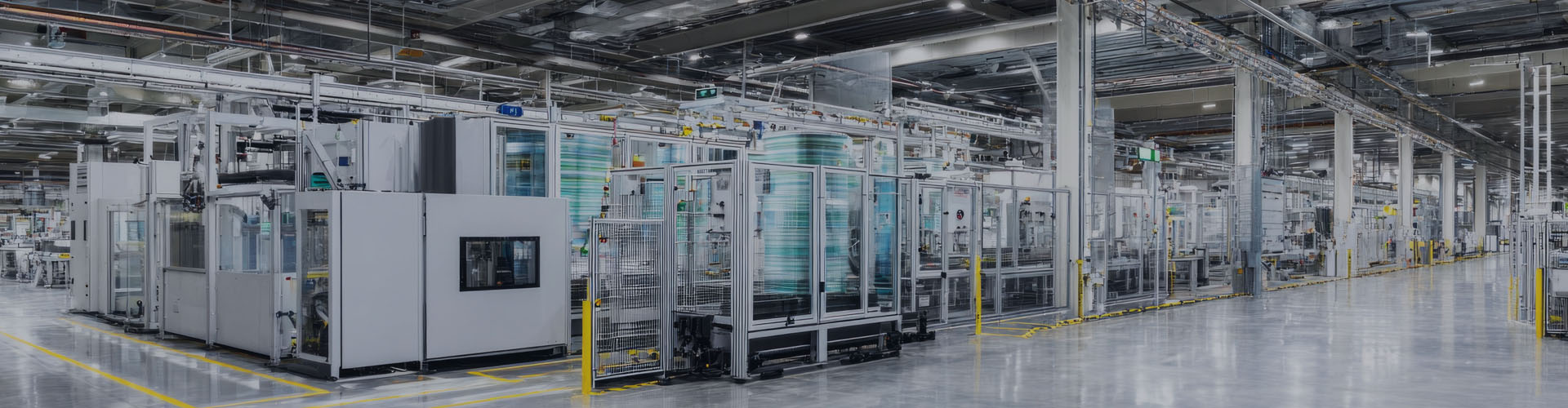
Air circuit breakers are large, heavy products with many possible configurations. One production line may need to handle different frame sizes, rated currents, pole configurations, and both fixed and draw-out designs.
The manufacturing process can include manual assembly, mechanical running-in, cradle assembly, accessory operation tests, high-current protection tests, dielectric testing and contact resistance measurement.
An incorrect product identity, test recipe or fixture configuration at any stage can affect the final test result.
For this reason, an ACB automatic assembly and testing line must coordinate product handling, testing, changeover, error prevention and data traceability as one production process.
From Material Delivery to Final Packaging
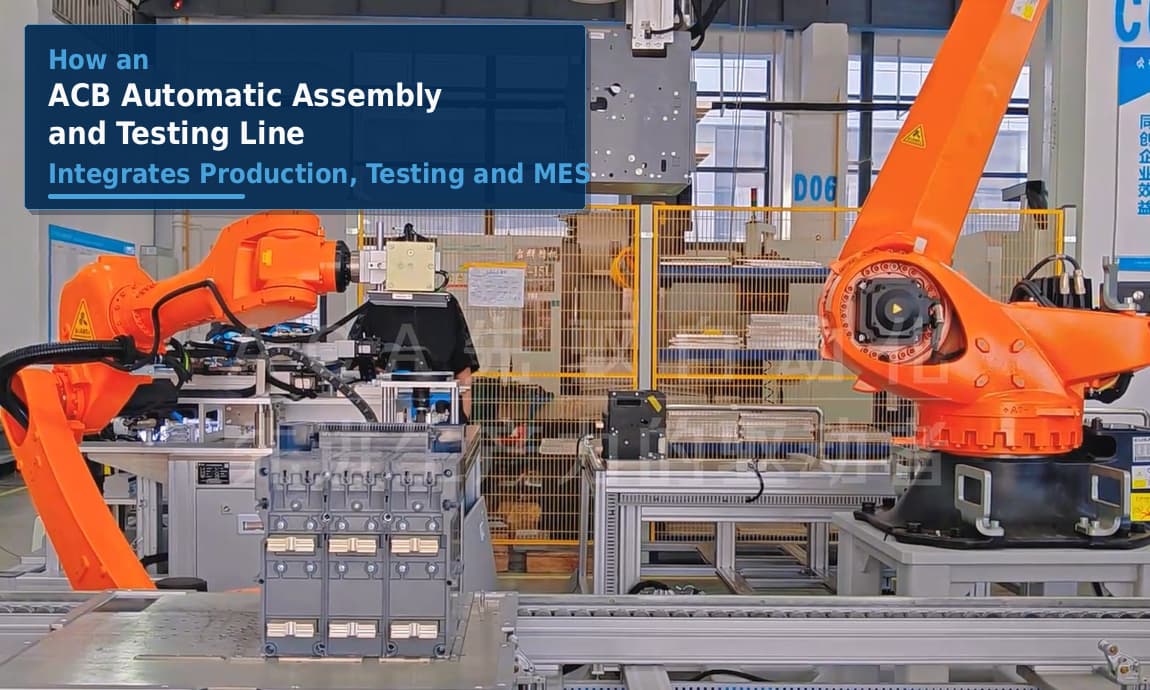
An air circuit breaker production line can use a roller conveyor and circulating pallets to move products between stations. Materials are prepared in the warehouse and transferred to the assembly area by AGVs or another internal logistics system.
When a product enters the line, the operator scans its code and binds the product information to the RFID tag on the pallet. At each subsequent station, the equipment reads the RFID information and loads the correct process route and test parameters.
A typical production flow can include:
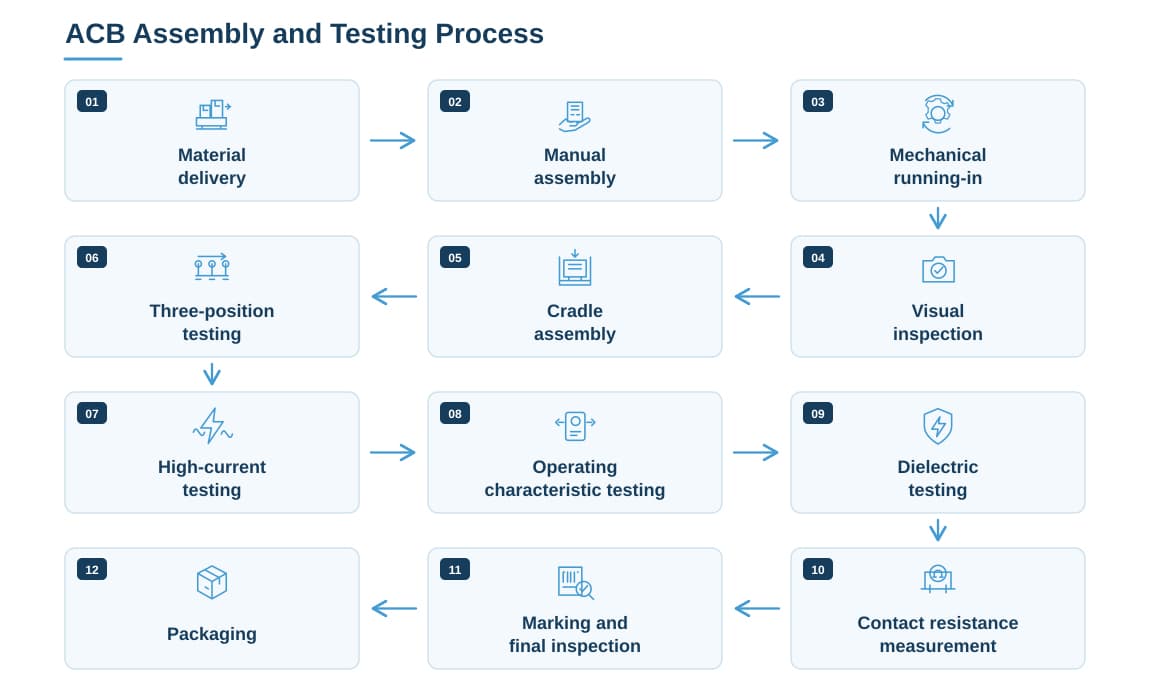
Manual work can remain in assembly processes that require flexibility. Repetitive tests, high-risk electrical operations and processes that require actual-value recording can be automated.
This arrangement retains flexibility in product assembly while reducing manual wiring, program selection and result recording during testing.
Multi-Model Production Requires Synchronized Changeover
An ACB automatic assembly and testing line may need to handle several frame sizes and rated currents. Primary terminals, secondary terminals and operating mechanisms can also differ between fixed and draw-out products.
Changeover should not depend only on an operator selecting a program.
Before testing starts, the control system should verify the product model, production order, test recipe, parameters and fixture configuration. Different secondary terminal arrangements can use dedicated test fixtures, each identified by a code.
If the product, fixture and test program do not match, the equipment should prevent the test from starting and generate an alarm.
This interlocking method reduces the risk of using an incorrect fixture, applying the wrong parameters or omitting required test items.
What Should an ACB Automatic Testing Line Check?
Mechanical Running-In
The station automatically performs opening, closing, charging and tripping operations. It can record the number of cycles, opening and closing forces, and trip force.
Where the product structure and visual conditions permit, the system can also inspect contact opening distance and overtravel.
Vision Inspection
A robot moves the vision system around the breaker to inspect buttons, indicator labels, controller models, rated-current markings, busbar terminals, fasteners and accessory nameplates.
Vision inspection must be validated with actual product samples. Surface colour, reflection, component tolerances and obstruction can affect inspection reliability.
Three-Position Testing
Draw-out air circuit breakers require verification of the connected, test and disconnected positions.
The equipment should confirm the position indication and mechanical interlock status before it performs the relevant closing, opening or electrical test.
High-Current Protection Testing
The high-current testing station checks the matching condition between the electronic trip unit and current transformers. Depending on the product requirements, it can test long-time, short-time, instantaneous and ground-fault protection functions.
The test system must control the output current, energising time, pole switching sequence and trip feedback.
For electronic trip units with a communication interface, the equipment can also read or write protection settings and perform automatic calibration. Products without a communication interface may still require manual support for some calibration and result confirmation steps.
Operating Characteristic Testing
This station checks the undervoltage release, shunt release, closing electromagnet, motor operating mechanism and auxiliary contacts.
The equipment applies the specified voltage and operating sequence, monitors each response and records the result automatically.
Dielectric and Contact Resistance Testing
The dielectric testing station checks the insulation between poles, between incoming and outgoing terminals, between phases and earth, and between the secondary circuit and earth.
The contact resistance station applies a controlled current and measures the resistance of each main circuit phase.
All actual test values should be linked to the individual product record and uploaded to the production database.
Test Duration Determines the Number of Stations
The capacity of an ACB testing line cannot be calculated from conveyor speed alone.
Mechanical operations, high-current application, protection delay and dielectric testing require different amounts of time. If one test takes longer than the target line cycle, two or more parallel testing stations may be necessary.
For this type of production line, the target cycle can be approximately three minutes per unit. The final station configuration must also consider changeover time, manual assembly time, selected test items, product configuration and the method used to handle abnormal products.
A complete cycle-time analysis is required before the number of stations can be confirmed.
How MES Connects Products with Test Data
An air circuit breaker production line should create a complete manufacturing record for each product.
The line-level MES can receive production orders from the factory MES and send the following information to each station:
• Product model and order information
• Process route
• Required test items
• Test parameters
• Acceptance limits
• Fixture and changeover requirements
After each operation, the station uploads assembly records, actual test values, alarm information and the final result.
If the factory network is temporarily unavailable, the line-level server can store the data locally. When communication is restored, the system can transmit the records to the factory MES in sequence.
This reduces the risk of losing production and test data because of a temporary network interruption.
Rework Must Be Part of the Production Flow
When a product fails a test, the system should record the station, failed test item and actual measured value.
When the product reaches the rework station, the operator can view the failure details on the station display and decide whether to repair the product online or remove it from the line.
After repair, the product must return to the relevant test process. A product that has not completed the required retest should not proceed to packaging.
This prevents unverified products from being mixed with accepted products.
Measurable Benefits of the Equipment
The value of an ACB automatic assembly and testing line should be evaluated through output, equipment efficiency, test coverage and data completeness.
Counting only the number of automated movements does not show whether the line supports stable production.
Evaluation item | Design target or measurement method | Production value |
Production cycle | Approximately three minutes per unit | Supports capacity calculation and station balancing |
Shift output | Target of approximately 150 units per eight-hour shift | Provides a basis for production planning and delivery scheduling |
Overall equipment effectiveness | Target OEE of at least 93% | Measures availability, performance and quality together |
Automatic test coverage | Mechanical, operating characteristic, high-current, dielectric and contact resistance tests | Reduces manual wiring, parameter selection and result recording |
Product traceability | Product code, RFID, pallet and MES data binding | Links each product to its production process, test results and failure records |
Changeover error prevention | Automatic verification of products, fixtures, programs and test parameters | Reduces incorrect program and fixture selection |
Abnormal-product handling | Automatic alarms, fault records and rework instructions | Shortens fault identification and rework confirmation time |
Maintenance management | Maintenance schedule monitoring and permission control | Reduces unplanned downtime caused by missed maintenance |
Production data management | Automatic recording of output, measured values, alarms and judgments | Supports quality analysis and continuous production improvement |
What Should Be Confirmed Before Planning an ACB Production Line?
Before equipment design begins, the manufacturer should provide the product range, frame sizes, rated currents, pole configurations, and the expected ratio of fixed and draw-out products.
Primary and secondary terminal drawings are also required.
Other important inputs include:
• Required output per shift
• Mandatory and sampling test items
• Acceptance criteria for each test
• Availability of controller communication interfaces
• Factory MES interface requirements
• Responsibility for AGVs and warehouse logistics
• Rework and retest rules
• Representative products and sample quantities
These inputs directly affect the number of testing stations, fixture design, parallel test configuration and the required automation level.
An ACB automatic assembly and testing line must handle heavy products, multiple configurations, complex electrical tests and production data traceability.
Its main task is to keep the product identity, process route, test parameters, fixture status and quality result consistent throughout production.
Production managers should evaluate more than the capability of each individual test machine. Line balance, error handling, maintenance access and MES data flow also determine whether the complete line can support stable manufacturing.
ACA Automation can evaluate assembly, testing, logistics and data-system requirements based on the customer’s ACB product range, test standards, capacity target and factory layout.