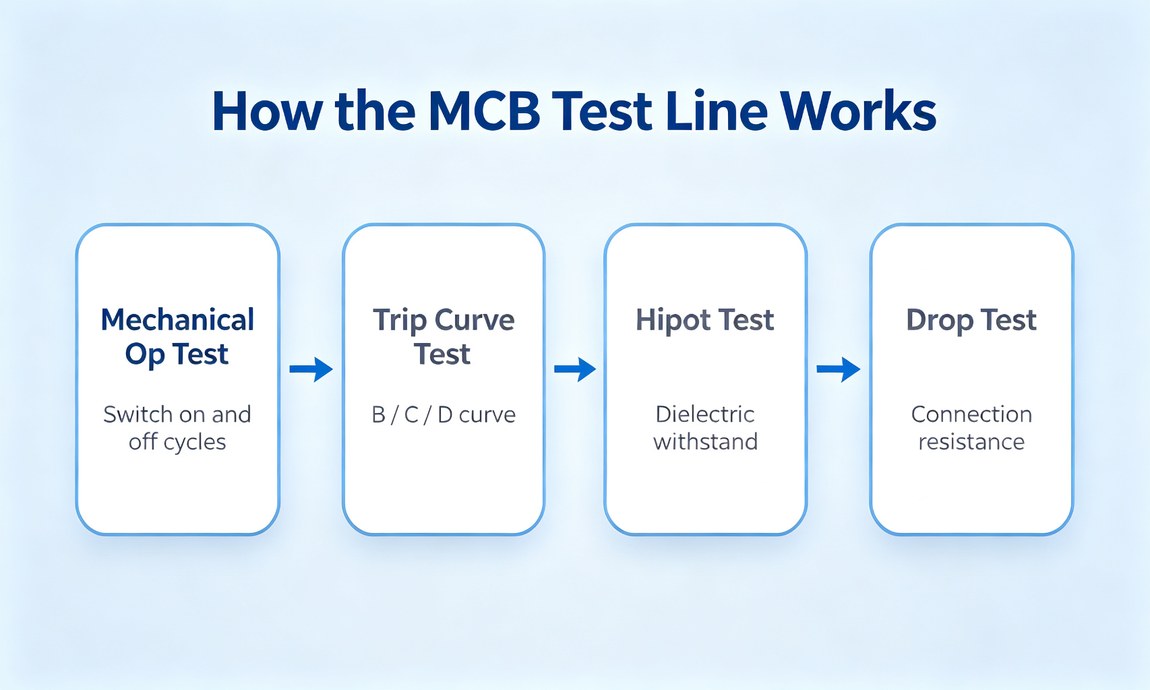
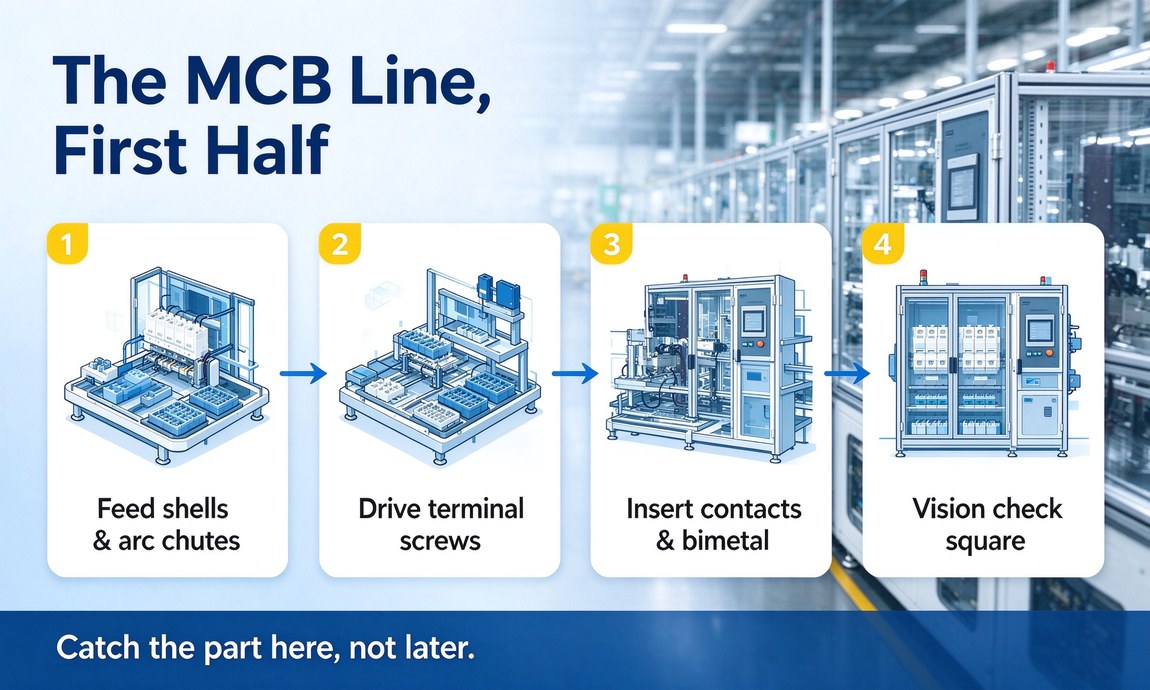
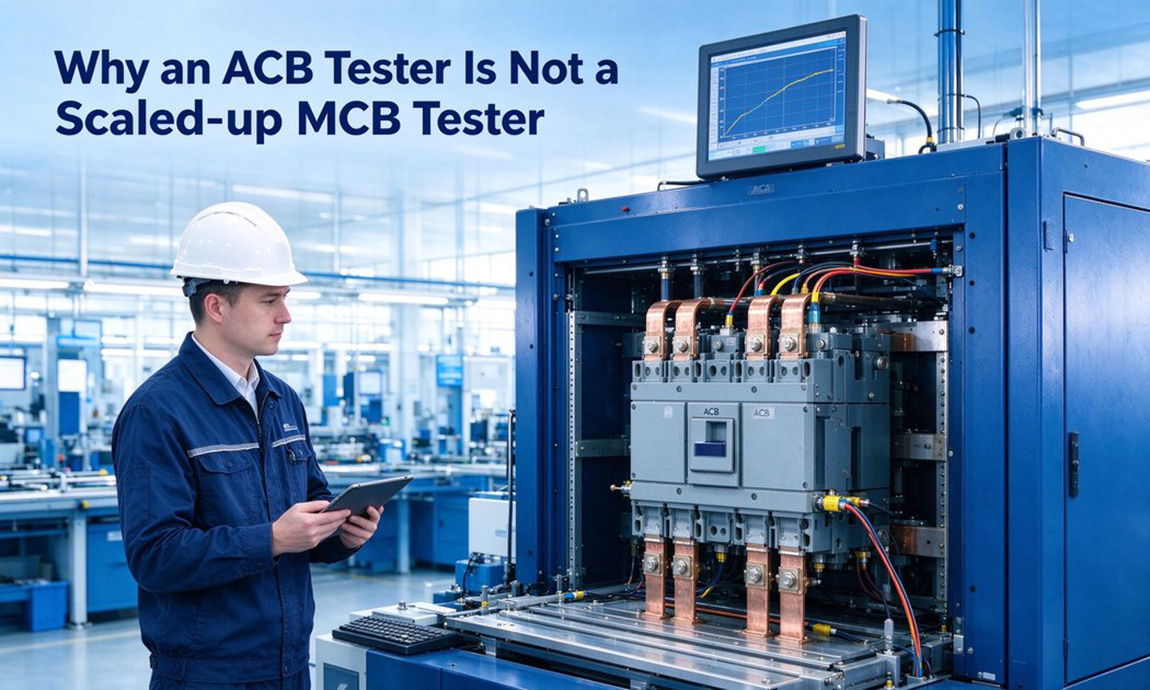
An ACB mechanical life test runs the breaker open and closed ten thousand times or more. On an assembly line where each station takes only a few seconds, nobody wants the product to sit at a station for hours while the cycling test finishes. Yet endurance cycling has to happen on the ACB automatic testing line, or the breaker ships without proof that the mechanism survives. The answer is not to slow the line; it is to give endurance its own cycling station that runs in parallel. This is how ACB endurance cycling testing fits into the ACB automatic testing line.
A routine functional test takes seconds and runs inline. An endurance test is a different animal: it repeats the same open-close operation thousands of times, watches for a seized mechanism or a dropped coil, and stops on the first fault. Running that inline would block the whole line for a shift, so the ACB automatic testing line treats endurance as a separate batch station fed by a buffer rather than as another in-line step. The cycling station sits beside the main flow, takes a sample from the buffer, and returns a pass or fail after the required operations are complete.
Why an endurance test cannot share the assembly takt
The mismatch is one of scale. A contact resistance check or a trip test takes seconds and belongs on the main ACB automatic testing line; a ten-thousand-cycle endurance run takes hours and would idle all upstream and downstream stations behind it. Endurance is a sampling and reliability test, not a per-unit pass gate, so it does not need to run on the main flow. Keeping it off the line is what lets the ACB automatic testing line hold its normal takt while a separate cycling station works through a sample. A line that tries to run endurance inline simply stops, because no conveyor can make a ten-hour test feel like a three-second station.
How the cycling station actually runs
The cycling station mounts the ACB in a fixed fixture and drives the closing and opening coil or stored-energy motor, counting each operation. A cycle counter tracks the target, position feedback confirms each open and close, and the station stops itself on an abnormal coil current, a missed operation or a mechanical jam. ACA Automation sizes the drive and the cooling around the heat of repeated coil pulses, because cycling heats the coil and the mechanism long before the target count is reached. The fixture is keyed to the frame so a sample can be loaded, cycled and unloaded without re-tooling, which is how the cycling station stays productive on an ACB automatic testing line rather than becoming a one-off test rig. Figure 1 shows the cycling station and its counters.
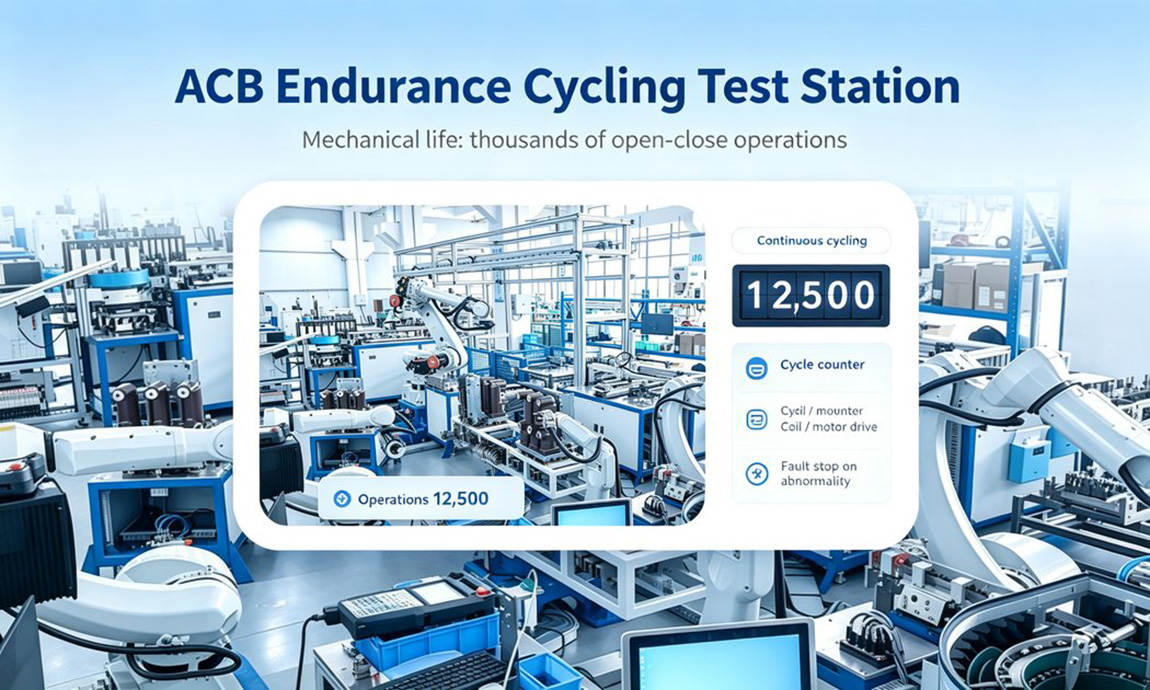
Figure 1. ACB endurance cycling station: continuous open-close cycling with a cycle counter, coil or motor drive and fault stop.
Stop at mid-life to measure, then resume
Running ten thousand cycles without checking anything means you only learn the unit failed at the end. An ACB automatic testing line pauses the cycling block at a mid-life point, pulls the unit to a quick measurement, then resumes. The mid-life check measures contact resistance, opening and closing time, the trip curve and visual wear on the contacts. That turns a blind endurance run into a trend: if contact resistance is already drifting at half life, the unit is flagged before it wastes the remaining cycles. These checkpoints are scheduled by cycle count, not by clock, so the same breakpoint runs the same on the ACB automatic testing line for each batch. Figure 2 shows the checkpoint pattern.
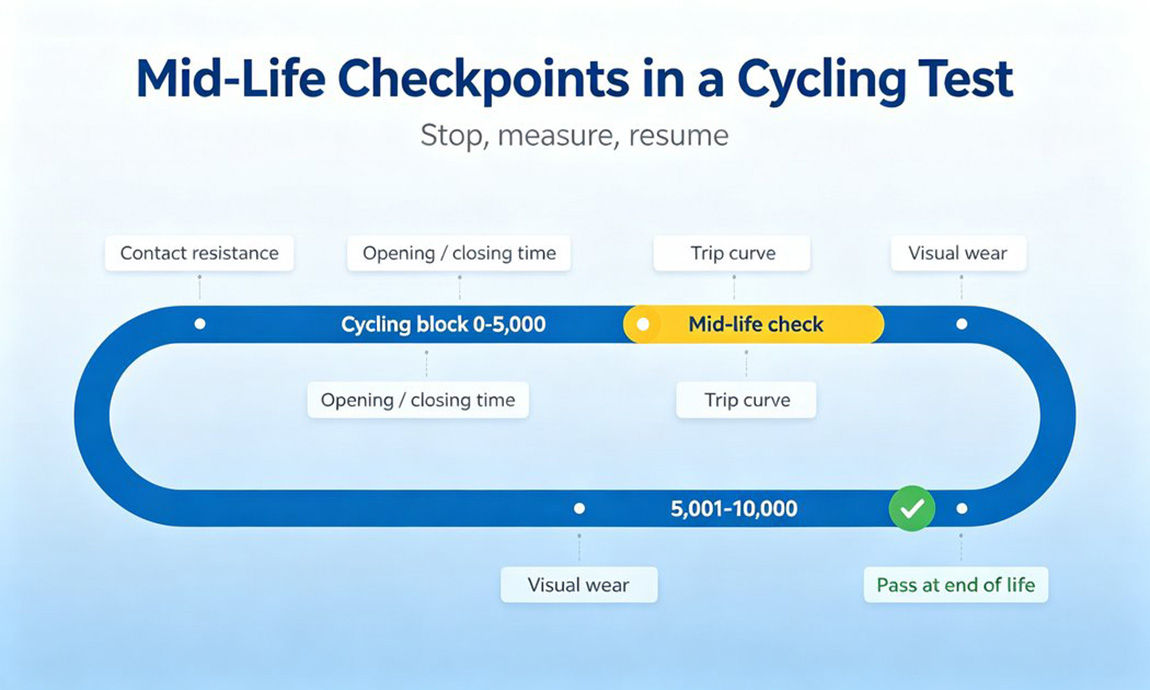
Figure 2. Mid-life checkpoints: cycling blocks pause for contact resistance, timing, trip curve and visual wear, then resume to end of life.
How ACA Automation integrates the cycling station
ACA Automation places the cycling station off the main flow with a small accumulator, so finished units queue while a sample or a dedicated batch cycles through. The station records the cycle count, the mid-life measurements and the pass-fail result to the unit serial, feeding the same record as the rest of the testing equipment. Browse our products and our solutions for how the endurance cell is matched to the ACB range. On a real ACB automatic testing line, endurance runs in the background and never blocks assembly; that separation of slow cycling from fast inline tests is the layout principle behind the ACB automatic testing line. The accumulator in front of the cycling station is small on purpose: it only needs to hold enough units to feed the sample, not to buffer a full shift, which keeps work-in-progress low while the cycling station works through its batch.
Send ACA Automation your ACB ratings and required cycle counts for a cycling-station layout and takt estimate of the ACB automatic testing line, including how many samples you want cycled per batch. We will size the drive, the cooling and the mid-life checkpoints around your frame.
Frequently asked questions
Does each unit run the full endurance test?
No. Endurance cycling is a sample and reliability test, usually run on a sample batch rather than on each breaker. The ACB automatic testing line routes production units through the fast inline tests, while a sample runs through the cycling station for the required number of operations; that is the standard split on an ACB automatic testing line.
How long does a 10,000-cycle test take?
It depends on the cycle rate of the mechanism. At a few seconds per open-close operation, ten thousand cycles runs for many hours, which is exactly why it lives on a separate cycling station rather than on the main ACB automatic testing line. The cycling station runs unattended overnight between batches, so the long endurance time costs no assembly time at all.
What happens when a unit fails mid-cycling?
The station stops on the first fault and flags the unit by serial. The mid-life measurements make the failure traceable: a rising contact resistance or a slowing opening time shows where the mechanism wore, instead of leaving only a final failure record. That record is stored with the unit on the ACB automatic testing line and can be compared against earlier batches.