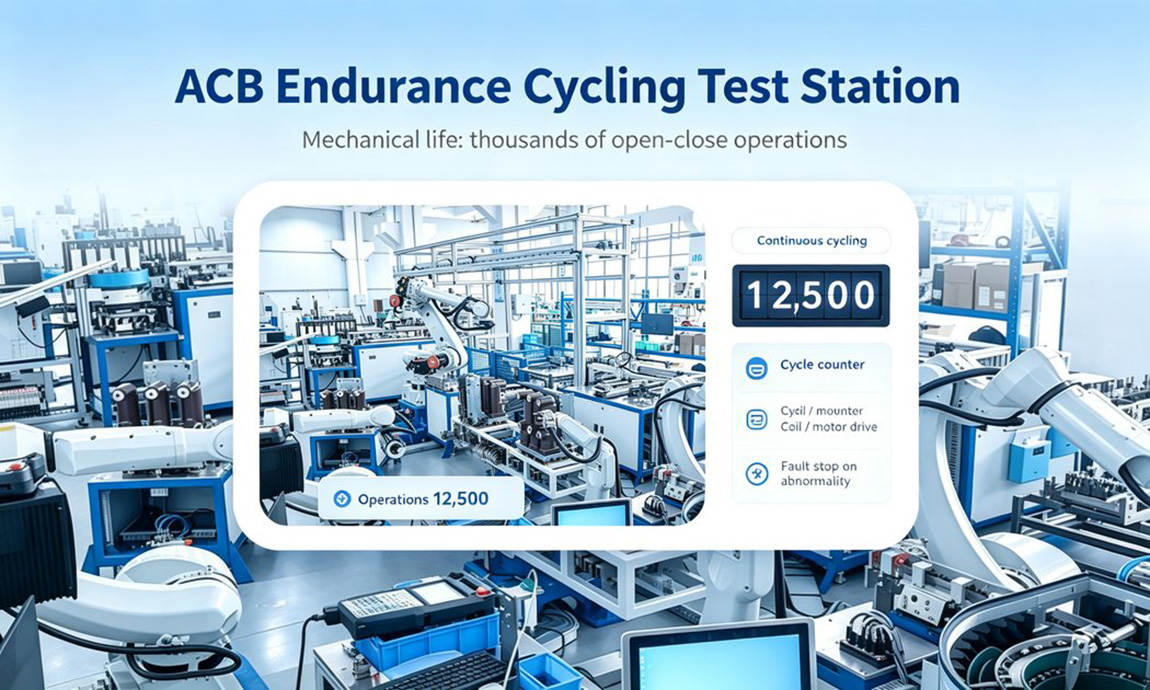
A buyer with a good MCB tester asks the question honestly: our small-breaker tester runs ten units a minute, so why can't we just stretch it to cover a 4000 A air circuit breaker? The short answer is that an ACB automatic testing line is not a bigger MCB tester. It is a different machine solving different physics. The current is hundreds of times higher, the contacts bolt through copper busbar rather than touch a small terminal, and the breaker needs time to stabilize before it trips. Try to scale up the MCB design and you will melt the fixture, overshoot the current, and slow the line to a crawl.
This matters because an ACB automatic testing line is bought once for a long production run. Get the current circuit, the clamping and the thermal timing wrong, and the test data itself is wrong. Here is how ACA Automation reads the difference.
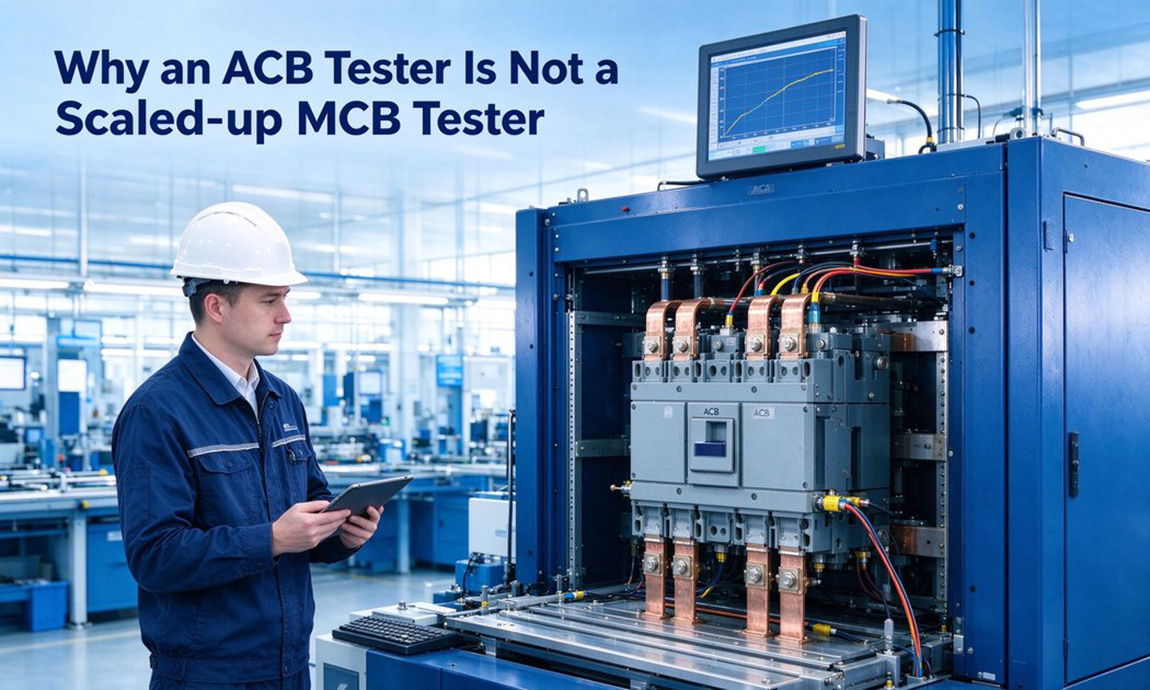
Figure 1. A heavy-duty ACB test cell with busbar clamping, where current and thermal time differ from an MCB tester.
Why a 6300 A breaker is not a bigger MCB
An MCB carries up to a few hundred amps and tests in seconds. An ACB handles 630 to 6300 A and its contact system, solenoid and bimetal are sized to carry that current continuously for a minute or more. The test that proves an MCB trips at its rated current is a short pulse. The test that proves an ACB trips correctly is a sustained high-current load while the mechanism is hot. An ACB automatic testing line has to deliver that sustained current to a heavy device without overheating its own cables. That is a power-circuit design problem, not a software setting, and no amount of tuning on an MCB tester closes the gap. An ACB automatic testing line is sized for that sustained current from the start, with busbars and cables rated for the heat it produces.
The busbar is the first thing that breaks the scale-up
On an MCB tester, small probes touch compact terminals. On an ACB, the unit bolts onto thick copper busbar; contact resistance at the joint has to stay near zero across hundreds of cycles, otherwise the fixture heats up and the measured current drops. A scaled-up probe will not carry the load, will not clamp evenly, and will wear out in days. An ACB automatic testing line uses heavy busbar clamping - hydraulic or servo - that repeats a known force, with contact surfaces checked and dressed on a schedule. The clamping is part of the measurement, not a fixture detail, and an ACB automatic testing line that treats it as a detail measures nothing trustworthy.
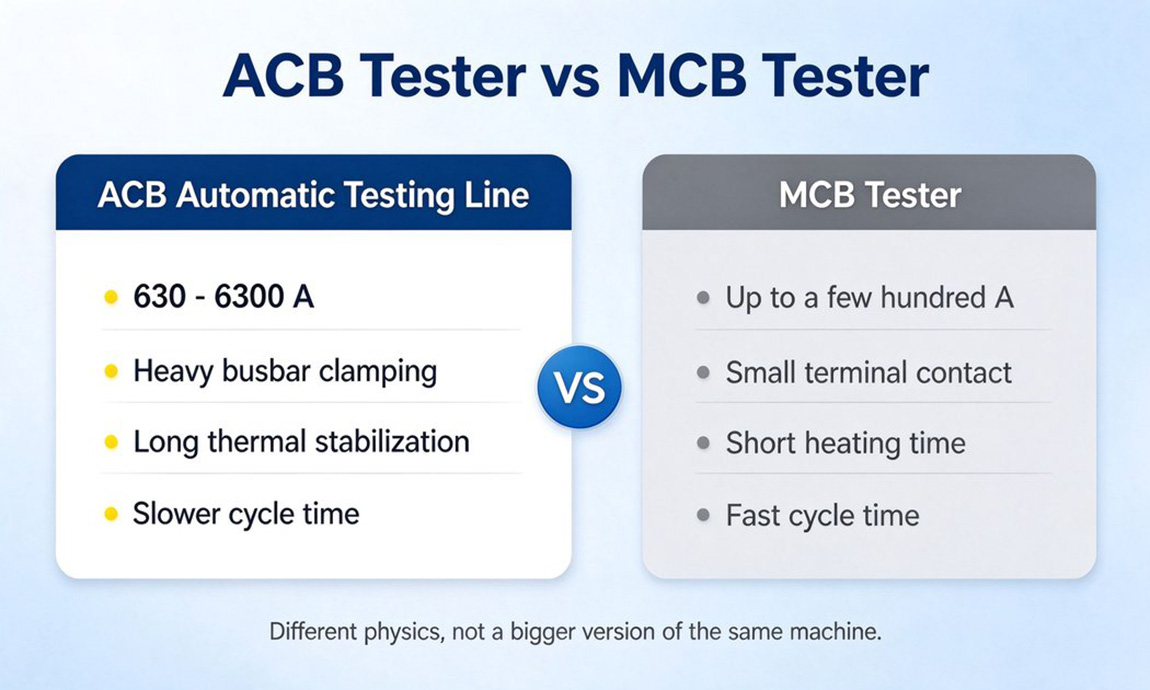
Figure 2. The core differences between an ACB automatic testing line and an MCB tester.
Thermal stabilization changes the cycle time
MCB tests are quick because the device heats fast and cools fast. An ACB has thermal mass; before a time-current test, the breaker and the busbar need to stabilize at a defined temperature, or the trip result shifts between the first and last unit. A line that runs at MCB speed will skip that stabilization and ship drifting units. A real ACB automatic testing line paces itself to the thermal cycle: ramp, hold, trip, cool - and logs the temperature as part of the result. At ACA Automation we treat the slower throughput as a design parameter, not a defect; it is what makes the test valid across the whole shift. A rushed ACB automatic testing line that skips the thermal hold saves minutes and ships a spread of trip values.
What a real ACB automatic testing line has to solve
Four things separate a purpose-built ACB automatic testing line from a scaled tester. A low-impedance high-current circuit that holds current steady while the breaker warms. Repeatable busbar clamping that does not drift across a shift. Thermal management for the cables, the busbar and the device. And a data record that ties the trip result to the temperature and the clamping force, so a drift is traceable. These are the stations you will see on our testing equipment page; they are engineered around the ACB, not adapted from an MCB cell, which is why an ACB automatic testing line costs more to build and runs for years.
How ACA Automation sizes an ACB test cell
We start from the breaker range and the required test schedule, not from a base machine. The maximum current sets the transformer, busbar cross-section and cooling. The device weight and bolt pattern set the clamping. The thermal tests set the cycle time and the spacing between stations. At ACA Automation we then review the whole test sequence against your existing products and solutions, so the cell fits the line rather than forcing the line to fit the cell. A well-sized ACB automatic testing line leaves room for the next breaker range, which is why the early sizing conversation matters. Treat the ACB automatic testing line as a long-cycle asset, not a box you select from a catalog.
An MCB tester scaled up for ACB looks cheaper on paper. It fails on current, clamping and thermal time, and it produces trip data you cannot trust. Build the ACB automatic testing line for the physics it actually has to deliver. Send ACA Automation your ACB model range and test schedule; we will scope the current circuit, the busbar clamping and the thermal timing before the design starts.
Frequently asked questions
Can one test line handle both MCBs and ACBs?
Rarely as a single cell. The current range, clamping and thermal cycle differ by an order of magnitude. Most lines run separate stations on the same line - an MCB tester and an ACB automatic testing line - sharing the conveyor and the data system rather than the power circuit.
Why is an ACB test cycle so much slower?
Because the breaker carries high current long enough to heat the mechanism, and it must stabilize thermally before a valid trip result. Skipping that hold time gives a faster cycle and a wrong measurement.
What current range should we plan for?
Plan around your heaviest ACB plus headroom, since upsizing the power circuit later is costly. Confirm the continuous and short-time test currents with your product range before the transformer is sized.