Stand in front of an MCB automatic assembly line and it looks like a lot of moving parts, which it is. But strip the noise away and it is really doing one thing: taking a tray of plastic and metal pieces and turning them into a breaker that trips when it should. People ask us all the time what the MCB automatic assembly line actually does station by station, so here it is, in plain terms. We built one last year for a customer who thought they needed more speed; they actually needed the stations in the right order. Once the feeding and mechanism stations were sequenced the way the part wanted, the output climbed without adding a single spindle. That is the point of this walkthrough: the MCB automatic assembly line is only as fast as its slowest, worst-ordered station.
Parts start in the right place, not the right place later
The first thing the MCB automatic assembly line does is feed the right parts. Base shells go in one rail, arc chutes in another, screws from a feeder bowl. If a part is missing or upside down, the line catches it here, before anyone spends a station on it. This sounds basic, but most of the trouble we fix on an existing MCB automatic assembly line is bad feeding upstream, not the robot in the middle. Get the nesting right and the rest gets easier. The shells are oriented by a vision check, because a backwards base will jam each downstream station even if the mechanism itself is fine.
Screws, contacts and the thermal bit
Next comes the screw and contact work. The line drives the terminal screws to a set torque, inserts the moving and fixed contacts, and seats the bimetal thermal strip. The bimetal is the part that heats and bends on overload, so its position is checked, not just dropped in. On the MCB automatic assembly line, a vision sensor confirms the contacts are square before the screw station tightens, because a tilted contact shows up later as a bad trip, not as a visible error. The screw torque is logged too, since a drifting spindle is the first sign the terminal station needs attention, and catching it on the MCB automatic assembly line saves a batch of loose terminals. Figure 1 shows the early stations.

Figure 1. Feeding, screw drive and contact insertion stations on the MCB automatic assembly line.
The trip mechanism and the handle
Then the line builds the heart of the breaker: the latch, the trigger, and the spring that snaps them. These small parts sit in tight stacks, so the MCB automatic assembly line picks them one at a time with indexed stations rather than dumping them in a bowl. The handle goes on last in this block, and a quick motion check makes sure it actually flips before the case closes. This is where ACA Automation spends the most time tuning, because a mechanism that binds at the bench is a breaker that will not reset in the wall. We have seen lines where the mechanism station was under-built to save floor space, and the reject rate told us within a week. The MCB automatic assembly line then has to slow down to feed that one weak station, which is the opposite of what the customer paid for.
Rivet it shut and test it for real
Once the mechanism moves, the line rivets the two halves of the case together. Then it tests. The MCB automatic assembly line runs an electrical test: does it carry rated current, and does it trip at the set overload? A unit that passes the visual check but fails the trip test goes to a reject bin, not to packing. This is the gate that keeps a bad breaker from leaving. Our testing equipment is built to log each result against the serial number, so a drift shows up as a trend within a shift, instead of as a complaint from a distributor months later. Figure 2 shows the test and pack flow.
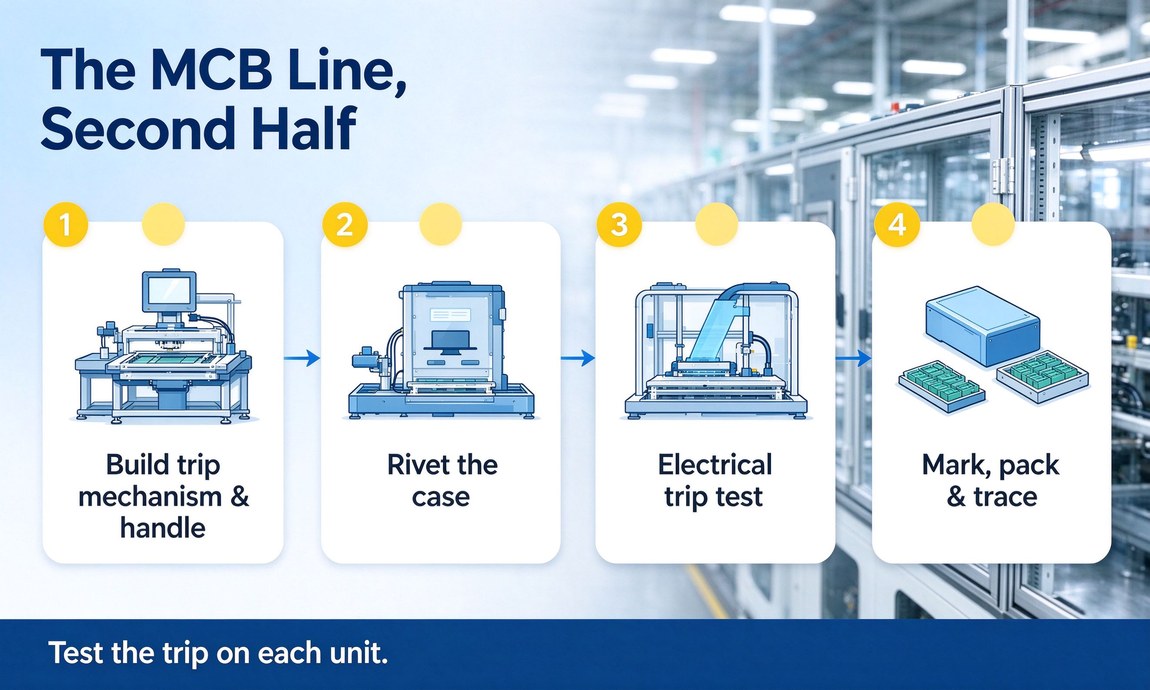
Figure 2. Riveting, electrical trip test and packing at the end of the line.
Pack it and keep the paper trail
The last stations mark the unit, pack it, and tie each result back to the serial number. When a breaker comes back as a field reject, that traceability is what tells you which shift, which recipe, which station caused it. Our assembly equipment is set up to hold that log, and the full range is under our products. If you are sketching a line, the order above is the order we start from on a real shop floor, and ACA Automation will tell you which station on the MCB automatic assembly line is the one worth spending the budget on, rather than speeding up all of them at once.
Send ACA Automation your MCB drawing and your target output; ACA Automation will map the station order so the MCB automatic assembly line catches bad parts early instead of late, and tell you which station is worth the budget.
FAQ
How many stations does an MCB automatic assembly line need?
Roughly feeding, screw and contact, trip mechanism, handle, rivet, test, and pack, grouped into indexed stations. The exact count depends on your current rating and how much you automate on the MCB automatic assembly line.
Can a line be changed between 1P and 2P breakers?
Yes, with quick-change nests and stored recipes. The MCB automatic assembly line swaps the nest and loads the recipe, rather than being rebuilt between variants, which keeps changeover under an hour when the platens are built right.
Why test the trip on the line instead of sampling?
Because a missed trip only shows up when someone overloads the circuit. Testing each unit on the MCB automatic assembly line is cheaper than the recall that follows a skipped sample, and the reading ties back to the station that caused it.