A customer asked us this on a site visit last month: their MCCB automatic assembly line took about two hours to switch from a 63 A frame to a 250 A frame, and the foreman called it normal. Two hours is workable, but it is not normal for an MCCB automatic assembly line that is set up for fast changeover. The question is not whether two hours is bearable. It is where those two hours go, and how much of that time the line actually has to be stopped. On a line that runs two shifts, a two-hour changeover twice a shift is a full extra shift a week that the MCCB automatic assembly line is not producing, and it is lost again at each frame switch.
hat a changeover actually touche
Switching MCCB frames on an MCCB automatic assembly line is not a single change. The locating fixture has to match a new case footprint, the riveting and pressing tooling has to match a different conductor size, and the test station has to load a new trip-curve recipe. Change the frame and you touch the feeder, the fixture, the tooling, and the test parameters in one go. A line that treats each of those as a separate on-the-floor task will spend its changeover searching tools and re-writing recipes. It also has to re-trim the bowl feeder for the new case geometry, which on an MCCB automatic assembly line usually means hand-adjusting orientation tracks until cases flow without jams. Miss one of these and the line starts, runs ten minutes, and stops again to fix the feeder, which is how a 30-minute changeover quietly becomes two hours.
here the two hours actually g
We timed a typical changeover on an MCCB automatic assembly line once: about half the clock was the actual physical swap, and the other half was looking for the right fixture, adjusting the feeder by trial, and running the first-article test until the trip curve came in. None of that lost time is on the critical path of the machine. It is preparation that happens while the line is stopped. Move that preparation offline and the stopped time drops. The fixture can be staged on a cart next to the line, the recipe recalled before the last good part runs off, and the feeder tracks pre-set for the incoming frame. When the old batch is finished, the operator swaps the cart fixture, recalls the recipe, runs one first article, and releases. Figure 1 shows the gap between the before and target state.
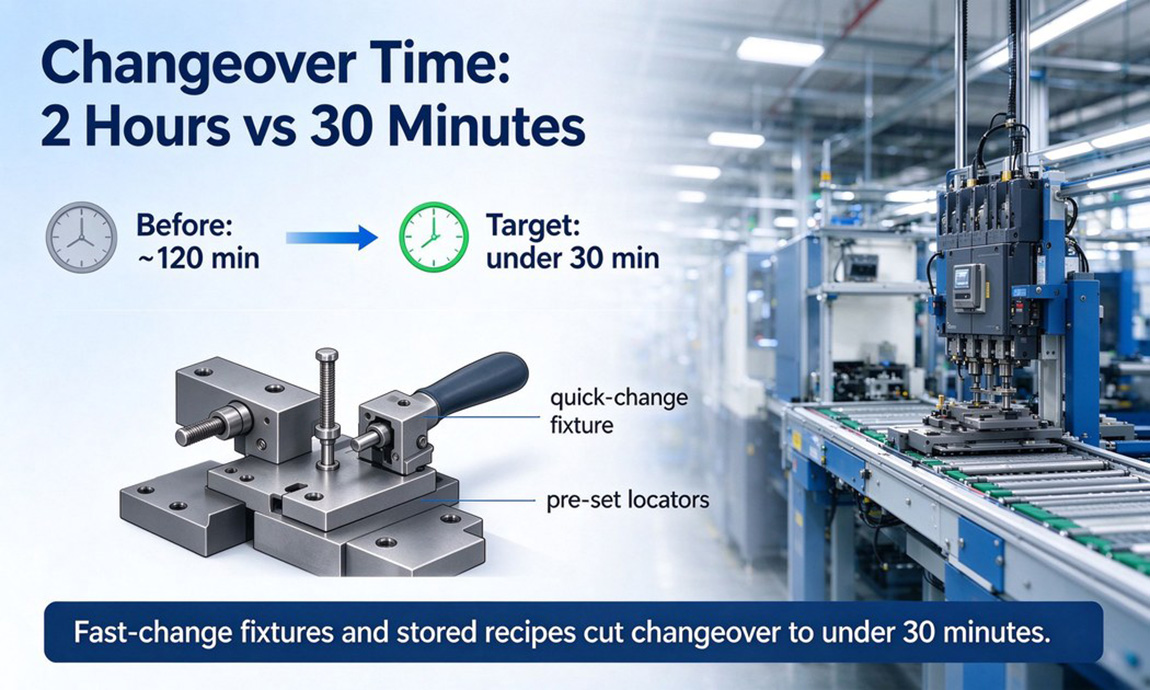
Figure 1. Changeover on an MCCB automatic assembly line: roughly 120 minutes today, under 30 minutes with fast-change fixtures.
he four levers ACA Automation pull
First, fast-change locating fixtures with pre-set locators and quick-clamp handles, so the new frame is located in minutes rather than an hour of shimming. Second, test recipes stored by frame and recalled from the HMI, so the operator selects a part number and the test station loads its own trip curve. Third, a vision part check that rejects the wrong case or conductor before it is riveted, which kills the most common changeover defect. Fourth, a first-article approval that combines a visual check and a single test run, so the operator knows within one cycle whether the changeover is good instead of discovering a problem after an hour of production. On the MCCB automatic assembly line we retrofitted last quarter, adding the stored recipe and the vision check cut the first-article loop from 40 minutes to under 10, based on ACA shop-floor data. Figure 2 lists the checklist in order.
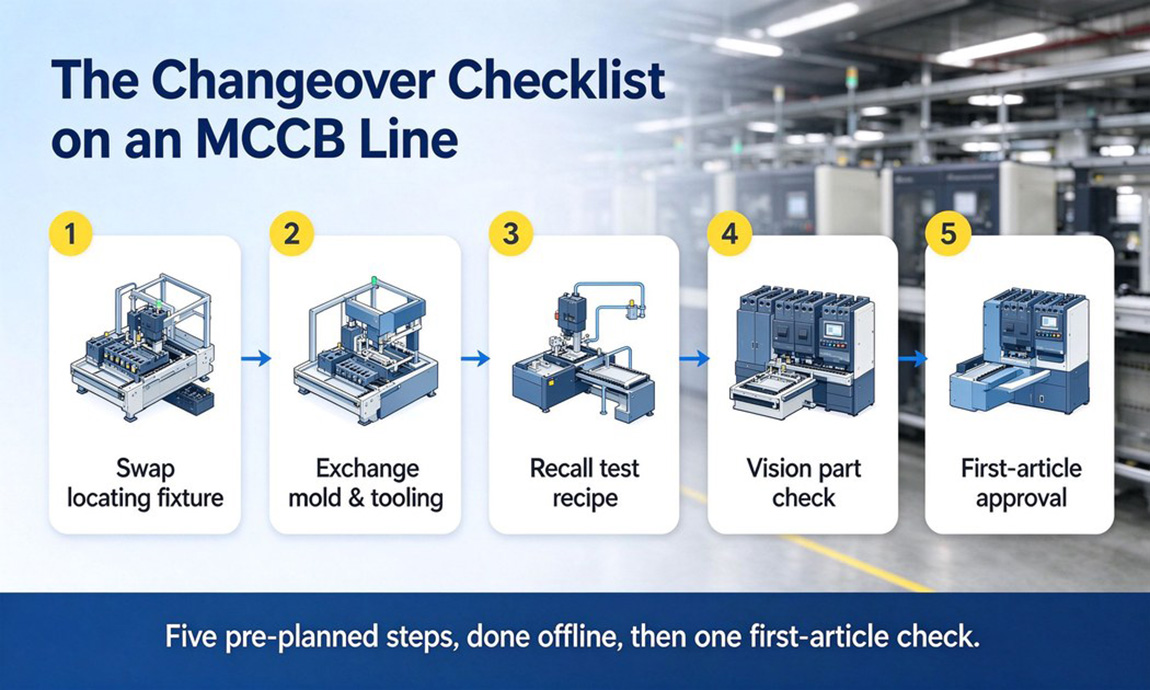
Figure 2. The five-step changeover checklist on an MCCB automatic assembly line.
hat a realistic target looks lik
For a two-frame family, an MCCB automatic assembly line built with these four levers should change over inside 30 minutes, typical and indicative, from stopped signal to a cleared first article. A line that still needs two hours is not slow because the actuators are slow; it is slow because the preparation is done on the clock. If you run three or four frames a day, even one saved hour per changeover pays back the fixture upgrade in months. The trick is to stop measuring changeover from the moment the line stops, and start measuring it from the moment the old batch finished, which exposes how much of the MCCB automatic assembly line's stopped time was avoidable. The MCCB automatic assembly line that records each changeover against that clock is the one that improves it month by month. Our flexible feeding systems (flexible feeding systems) and assembly equipment (assembly equipment) are designed around offline preparation. For a semi-automatic starting point, see our MCCB semi-automatic assembly line (MCCB semi-automatic assembly line).
Send ACA Automation your frame list and the parts-per-frame volume; ACA Automation will tell you which changeover step on the MCCB automatic assembly line is costing you the most stopped time, and which of the four levers pays back fastest for your mix.
A
Is a two-hour changeover on an MCCB line acceptable?
It is bearable but not a target. On a well-prepared MCCB automatic assembly line, most of those two hours is offline preparation happening on the clock, which fast-change fixtures and stored recipes bring down toward 30 minutes. The MCCB automatic assembly line that holds two hours simply has not moved its preparation off the stopped clock yet, and that is the very first lever to pull first.
Which step usually takes the longest?
The first-article test loop, when the recipe is re-written by hand each change. Recall a stored recipe and run one first article, and that loop shrinks to a few minutes on the MCCB automatic assembly line instead of a trial-and-error session at the bench that can stretch to half an hour.
Do we have to change the whole line for each frame?
No. The fixture, a few tooling inserts, and the test recipe change; the machine base, actuators and control stay. That is why an MCCB automatic assembly line is specified around a frame family, not a single part, so the fast-change parts are the only things touched between runs. The control logic never changes.