A MCCB rolls off the end of the line and lands on the test fixture. The question is which checks it has to pass before it leaves the building, and which checks we only sample from a batch. Run a full time-current curve on each unit and the takt doubles; sample the instantaneous trip and a mis-wired coil reaches a customer. That trade-off is what a MCCB automatic assembly line has to settle station by station. A bad unit that slips past end-of-line acceptance costs far more than the extra test second: a breaker that will not trip on a short circuit is a field failure that pulls the whole batch into question. A well-designed MCCB automatic assembly line turns that risk into a documented pass or fail on each unit. This is how ACA Automation decides the split on an outgoing MCCB line.
The question an outgoing MCCB has to answer
An MCCB has to trip on overload, trip faster on a short circuit, hold up to power-frequency voltage, carry rated current without overheating, and open and close the way the handle says. Some of these checks are fast enough to run on each unit; others take minutes or need a heavy test bench, so they belong in sampling. A MCCB automatic assembly line is designed around that split: the cheap, fast, failure-prone tests are on-line on each unit, and the slow characterization tests are sampled by batch. Get the split wrong and you either waste cycle time or ship a latent defect. The job of a MCCB automatic assembly line is to make that split explicit, so the customer's acceptance record shows which tests were run on each unit and which were sampled by batch.
Tests that run on each unit
First is the instantaneous magnetic trip. On a MCCB automatic assembly line this check runs in under a second. The station injects a calibrated overcurrent pulse and confirms the contacts open within the required window; a mis-gapped magnetic system fails here. Next is the dielectric withstand, a power-frequency hi-pot between poles and between pole and frame, held for a set time with no breakdown. Then contact resistance per pole, read in milliohms, which catches a loose busbar or a plated contact. Finally a mechanical open-close cycle, to confirm the mechanism and the handle action. These four tests sit on the MCCB automatic assembly line itself, because they are fast and they catch the defects an assembly mistake leaves behind. We pair them with our testing equipment range, and we use our vision inspection systems for label, seating and handle-position reads between electrical tests. A typical hi-pot holds around 2 kV for one second with a leakage limit, and the milliohm reading must sit under the recipe ceiling for each pole. When a reading drifts near the limit, the MCCB automatic assembly line flags the unit rather than shipping it on the margin.
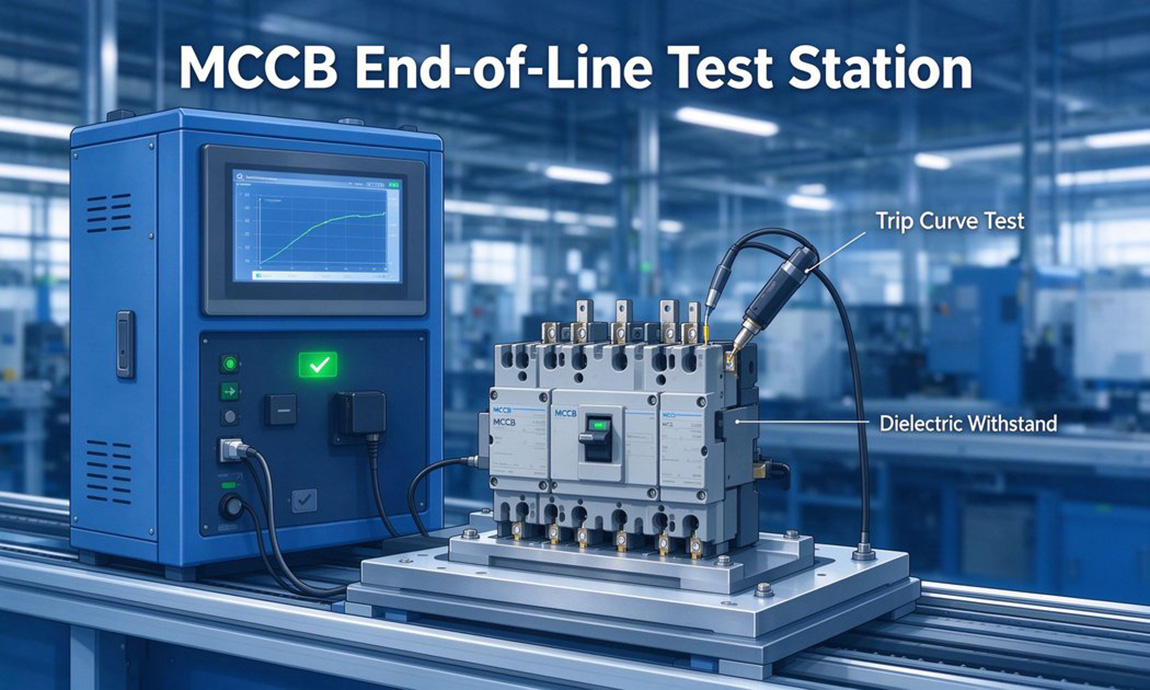
Figure 1. The MCCB end-of-line test station: breaker on the fixture, hi-pot and trip-curve instrumentation with a pass readout.
The tests we sample instead of run per unit
The time-current overload curve is the classic sample. Plotting the trip time across a range of currents takes minutes per unit and a programmable high-current source, so the MCCB automatic assembly line pulls one or two units from each batch to map the curve against the type-test envelope. Temperature rise at rated current is sampled the same way, because it needs the breaker under load for hours. Sampling is not a weaker control; it is a statistical one, and it works only if the on-line tests above already catch the random defects. When ACA Automation lays out a MCCB automatic assembly line, the sample plan is written against the customer's acceptance standard rather than guessed at. The sampled curve and rise results are still logged to the batch, so a drift over weeks shows up as a trend on the MCCB automatic assembly line's dashboard, not as a surprise at the customer site.
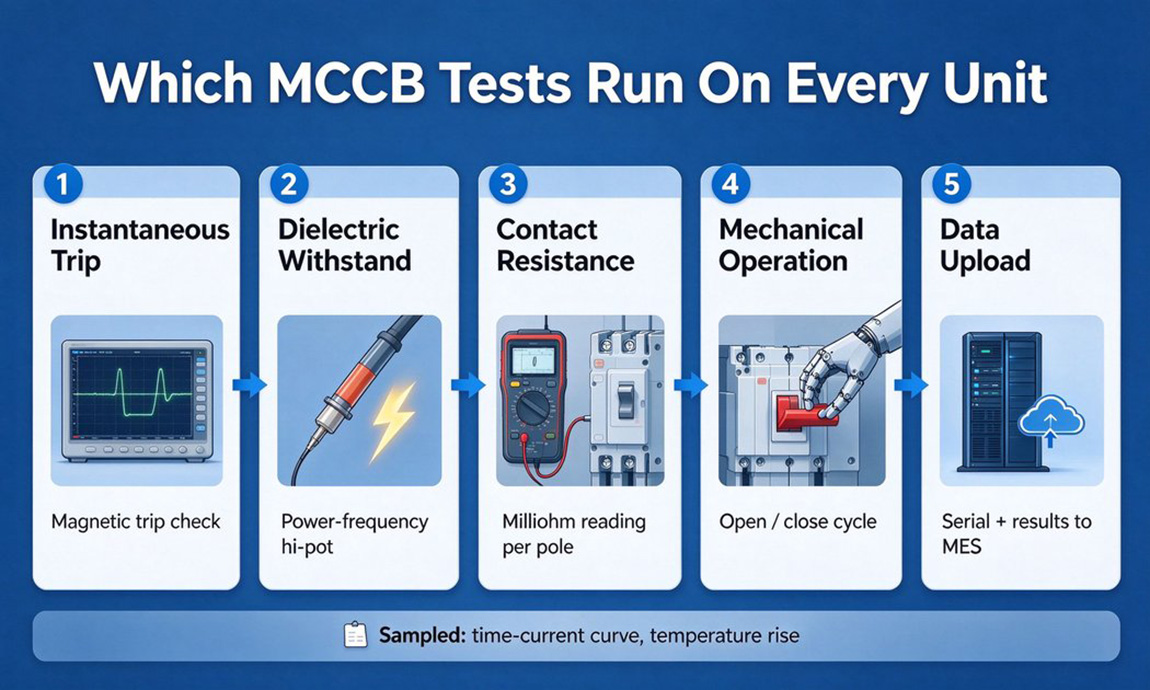
Figure 2. The on-line test sequence: instant trip, dielectric withstand, contact resistance, mechanical operation, then data upload; curve and rise tests are sampled.
How the results become traceable data
Each unit carries a serial barcode. When the instant trip, hi-pot, contact resistance and mechanical cycle finish, the MCCB automatic assembly line uploads one record: serial, trip current and time, hi-pot voltage and leakage, milliohm reading per pole, open-close result, timestamp and station ID. Sampled units add their curve and rise data. The record goes over OPC UA to the MES. If a unit comes back from the field, we scan it and pull the exact readings the MCCB automatic assembly line took at birth, so a dispute about a trip setting becomes a record lookup rather than an argument. The MCCB automatic assembly line buffers records locally if the network drops, then resyncs when the MES returns. The MCCB automatic assembly line is only as trustworthy as its logged readings, so the fixtures are calibrated on a schedule.
Back at the fixture, the next MCCB is already rolling in. The split between on-line and sampled tests is not a compromise; it is the control logic that lets a MCCB automatic assembly line ship hundreds of units a shift without missing a bad trip coil. When ACA Automation commissions a MCCB automatic assembly line, we run a trial batch first and compare the on-line readings against the lab bench, so the operators trust the pass and fail decisions. That is the view ACA Automation brings to end-of-line acceptance: test what you must on each unit, sample what you must, and record the rest.
Frequently asked questions
Which MCCB tests must run on each unit before shipment?
The instantaneous magnetic trip, the power-frequency dielectric withstand, per-pole contact resistance, and one mechanical open-close cycle. These are fast and catch assembly defects, so they run on-line on each unit.
Why is the time-current overload curve sampled instead of run per unit?
Plotting the trip curve across a range of currents takes minutes and a programmable high-current source, which would double the takt. It is a characterization test, so the line samples one or two units per batch and trusts the on-line instant-trip test to catch random defects.
What data is stored for each MCCB?
One record per serial: instant trip current and time, hi-pot voltage and leakage, contact resistance per pole, mechanical cycle result, timestamp and station ID, plus sampled time-current and temperature-rise data where applicable.
If you are laying out an MCCB end-of-line acceptance flow, send ACA Automation your acceptance standard and target takt for a test-station layout review.