Last March, the rework bench at a relay-contact plant we visited held 47 parts stacked on one tray at 8 a.m. - joints that had come off the manual welding station the night before and were queued for a touch-up. The shift leader said that tray showed up on most mornings. When we asked how much of that pile an automatic welding equipment line would actually remove, the answer depended on who was counting. We are a welding equipment manufacturer, and the first thing we learned is that 'rework rate' means three different numbers on three different clipboards. That confusion is why so many rework-reduction promises never match the plant floor, and why a serious welding equipment manufacturer starts with the clipboard rather than the sales slide.
Why the rework rate number is never the same twice
Walk into three meetings and you get three definitions. The post-weld inspection reject rate counts joints a visual or dimensional check flags right after welding. The in-line rework touch rate counts parts an operator pulls aside mid-shift and fixes quietly, never entering the quality dashboard. The pre-shipment rate counts units that fail only during final outgoing inspection. A welding equipment manufacturer who hands you one blended percentage is hiding where the money leaks. At ACA Automation, we split the log into these three streams before quoting any target, because a line can look clean on the post-weld rate and still burn labor on hidden in-line touches. When a welding equipment manufacturer first audits a rework log, this three-way split is the first thing we check; a welding equipment manufacturer who skips it is already guessing at the payback.
What actually moves after the automatic cell goes live
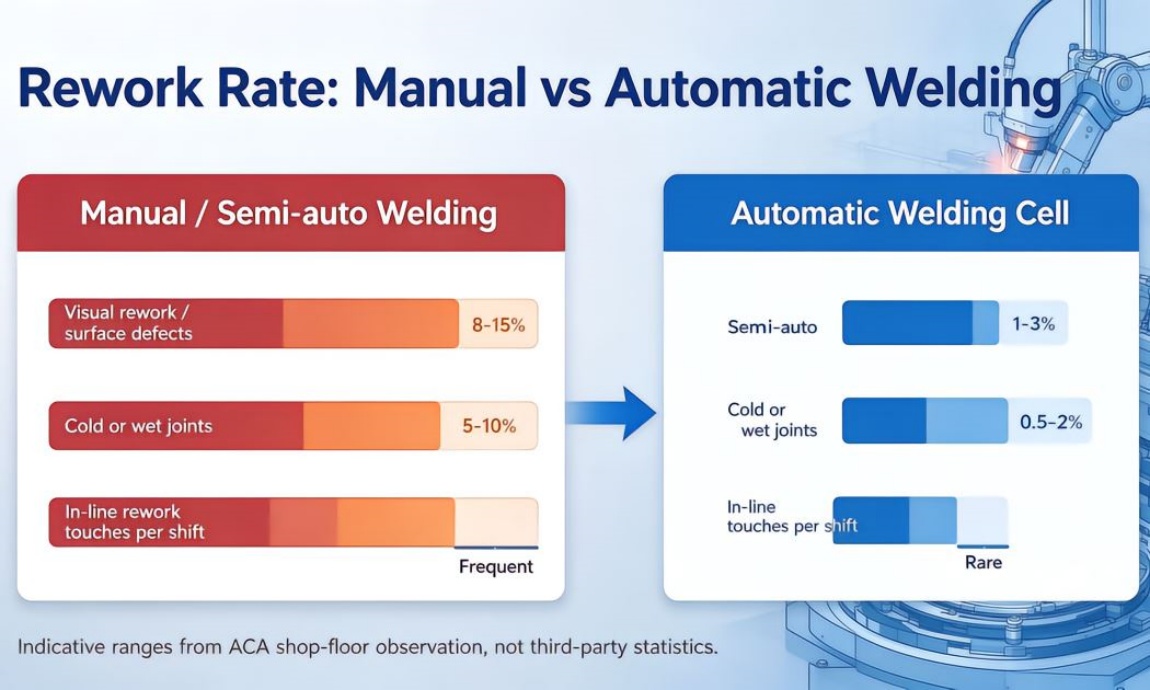
These are indicative bands, not a guarantee. On small copper-contact and conductor joints, the post-weld visual reject rate on a manual or semi-automatic station typically runs 8 to 15 percent once you average in electrode wear and operator variation. After the automatic welding cell is commissioned and the recipe locked, that band settles near 1 to 3 percent. The cold- or wet-joint rate, joints that pass a glance but fail a pull test, falls from about 5 to 10 percent down to roughly 0.5 to 2 percent. A welding equipment manufacturer averages these bands across many cells rather than quoting a single point, because each line starts from a different place. Any welding equipment manufacturer who has tuned these cells will tell you the relative drop depends on how loose the manual station was to begin with. Figure 1 shows the before-and-after range side by side.

What the cell eliminates, and what it cannot
The rework an automatic welding equipment cell removes is the rework caused by variation: inconsistent heat input between operators, a weld path that drifts as the operator shifts position, and defects that slip past a tired inspector. The cell fires the same current, time, force and path each cycle and logs each pulse. Pair it with inline testing equipment and cold joints get caught on the spot, which is why ACA Automation usually specifies our welding equipment and assembly solutions together with a test station rather than a bare welder. A welding equipment manufacturer who leaves out the test station is selling only half the loop.
What it cannot remove is upstream rework. Incoming strip carrying oil or oxide will produce bad welds on an automatic cell exactly as it did by hand. A part design with a fit-up gap larger than the joint was engineered for will not weld cleanly no matter how repeatable the machine is. Wrong plating, or an alloy the recipe never covered, is a process problem, not a machine problem. A seasoned welding equipment manufacturer tells you this early, because disappointment here is what sours a commissioning. Put a highly repeatable machine on contaminated, ill-fitting parts and you have simply made the bad welds faster. That is the conversation a careful welding equipment manufacturer wants early, before the line ships, not after the first rework dispute. Figure 2 splits the two sides.
How to read these numbers for your own line
Measure your three rates before installation, commission the cell, then measure again after week three. A new cell runs hot while electrodes seat and recipes settle, so launch-day numbers are not the steady state. The before-and-after comparison is the only figure that belongs in your payback case. Ask any welding equipment manufacturer for the underlying log, not a single reduction percentage; the one who shows you the three-stream method is the one whose numbers you can bank on. This is the method ACA Automation uses on each commissioning, from electrical contacts to new-energy busbars. A reliable welding equipment manufacturer schedules that re-measurement into the plan, and a welding equipment manufacturer who only promises the week-one number is worth a second look.
Frequently asked questions
Does automatic welding eliminate all rework on its own?
No, and no honest welding equipment manufacturer promises that. The machine removes variation-driven rework - inconsistent heat input, a drifting weld path, defects missed between cycles. It cannot fix contaminated incoming strip, an oversize design gap, or wrong plating. Clean those upstream first, or the machine simply repeats the bad weld faster.
What rework rate should we expect after commissioning?
Expect bands, not one number. For small copper-contact joints, the post-weld reject rate typically moves from the 8 to 15 percent manual band to about 1 to 3 percent, and the cold-joint rate from 5 to 10 percent to 0.5 to 2 percent. These are ACA Automation shop-floor observation ranges, indicative, not third-party statistics, and any welding equipment manufacturer should let you see the underlying log before quoting a target.
When should we measure the improvement?
Not on launch day. Wait until week three, once the cell has stabilized. Compare the steady-state readings taken before and after installation, not the first-week spike while electrodes seat and recipes settle.
If you want a realistic rework-reduction band for your own line, send ACA Automation your part drawings and current rework log; as a welding equipment manufacturer we will walk the three-rate method with you before quoting. Explore our automatic welding equipment range, our welding equipment and assembly solutions, and the inline testing equipment that closes the loop.