The drawing is flat on the desk: a silver-oxide contact button resistance-welded to a copper bridge, with a nugget-diameter callout and a shear-force minimum. Beside it sits the annual capacity line: the same contact family must run from about 50,000 pieces a year at launch to several million once the order book fills. As a welding equipment manufacturer, this is where the real decision sits. Choosing the right welding equipment design for electrical contacts production is not one machine; it is four possible equipment shapes, and the wrong pick means a line that sits half-idle or a manual cell that cannot keep up. Our view at ACA Automation is that the shape should follow annual volume and part-number count, which is how any welding equipment manufacturer should read a capacity sheet.
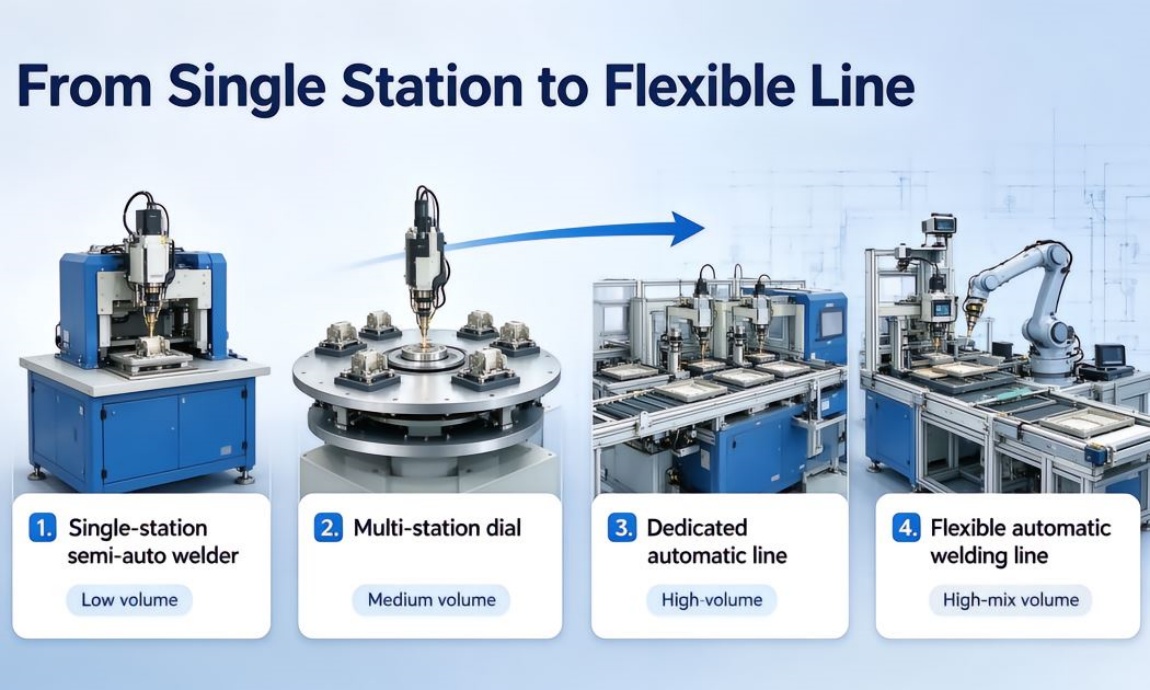
Form 1 - single-station semi-automatic welder
This is the bench: one resistance-welding head on a steel frame, a pneumatic press, a weld controller and a two-hand start. The operator loads the copper carrier and the contact, the head descends, current flows for 40 to 120 milliseconds, and the part comes out. A welding equipment manufacturer sizes this for about 800 to 2,500 good pieces per shift (indicative), with 0.5 to 1.5 days changeover and the lowest investment, taken as the 1x baseline. It suits prototypes, pilot batches and low-volume relay or switch contacts; no welding equipment manufacturer would automate a pilot batch. A bench station usually runs water-cooled copper arms and an electrode-dressing fixture, because the silver contact wears the tip faster than a plain spot weld. A welding equipment manufacturer will also mount a small pull-test gauge beside it so the first parts of each shift are checked.
Form 2 - multi-station dial machine
The second form keeps the head but adds a rotary dial of four to six nests. While the operator loads one nest, the previous part welds, cools and unloads on the next, so welding time overlaps operator time. A welding equipment manufacturer quotes this for roughly 3,000 to 8,000 pieces per shift, 1 to 2 days changeover, and about 2.5x to 4x the single station. The welding equipment manufacturer chooses a dial when the operator, not the weld, becomes the bottleneck, and it is built around one contact family. Index accuracy, not the weld current, is what decides how repeatable the nugget lands around the dial; a cam indexer keeps the nests in phase, while a servo indexer shortens the move between cycles.

Form 3 - dedicated automatic welding line
The third form is a line, not a machine: a vibratory or magazine feeder presents copper carriers to fixed welding stations, then inline shear test and vision check the nugget before outfeed. As a welding equipment manufacturer, ACA Automation designs this for one product family and pushes cycle time to the part's limit, at about 10,000 to 30,000+ pieces per shift (typical). A welding equipment manufacturer prices this around 6x to 10x the single station, with 1 to 2 days changeover between close variants. It suits high-volume contact rivets where the geometry stays locked for years. The reject diverter pulls bad parts out before they reach the good-parts bin, and the MES hook logs the weld current, force and nugget result against each serial number.
Form 4 - flexible automatic welding line
The fourth form is the recipe-driven cell: flexible feeding, a gantry or robot, quick-change fixtures, inline vision, and a barcode recall that loads the weld schedule, electrode program and vision recipe together. A welding equipment manufacturer offers this when a shop runs five to fifteen contact families at medium volume. Output sits near 8,000 to 20,000 pieces per shift, changeover drops to 15 to 45 minutes, and a welding equipment manufacturer quotes about 8x to 14x. It is where our automatic welding equipment, assembly equipment and automation solutions integrate into one traceable cell.
How ACA Automation weights the choice
When a welding equipment manufacturer and a contact maker sit down, we weight four numbers: steady-state volume, the count of part numbers, the quality bar (nugget callout plus shear minimum plus traceability), and the total budget release beyond the machine price. A welding equipment manufacturer picks the form that matches next year's volume, not the decade after. The welding equipment manufacturer who sells a flexible line for a 1,500-piece-a-shift part is loading depreciation you do not need; the one who pushes a dedicated line before the drawing is stable is worse. Quality spend is where shops under-budget: a nugget callout plus shear minimum plus lot traceability usually needs inline test and vision that a bench or dial station cannot carry.
The staged upgrade path
The practical route most contact makers take is staged. Buy the single-station welder now, qualify the weld schedule and the shear window, then move to a dial or the first automatic cell when volume crosses 2,500 to 3,000 pieces a shift. Ask ACA Automation to design the first machine so the fixture plate, weld controller and fume interface carry over; any welding equipment manufacturer can price that migration path into the first quote. Then the upgrade is a recipe change, not a rebuild.
Q1: At what output should I leave the bench welder?
A1: Above about 2,500 to 3,000 good pieces per shift, the manual load time dominates and a dial or inline line earns its keep; that is the line a welding equipment manufacturer draws on the capacity chart.
Q2: Can I start semi-automatic and expand later?
A2: Yes, if the first machine uses a recipe-capable controller and quick-change fixtures; the weld schedule and fixture plate transfer to the cell the welding equipment manufacturer adds later.
Q3: What changeover should I expect between contact part numbers?
A3: A bench or dial machine runs 0.5 to 2 days; a flexible line with recipe recall drops that to 15 to 45 minutes, which is why a welding equipment manufacturer recommends it for high-mix shops.
Send ACA Automation your contact drawings and the annual capacity numbers, and a welding equipment manufacturer will map which of the four shapes fits today's volume and tomorrow's part mix.