08:00. The first tray of thin FR4 PCBA boards slides to the loading nest, and an automatic laser welding machine in the corner of our Wuxi cell wakes up. On this product we used to solder the connector pins by hand and run the board through a wave bath. The yield number told us why we stopped: cold fillets, inconsistent wetting, and boards that looked fine on the bench but failed at a customer's hipot test. A hand iron and a wave tank cannot hold a 0.3 mm pad once the board gets smaller. So this morning we watch one board cross the light curtain of an automatic laser welding machine and follow it to the output chute. The automatic laser welding machine never touches the board with a metal tip; it places a focused near-infrared spot on each joint. There is no tip to wear and no iron to calibrate between operators, and the automatic laser welding machine repeats the same profile on board one and on board the thousandth.
Why a hand iron stopped working on this board
The board is 1.0 mm thick, with eight small pads feeding a connector. With a hand iron, each operator held the tip for a slightly different time and set a slightly different iron temperature. On a thin board that small difference lifts the pad or leaves a dry joint. Wave soldering is worse here: the whole board sees the bath, and the connector housing weathers. One batch, twelve boards came back from functional test with a cold joint at pin four; the iron operator had changed shift mid-run. Our indicative rework rate on the old process ran around 1.5% per shift, mostly cold joints that only showed up in functional test. That is the problem an automatic laser welding machine is meant to remove rather than soften. The automatic laser welding machine does not rely on an operator's wrist, so the gap between shift one and shift two nearly disappears; the automatic laser welding machine removes the human variable from the joint itself.
The workstation flow, from nest to galvo
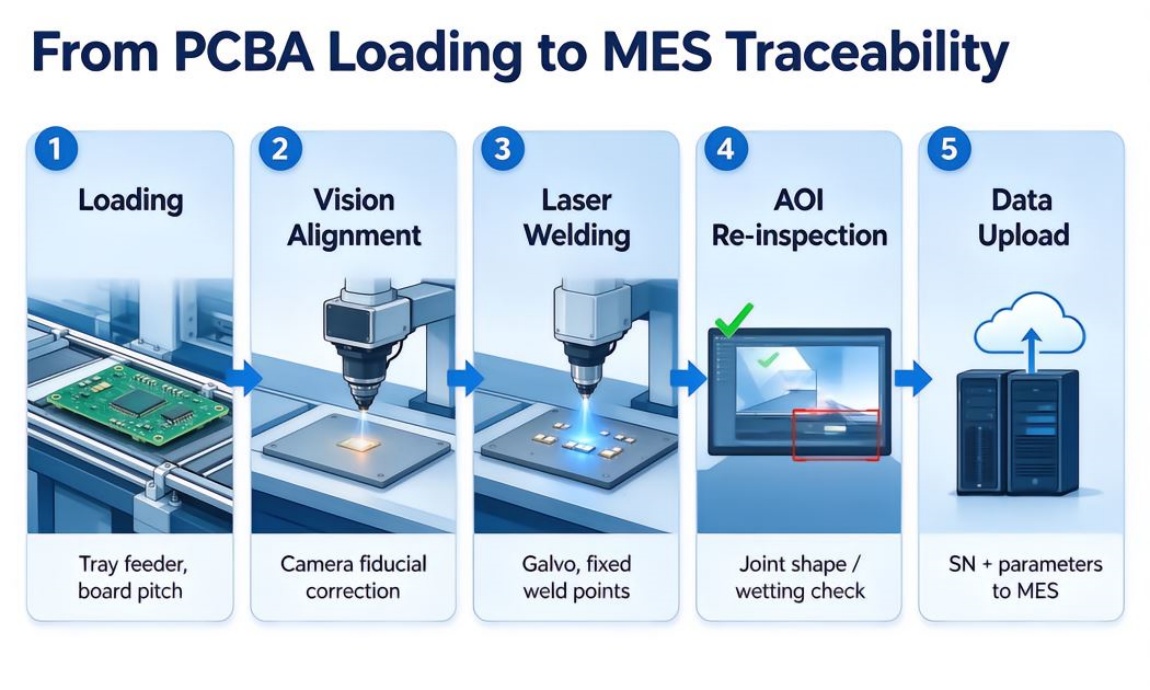
A tray feeder picks the board and lowers it onto the XY nest. A small preform is set on each pad before the board reaches the nest, so the joint volume is fixed and wire-feeding drift never enters the recipe. A grayscale camera reads two fiducial marks, computes the X/Y/rotation offset, and shifts the galvo scan field before the first pulse. Then a 100 W fiber diode delivers an 18 ms profile to each of the eight joints. The whole cycle runs about fourteen seconds per board, and the feeder overlaps loading with welding, so the automatic laser welding machine is rarely idle. For us, a dependable automatic laser welding machine is rated by repeatability and traceability, not by the highest wattage it swings. The guard stays locked while the beam is on; a door-open signal cuts the pulse in under a millisecond. This is the cell ACA Automation ships for electrical-and-electronics assembly: laser source, motion, vision and data interface in one frame rather than four bolted vendors.

Vision alignment and the AOI check after the pulse
Before welding, the fiducial loop holds repeatability near ±0.02 mm, which forgives tray tolerance and a slightly warped board. After the pulse, a second camera with ring light judges each joint: wetting fillet, solder volume, missing joint, bridge and pin coplanarity. The ring light keeps the fillet shadow readable at the resolution the rule needs. Good joints get a green box; suspects get a red box and a reason code, then drop to the reject chute, where the operator clears them once a break. On this product our indicative first-pass read sits around 99.2%. The same vision core runs in ACA Automation's standalone vision inspection systems, so the calibration language stays consistent across the line. If a correction exceeds the guard limit, the automatic laser welding machine flags the board instead of welding through a bad position.
What the cell uploads at shift end
The board barcode ties the cycle together. When the automatic laser welding machine finishes, it sends one record: serial, recipe version, X/Y/theta correction, laser power and duration per point, AOI result, timestamp and station ID. The automatic laser welding machine stamps each record with its own station ID, so a line running several cells can tell which cell made which board. The record goes over OPC UA to the line MES, about 60 KB per board. On a 6.5 effective-hour shift at fourteen seconds, one cell ships roughly 1,670 boards. Scale the island and the automatic laser welding machine becomes a node management can monitor rather than a black box. If a network drops, the cell queues records locally and resyncs when the MES returns. Compared with our wider automatic welding equipment range, the laser station is the contact-free option that will not lift a delicate pad. When a field return arrives months later, we scan the board and pull the exact recipe the automatic laser welding machine used on that serial.
Back at 08:00, the first board has long left the chute. Its eight joints are judged, its serial number is logged, and the next tray is already on the lift. That is the inside of an automatic laser welding machine on a normal morning — not a pitch, just one board after another, while the old rework line stays switched off. That consistency is the point: the automatic laser welding machine solders the first board this morning the same way it will solder the last board tonight.
Frequently asked questions
How long does one PCBA board take inside the automatic laser welding machine?
About fourteen seconds on this eight-joint product, including the pick, fiducial alignment, the laser profile and the AOI check. The automatic laser welding machine overlaps feeder motion with the vision check, which is how it holds that takt. The actual laser-on time is roughly 0.15 seconds; most of the cycle is galvo travel and settle before the next point.
Why use laser instead of wave soldering on a thin PCBA?
A wave bath exposes the whole board and can weather the connector housing or lift small pads. The laser heats only the target joint for about 18 ms, so the surrounding FR4 stays cool and the pad is not stressed by a contact iron.
What traceability data goes to the MES?
One record per board: serial, recipe version, fiducial correction, laser power and pulse duration per point, AOI per-joint result, timestamp and station ID, plus a small AOI crop.
If your line is fighting cold joints on thin PCBA boards, send ACA Automation your part drawings and target takt for a feasibility study.