Pull a high voltage DC contactor out of an electric vehicle powertrain and its job looks simple: close when commanded, stay closed under load, never leak. Do that for ten years and three hundred thousand cycles, and simple becomes hard. On our line, a failed seal or a dry contact can mean a whole lot returns from the field. That is the problem a high voltage DC contactor assembly line is built to solve, and it starts before the first screw is turned on any high voltage DC contactor assembly line.
Why a contactor that works once is not enough
A new energy contactor switches 400 to 800 V DC and carries hundreds of amps. It must hold a helium leak rate below a tight limit, keep contact resistance stable over tens of thousands of operations, and survive vibration and temperature swings. Assembled by hand, the seal force varies between operators, the weld seam follows a slightly different path each cycle, and contact resistance drifts. Our indicative field-return data on a semi-automatic build showed seal and contact issues as the top two failure modes. A purpose-built high voltage DC contactor assembly line removes that operator variable and locks the process. The high voltage DC contactor assembly line treats each station as a controlled step rather than a hope. The contactor must also survive a coil that heats up over a long duty cycle, and contact resistance that drifts upward as the contacts wear. A manual build cannot hold those windows tight, which is why the automatic approach matters on a high voltage DC contactor assembly line.
The sealing station sets the lifetime
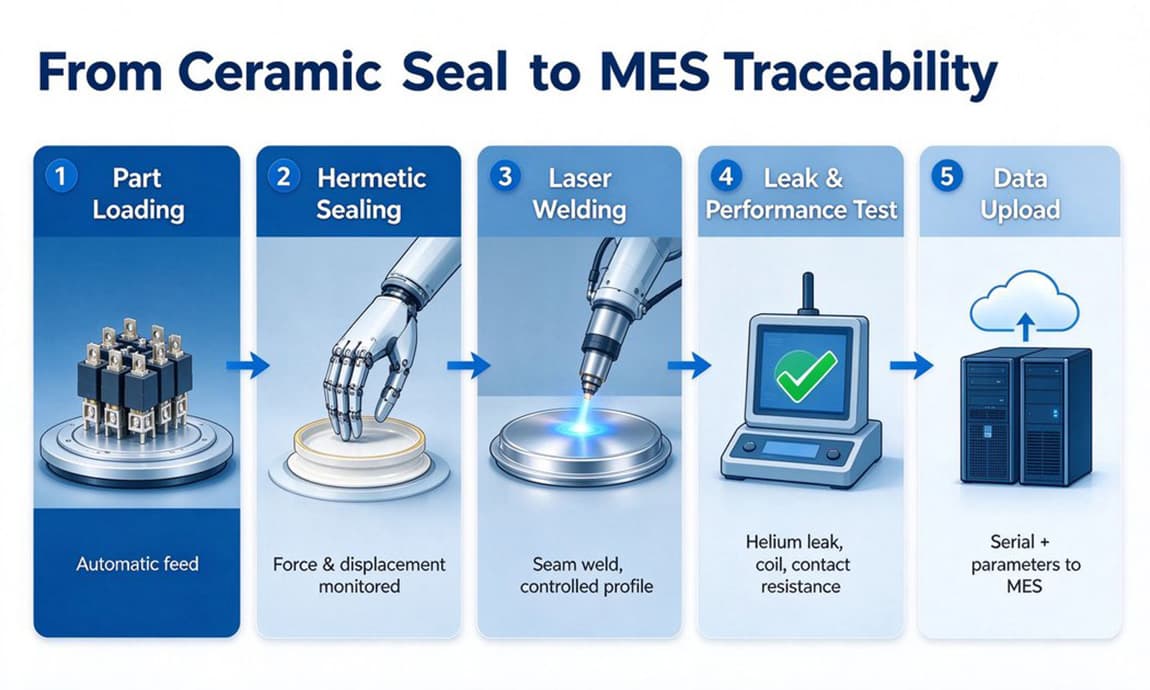
The ceramic-to-metal seal is where the contactor lives or dies. On the line, a rotary dial indexes the base, the ceramic ring and the cap under a servo press that monitors both force and displacement. The press does not stop at a fixed depth; it stops at the force curve the recipe expects. If the curve wanders, the high voltage DC contactor assembly line flags the part and routes it aside, because a seal set too hard cracks the ceramic and one set too soft leaks. This is one of the stations ACA Automation designs into its new energy solutions, with the force trace logged against the part serial. Each station on the high voltage DC contactor assembly line feeds that same serial, so the seal curve is never untraceable. The rotary dial indexes one station per beat, so the high voltage DC contactor assembly line runs sealing, welding and testing in parallel rather than one after the other.

Laser welding the seam without stressing the ceramic
After sealing, the cap seam gets a controlled laser weld. A galvanometer head runs a programmed profile around the seal, heating only the seam zone rather than the whole housing. The beam is near-infrared, fully enclosed, and the power and pulse duration are set by seam geometry rather than housing size. Compared with contact welding, the laser station adds no mechanical stress to the fragile ceramic, which is why we pair it with our automatic laser welding machine. When ACA Automation lays out a high voltage DC contactor assembly line, the laser head is sized by seam length, not by the biggest part on the dial. The same parameter set repeats on unit one and on unit ten thousand, and it is the reason a high voltage DC contactor assembly line can promise consistent hermeticity batch after batch. The guard stays closed while the beam is on, and an exhaust port pulls weld fumes away from the ceramic. When we commission a high voltage DC contactor assembly line at a customer site, we first weld a trial batch and read back the leak results against the recipe.
Each unit leaves with a full traceability record
Before pack-out, the contactor passes a helium leak test, a coil resistance check and a contact resistance measurement. A barcode serial ties the cycle together: seal force curve, laser power and duration per seam, test results, timestamp and station ID all upload over OPC UA to the MES. If a unit returns months later, we scan it and pull the exact recipe. The high voltage DC contactor assembly line stamps each record with its own station ID, so a line running several cells can tell which cell built which contactor. Compared with our wider assembly equipment range, this high voltage DC contactor assembly line is the variant tuned for sealed, high-voltage parts where a single bad seam is expensive in the field. A network dropout buffers the records locally, and the high voltage DC contactor assembly line resyncs when the MES returns.
Back on the dial, the next contactor is already indexing under the seal press. The problem we started with — a contactor that works once but not for a decade — is handled station by station, with a logged decision at each one. That is what ACA Automation ships: a high voltage DC contactor assembly line built around sealing, laser weld and traceability, so the unit that leaves the floor matches the unit the customer fits years later. A high voltage DC contactor assembly line measured this way is judged on consistency, not on any single good joint.
Frequently asked questions
What makes a high voltage DC contactor assembly line different from general relay assembly?
The sealed ceramic-to-metal joint and the high-voltage performance tests. The line monitors seal force and displacement, runs a controlled laser seam weld, and checks helium leak and contact resistance on each unit, rather than relying on a loose mechanical build.
Why laser welding instead of contact welding for the seal?
A contact weld adds mechanical stress that can crack the ceramic seal. The laser heats only the seam zone with a programmed profile, so the surrounding housing and ceramic stay cool and the seam is repeatable from unit to unit.
What traceability data is stored per contactor?
One record per serial: seal force and displacement trace, laser power and duration per seam, helium leak, coil and contact resistance results, timestamp, station ID and recipe version, so a later field return can be traced back to the exact build.
If you are scaling sealed high-voltage contactors, send ACA Automation your part drawings and target cycle time for a feasibility study.