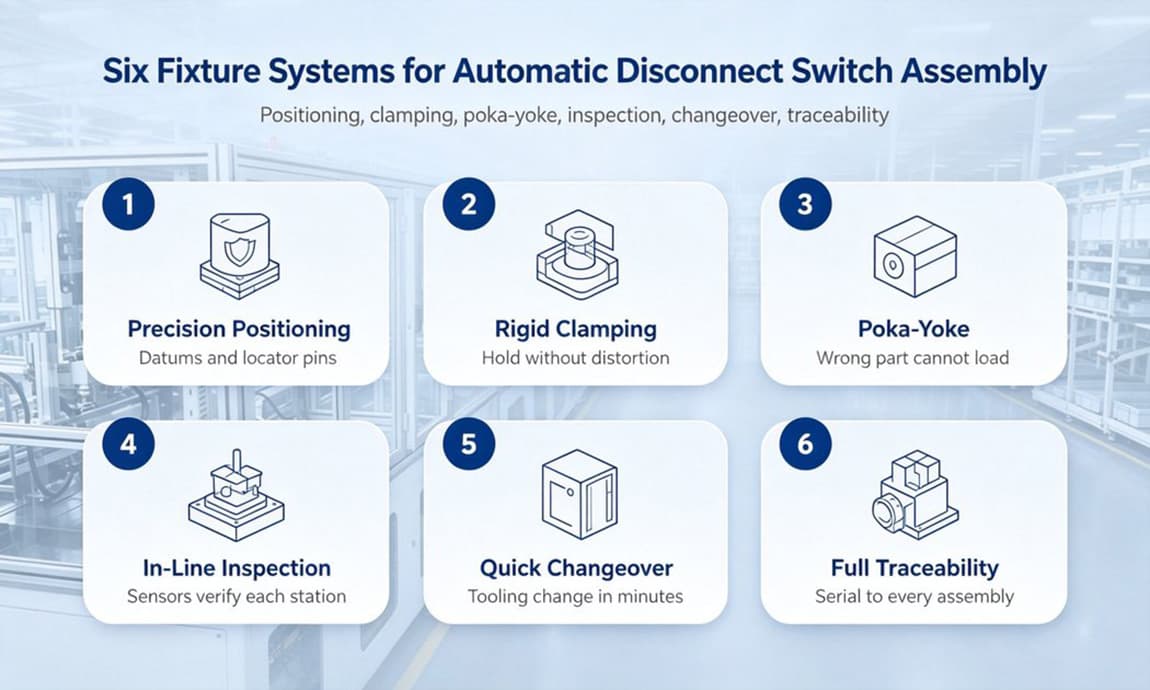
The workbench fixture was a drilled plate and a pair of toggle clamps. An operator laid the disconnect switch base in by hand, dropped the contacts in, and hoped they landed square. On this line the disconnect switch assembly equipment was only as accurate as the last touch of a finger, and rework ran near 6% of output. When you move from bench work to an automated disconnect switch assembly equipment cell, the fixture stops being a holding plate and becomes the process. Six fixture functions carry that job: positioning, clamping, poka-yoke, inspection, changeover and traceability.
The drilled plate failed in three ways: no repeatable datum, no check that the right part was loaded, and no record of what was built. An automated cell replaces it with a fixed nest. The nest is the reference for the whole station; if the part sits 0.2 mm off, the press and the screwfeeder build a wrong product each cycle. On a disconnect switch assembly equipment line, the nest is engineered first and the actuators are chosen to match it. Treat the fixture as the part of the disconnect switch assembly equipment that decides whether the rest of the machine can perform at all.
Positioning and clamping hold the part to one datum
Positioning sets the part against fixed datums, two locator pins on the base holes and a machined rest plane, so each part arrives in the same orientation without an operator checking. The locators contact the machined or moulded reference features, never the cosmetic surfaces, and they are hardened so years of loading do not wear them loose. Clamping then holds the part rigidly but without distorting the moulded housing. On small disconnect switch parts, over-clamping bows the base and throws contact alignment off, while under-clamping lets the part shift under the screw. The ACA Automation fixture rule is to clamp on rigid metal bosses, never on the plastic wall, and to size the pneumatic clamp force to the thinnest feature. A well-engineered nest on a disconnect switch assembly equipment cell holds the part to within a few hundredths of a millimetre, repeat after repeat. Figure 2 shows a station nest with locator pins, clamp and presence sensor.
Poka-yoke and in-line inspection catch the wrong part
Error-proofing makes a wrong part physically unable to load. Locating pins are placed so a reversed housing cannot drop in, and a missing contact blocks the nest with a sensor. In-line inspection then confirms each step: presence sensors check contacts and screws, a vision check verifies the switch lever orientation, and a torque transducer confirms each screw. On a disconnect switch assembly equipment cell this closes the loop so a defective part cannot flow downstream. Feeding is error-proofed too; parts arrive through flexible feeding systems that reject bent or mis-formed components before they reach the nest. Sensing the nest costs little compared with a unit that reaches the field and fails there, so an automated disconnect switch assembly equipment station should verify before it assembles, not after. This is the layer that makes a disconnect switch assembly equipment line predictable across a long run.
Quick changeover and traceability keep each unit accountable
Disconnect switch families share a platform but change bases, contacts and ratings often, so the fixture has to change fast. Quick-change nests bolt to a common base plate with dowel locators, so a tooling swap takes minutes rather than hours and the new nest indexes to the same datum. Traceability ties each unit to its build: a scanner reads the part serial at the first station and links it to screw torque values, vision results and test data. When ACA Automation supplies the line, that serial travels with the unit through each station, so a field return traces back to the exact build recipe. On a running disconnect switch assembly equipment line, this record is what lets you recall a batch and defend a warranty claim instead of guessing.

How ACA Automation lays out the cell
ACA Automation designs the nest, the clamp force and the sensor logic as one block, then wraps them around the actuator and the press. The line uses standard assembly equipment modules so changeover stays fast, and the vision and torque checks feed the same data record. The gap between a bench fixture and an automated disconnect switch assembly equipment cell is exactly datum, clamp and sensor strategy; close that gap and rework drops away. Any disconnect switch assembly equipment worth its cycle time starts from the nest, not from the robot. On a mature disconnect switch assembly equipment line, that discipline shows up as stable first-pass yield and predictable takt.
Send ACA Automation your part drawings and a photo of the current bench fixture for a feasibility review; explore our flexible feeding systems and our products to see the modules behind an automated disconnect switch assembly cell.
Frequently asked questions
How accurate does the fixture datum need to be?
Set the locator pins and rest plane to a repeatability within a few hundredths of a millimetre, and machine them from a hardened plate rather than a drilled plate. The datum is what each downstream actuator depends on; if it drifts, the screw and press build wrong parts on the disconnect switch assembly equipment each cycle.
Can one fixture handle several disconnect switch variants?
Yes, through quick-change nests on a common base plate. Variant-specific nests carry the changed locators and clamps, while the base, feeders and actuators stay common. Dowel locators keep each nest indexing to the same datum so changeover takes minutes, which is how an automated disconnect switch assembly equipment line stays profitable across a product family.
What should be inspected in-line?
Confirm part and contact presence, screw torque, lever orientation by vision, and the final electrical or mechanical test. Each result ties to the unit serial so a bad part is caught before it leaves the cell and the build stays traceable, the audit trail a modern disconnect switch assembly equipment is expected to keep.