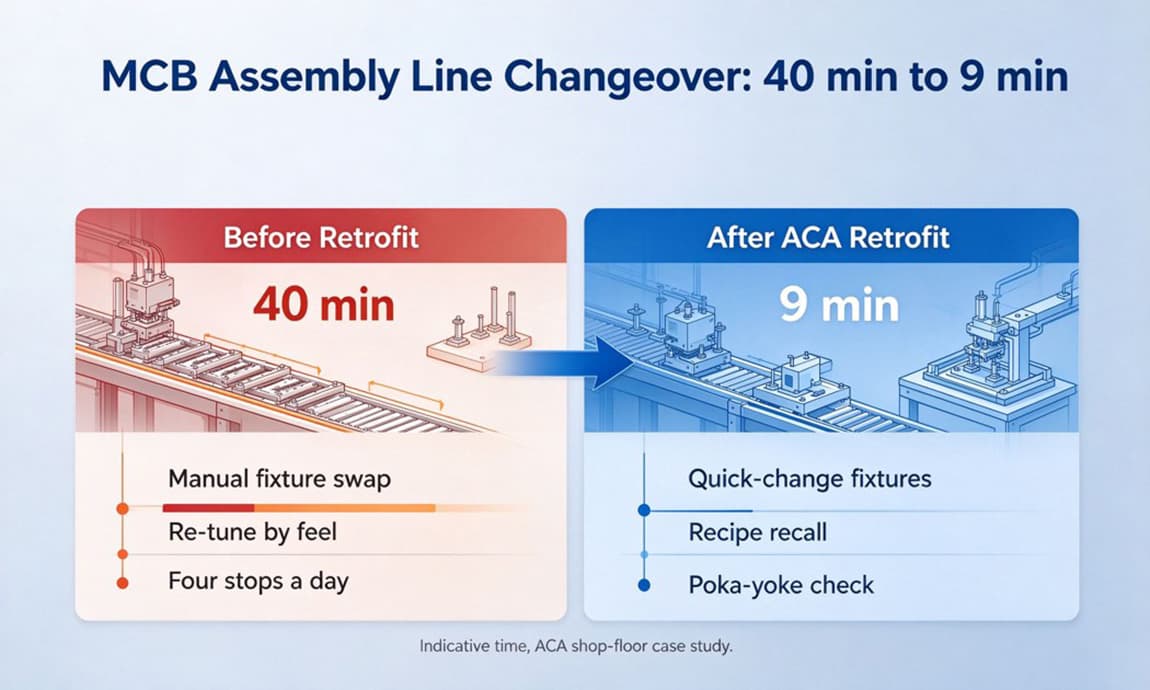
Forty minutes. That is how long one MCB assembly line sat idle whenever the model changed, and the plant ran four model changes a day. By the time the team swapped the fixtures, re-seated the tooling and walked the line re-adjusting the pick-and-place positions, almost three hours of the shift were gone to changeover alone. We are ACA Automation, and when this customer asked whether an MCB assembly line could switch models without grinding the shift to a halt, the answer was not a faster wrench. It was rethinking what the line actually needed to hold, recall and verify between runs.
The cost hidden in a 40-minute changeover
The 40 minutes were not spent warming anything up. They were spent on human setup. At each changeover, operators loosened and relocated clamps, bolted in new nests, then toured the MCB assembly line station by station because no two setups matched. The first parts after a changeover were often pulled as rejects, which meant the loss was idle time plus a fresh defect spike. On a line running four changes a day, that is roughly 160 minutes of lost takt before a single good part came off the new model. The MCB assembly line was capable of the cycle; the changeover was what wasted it. We see this pattern on most MCB assembly lines that were built for one model and later asked to make three. Worse, the operators who knew the old setup were the only ones who could rebuild it, so a single sick shift leader could stall the whole changeover.
Three changes we made to the line
We treated the changeover as three separate problems and fixed each one with a piece of hardware or software, not with a training poster. First, quick-change fixtures: the clamps and nests now sit on hardened locator pins and hand-tightened knobs, so an operator swaps them with no spanner. Second, recipe recall: the MCB assembly line stores one program per model, and a barcode scan brings back the pick positions, screw torque and test thresholds automatically. Third, poka-yoke identification: a sensor confirms the correct nest is fitted, and the MCB assembly line refuses to start if the part does not match the loaded recipe. Figure 2 shows the three pieces together.

The point of the kit is that the MCB assembly line stops asking an operator to remember the setup. The pins carry the location, the recipe carries the parameters, and the sensor carries the verification. That is the same logic we build into our flexible feeding systems and assembly equipment lines for customers who run short model families, and it is why a modern MCB assembly line changes over in minutes rather than in a morning. For a typical MCB assembly line that switches models more than twice a day, this kit pays back within the first quarter of output.
From 40 minutes to 9 minutes: what actually moved
After the retrofit, the changeover on that MCB assembly line dropped to about 9 minutes. The drop was not because operators worked faster; it was because the tasks were converted from manual judgment into fixture, recall and check. The nest swap took under a minute, the recipe loaded from a scan, and the first-article check passed without the station-by-station walk. The defect spike that used to follow each changeover largely disappeared, because the line refused to run on a mismatched nest. Four changes a day at 9 minutes instead of 40 gave the plant back about two hours of usable takt per shift, which is output that did not require adding a station or hiring an extra operator. Figure 1 puts the two states side by side. These are indicative times from this one case, not a universal average; your own number depends on how many stations and models you carry.
What this means for your own line
The lesson transfers. Before retrofitting, time one full changeover on your MCB assembly line and split it into fixture swapping, parameter re-entry and first-article verification. The biggest chunk usually sits in the parameter re-entry and the walk-through, which is exactly what recipe recall and poka-yoke remove. A new MCB assembly line is easier to plan for than a retrofit, but the same three pieces apply to both: locate on pins, recall by scan, verify by sensor. ACA Automation lays all three into the line from the start, so the changeover number stays low as you add models. If your current changeover still relies on one experienced operator to rebuild the fixtures by hand, treat that as the first risk to remove; it is the part that breaks on a sick day and the part that multiplies your changeover time on the next model.
Frequently asked questions
Do we have to replace the whole MCB assembly line to cut changeover time?
No. Most of the gain came from adding a fixture, recipe and verification layer on top of the existing line rather than tearing it out. We keep the productive stations and rebuild only the parts that cost changeover time.
How many MCB models can one line handle this way?
The recipe recall scales with the line's memory. One stored program per model is the rule, and a barcode on the carrier selects it. We have set up MCB assembly lines that switch among four or five models on the same shift without a manual re-tune.
How long does the retrofit itself take?
It depends on how many stations need locator pins and sensors. On a comparable MCB assembly line, the mechanical fixture work and recipe mapping were completed over a scheduled shutdown, followed by a short trial week. Ask ACA Automation for a plan based on your station count and model range.
Send ACA Automation your model range and a timed sample of your current changeover, and we will map which of the three pieces your line is missing. See our MCB semi-automatic assembly line, our flexible feeding systems, and our wider assembly equipment range to picture how the pieces fit together.