Monday, 07:55, the MCB assembly line stopped for the third time that month. A wedged bowl feeder had jammed three bases together, and the first shift lost forty minutes before restart. Taped to the line-side whiteboard was the customer's problem list: actual cycle time 9.5 s against a 7.2 s target; feeder jams twice an hour; rivet-missing rejects on 3.2% of output; a manual leakage tester flagging 4% at the end of the line; and no production data stored anywhere, so nobody could say which shift, which feeder lot, or which press stroke produced a bad breaker. The MCB assembly line was a twelve-station semi-automatic cell installed in 2019, staffed by six operators per shift. ACA Automation was called in to rebuild it rather than replace it.
A rebuild goes wrong the moment the team starts ordering new machines. This MCB assembly line needed a diagnosis first: which station actually paced it, which station actually made the rejects, and why no traceability existed. The customer wanted the line back within a quarter, and wanted the next bad breaker from the field traceable to the exact cycle that built it. We agreed on that goal before touching the MCB assembly line. The review below follows that rebuild from the Monday stop to the rebalanced, data-connected line that followed.
The diagnosis: where the old MCB assembly line lost time and parts
We spent two weeks with stopwatches and tagged rejects before moving any hardware. A station cycle study showed the old MCB assembly line was paced by a pneumatic riveting press at station 5, which took 11.8 s per cycle while the other stations ran at 6 to 8 s; upstream stations piled buffers in front of it, downstream stations waited, and the average cycle stretched to 9.5 s. The tagged-reject Pareto, indicative for this product mix, read: wrong spring height 28%, under-set rivets 24%, contact misalignment 19%, leakage fails 15%. The stop log blamed the feeder, the rivet press and the manual tester. The old MCB assembly line had grown by adding stations over the years, and nobody had ever rebalanced the MCB assembly line takt or wired a single data point. Without stopwatch data, the team had been solving the wrong problems for months: tightening the feeder, re-training operators, adjusting the tester, while the real bottleneck sat untouched at the riveting station.

Rebuilding the stations against the named problems
We rebuilt the MCB assembly line along the physical flow, one station per whiteboard problem. The feeder got a vision-checked escapement that holds the next part until the nest is ready, cutting jams from two an hour to a handful per week. The two hand-worked core benches became a four-nest rotary dial: the operator loads only the housing, and gauge-controlled seats position the spring and arc chute, which pulled the spring-height defect out of the Pareto. The riveting press was the real fix. ACA Automation installed a servo-electric press with a force-displacement window that reports each rivet in or out of spec in under 4 s, dropping the bottleneck from 11.8 s to 3.6 s. Testing moved inline as an automated bench measuring insulation resistance and tripping current, ejecting rejects immediately instead of queueing them at a manual table, and customers can extend this with our inline testing equipment. Packing became an automatic counter and bagger. The rebuilt MCB assembly line now needs three operators per shift instead of six. Each rebuilt station also got a front-panel stack light: green for run, amber for attention, red for stop, so the MCB assembly line signals its own state from across the shop floor.
Connecting the rebuilt line to MES data
A rebuilt MCB assembly line without a data layer is just a rearranged old line. Before trial production, ACA Automation wired each station controller to the customer's MES. One serial number per breaker now carries the material lots, the spring-height check, each rivet's force-displacement result, the inline test values, and the timestamp. The daily reports stay simple: shift OEE, first-pass yield by station, the defect Pareto, and a stop-reason log, so quality sees drift the same day instead of arguing about it at the weekly meeting. This traceability layer is part of our automation solutions. When a failed breaker comes back from the field, we pull the serial, show the rivet curve and the test values for that exact cycle, and tell the customer whether the part left the MCB assembly line inside window or not.
What changed in takt and yield
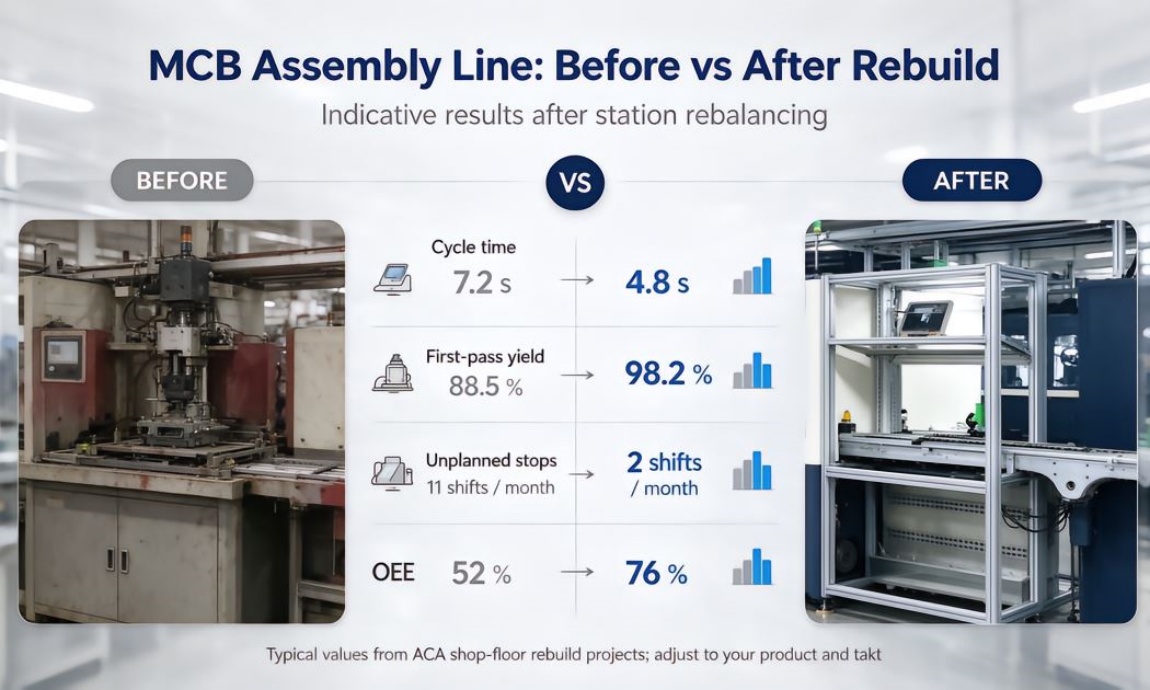
The numbers below are typical for this product mix, based on ACA Automation shop-floor rebuild practice; your own figure moves with pole count and variant count. On the rebuilt MCB assembly line, average cycle time moved from 9.5 s to about 4.8 s, first-pass yield from 88.5% to 98.2%, unplanned stops from eleven shifts a month to two, and OEE from 52% to 76%. Eight of the twelve old stations were kept; only the feeder, the core benches, the rivet press and the packing table were rebuilt. The yield gain does not come from better operators; it comes from ejecting defects at the station that caused them, instead of letting them travel to the end of the MCB assembly line. Figure 2 shows the comparison visually.
If your MCB assembly line shows slow takt, recurring feeder jams and end-of-line defect chasing, ask ACA Automation to review it. You can start from our MCB semi-automatic assembly line reference and send us your product mix and target takt for a rebuild proposal.
Frequently asked questions
Do we have to replace the whole MCB assembly line?
Not usually. On this project, the rebuilt MCB assembly line kept eight of twelve stations, because the frames and conveyors were still sound. We replaced the stations that caused the bottleneck and the rejects - the feeder, the core assembly benches, the riveting press and the packing table - and added the MES data layer. We list which stations we keep, replace and move in the rebuild proposal before any steel is cut. A full replacement makes sense only when the fixturing is worn out beyond recovery or the product range changes completely.
How long does a typical MCB assembly line rebuild take?
Two weeks of diagnosis on the running line, then four to six weeks of fabrication and FAT in our workshop, followed by one to two weeks of on-site installation and trial running. The old line keeps producing while we build the new stations in the workshop, so production barely pauses. A line of this size is normally stable within two to three months from order to first good batch.