A contract breaker plant rebuilt its 2027 plan last quarter: 1.8 million MCBs a year, 11 frame sizes, and 36 scheduled changeovers. The purchasing team asked one question — does that volume justify a fully automatic cell, or does an MCB semi-automatic assembly line make more sense? The headline number looks large enough for full automation. Spread across 11 frames, it is not. This is the decision ACA Automation works through with breaker makers most weeks of the year, and the answer rarely follows the biggest digit on the volume chart. An MCB semi-automatic assembly line is not a cheaper version of a fully automatic cell; it is a different match for a different production mix.
Where the dividing line actually sits
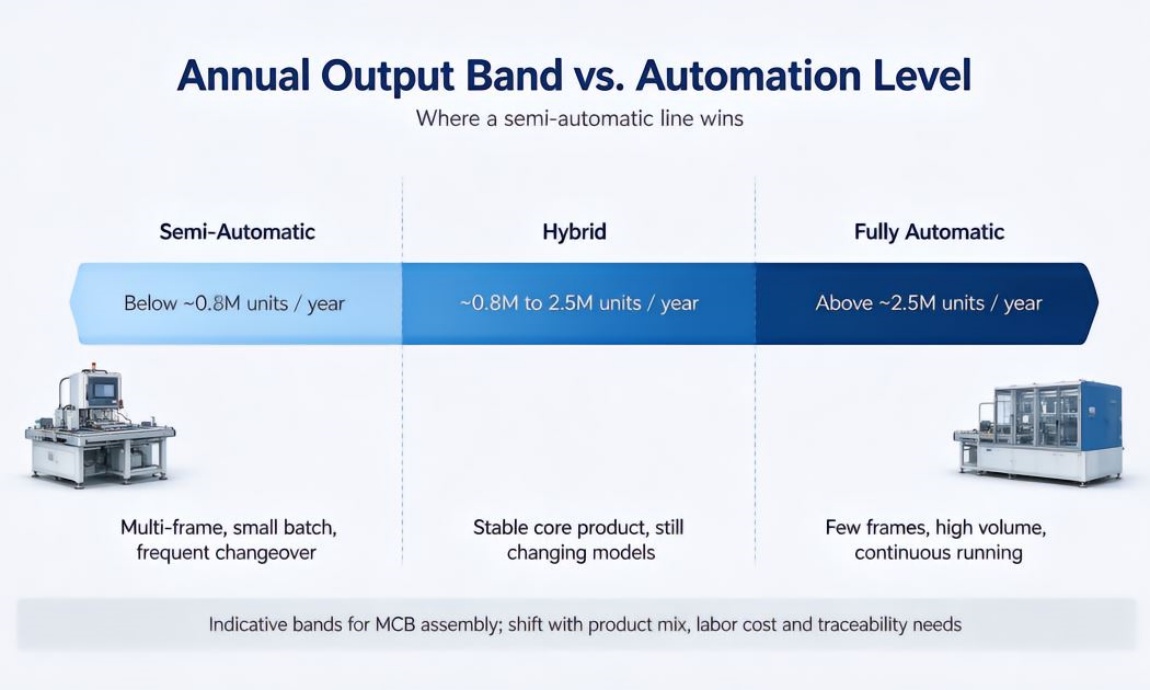
On an MCB semi-automatic assembly line, operators do the flexible steps — seating the arc chute, snapping the cover, presenting a sub-assembly to the tool — while stations do the repeatable steps: torque screw driving, contact-resistance measurement, hipot, mechanical trip testing, vision checks and reject sorting. A fully automatic line inverts that split. A feeder bowl or robot picks each part, a transfer index moves the sub-assembly between stations, and a single cycle runs the frame without a hand touching the product. As an indicative rule from our shop-floor data, a dedicated fully automatic MCB cell runs several times the upfront capex of a comparable MCB semi-automatic assembly line, and pays back only when one frame runs long enough to occupy those stations around the clock. Choosing a MCB semi-automatic assembly line is therefore a decision about product mix, not about chasing the fastest cycle.
Three dimensions that move the choice
The first dimension is annual throughput. A human-paced MCB semi-automatic assembly line with 4 to 8 operators and a 4 to 8 second takt delivers roughly 0.3 to 0.7 million breakers a shift, or 1.0 to 1.4 million across two shifts. A fully automatic cell runs a 2 to 4 second cycle and can pass 2.5 million units a year. Those are indicative bands, not walls; frame size, component count and test time shift them. If your forecast is one stable frame above 2.5 million units, the fully automatic cell wins; if it is a spread, the MCB semi-automatic assembly line keeps its cost per breaker stable across frames.
The second dimension is variety, and on MCBs it often outweighs volume. B-, C- and D-frames, different pole counts, accessories and customer terminals arrive as a family. A MCB semi-automatic assembly line absorbs them with quick-change nests and recalled torque programs; a changeover takes minutes to half an hour. A fully automatic cell changes over by recipe recall too, but feeder bowls and transfer tooling are tuned to one geometry, so the same switchover can take half a day and needs an engineer. Thirty-six changeovers a year is exactly where that gap decides the budget, and why a MCB semi-automatic assembly line is usually the lower-cost answer for a breaker family.
The third dimension is what you must prove about each breaker. The hipot unit, trip tester and vision station run the same hardware on either line. On an MCB semi-automatic assembly line the manual insert step can introduce variation, so the line leans on in-process vision and a serial-numbered torque-and-test record. If your market demands per-unit traceability, the semi-automatic line still logs each result to a database; what it cannot do as cheaply is run unmanned, lights-out production.

When a semi-automatic line wins
ACA Automation recommends a MCB semi-automatic assembly line when most of these hold. Annualized volume sits below about 1.5 million units per dedicated line, or above that but split across many frames. You build more than three or four frame sizes, with changeovers more than a few times a month. Capex must stay in a lower band with a two-to-three-year payback. Floor space is tight, skilled operators are available, and lights-out production is not yet a hard requirement. Match most of these and the MCB semi-automatic assembly line usually wins on five-year cost of ownership; match only two or three, and price a hybrid line alongside it.
Two typical customer profiles
One customer builds eleven frames for export, with a top frame taking 400,000 units and a tail adding 600,000. We at ACA Automation quoted seven manual insert stations, two automatic screw stations, contact-resistance and hipot test stations, a trip tester and a reject sorter. Changeover stayed under thirty minutes, and the line covered the whole catalog without an unmanned overhead they could not amortize. A second customer was launching a smart MCB with a communication module still changing twice a quarter. We specified a manual-present-to-nest station for the module, so a revised nest prints and swaps in an afternoon, while the test and screw stations stayed automatic. As volume passes a million units on the stable product, those manual stations convert one by one.
Back to the plant with 1.8 million units and 11 frames. That is not a lights-out volume for one frame; it is a long-tail volume across eleven. For that mix, the MCB semi-automatic assembly line is the better-matched investment, not the cheaper compromise. A MCB semi-automatic assembly line covers the long tail that a fully automatic cell would leave idle.
Before you compare quotes, browse our MCB assembly equipment, see the wider assembly equipment range, or open the dedicated MCB semi-automatic assembly line page for station layouts and indicative takt.
Frequently asked questions
How many operators does a MCB semi-automatic assembly line need per shift?
Indicative headcount runs from 4 to 8 operators per shift, set by the insert and placement steps. A simple 1P or 2P frame can run comfortably with 4 to 5; a 3P or 4P frame with accessories often needs 7 to 8. The automatic test and screw stations run without dedicated staff, which is the main reason a MCB semi-automatic assembly line stays economic at lower volume.
What annual output can one MCB semi-automatic assembly line produce?
Roughly 0.3 to 0.7 million breakers a year on a single shift, or 1.0 to 1.4 million across two shifts. Above about 2.5 million units a year of a stable single frame, a fully automatic cell usually wins on unit cost; below that, and across many frames, a MCB semi-automatic assembly line is the better fit.
Can a MCB semi-automatic assembly line be upgraded later?
Yes, when it is specified that way. The stations are modular blocks, so manual insert stations can later be replaced by robotic pick-and-place while the test stations, conveyor and control system stay in place. This staged route fits ramping volume or an evolving product.
Send ACA Automation your annual volumes and frame list, and we will map whether a semi-automatic line, a hybrid line or a fully automatic cell is the right fit.