Two cost sheets land on the table at the review. One prices a resistance spot welding fixture with electrodes and tooling; the other quotes an automatic laser welding machine with a rotary dial, scanner optics and a vision camera. The room argues about technology before anyone asks what the part needs.
Our view at ACA Automation is simple: match the process to the contact, not the contact to the process. Four numbers settle the argument: contact geometry, annual volume, the contact-resistance variation your spec tolerates, and the capex envelope you are allowed. A spot gun wins on some joints; an automatic laser welding machine wins on others. The sections below compare the two on the numbers that move the line.
How each process forms the joint
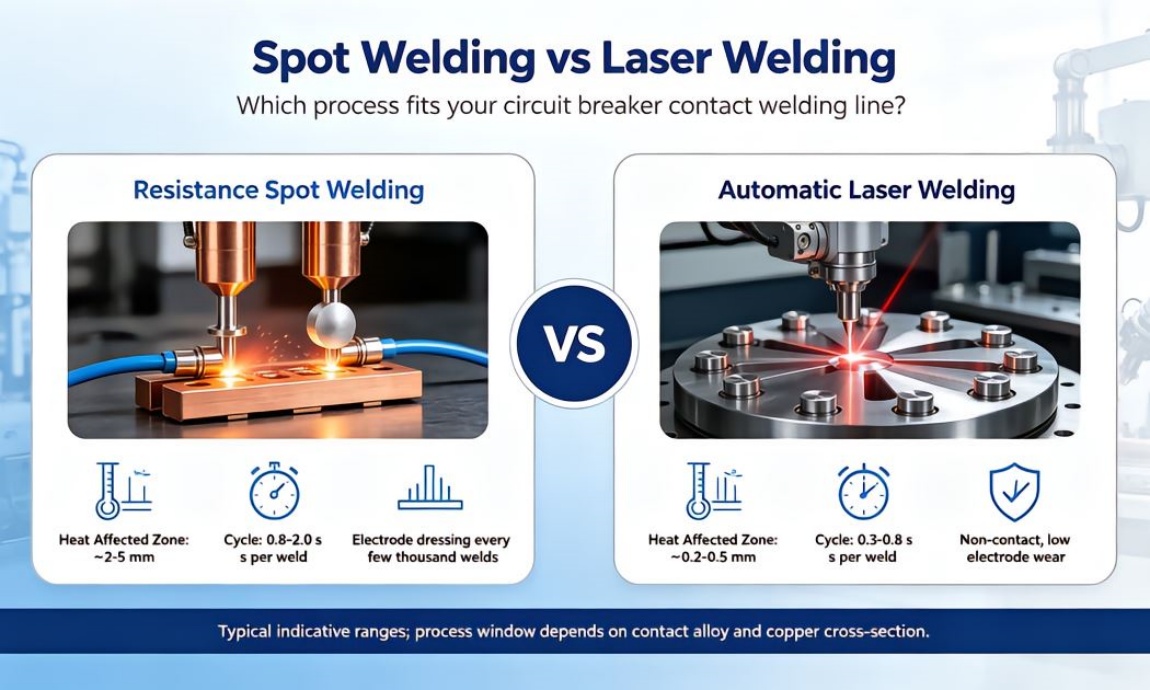
Resistance spot welding presses two water-cooled copper electrodes onto the overlapping parts and fires a short, high current pulse through the contact resistance at the faying surface. Energy melts a nugget inside the joint. The machine is mechanically simple: a servo or pneumatic press, a capacitor-discharge or medium-frequency inverter supply, exchangeable electrode tips and a fixture that holds the contact against the copper backing. The electrodes push hard, so fixturing must hold position. Ask how an automatic laser welding machine handles your smallest contact geometry before you price a cell.
A laser route focuses a fiber beam through a scanner or a fixed optics head and melts a narrow keyhole seam. A typical automatic laser welding machine for breaker contacts runs a 200-500 W fiber laser, a galvanometer scanner, a rotary dial and a shielding-gas nozzle. Nothing touches the part, so there is no electrode force and no tip-wear loop.
Four numbers that separate the two
Start with heat. On a 1.6 mm silver-tungsten contact riveted to copper, spot welding leaves a heat-affected zone roughly 2-5 mm around the nugget; an automatic laser welding machine closes a seam under 1 mm wide with a heat-affected zone near 0.2-0.5 mm. The thermal footprint of an automatic laser welding machine is why it appears on dense contact assemblies. Typical for AgW and AgSnO2 contacts on copper backings; plating shifts the window.
Look at weld-to-weld spread. Spot results track electrode condition: as the copper tip mushrooms, current density drops and nugget size drifts until the tip is dressed. An automatic laser welding machine regulates power and beam position in a closed loop, so an automatic laser welding machine repeats the same pulse from the first weld to the ten-thousandth. Cycle time: a spot gun lands near 0.8-2.0 s per weld; an automatic laser welding machine fires in a 0.3-0.8 s window and jumps between contacts inside one dwell. Maintenance: spot tips are dressed after a few thousand welds; laser cover glass and gas nozzle are cleaned on a planned interval of weeks, and the fiber source runs tens of thousands of hours.
When the thermal margin decides
Breaker contacts are welded next to a plastic carrier, a pressure spring and sometimes a coil lead. Excess heat softens plastic or anneals springs. Spot welding pushes current through the whole stack, spreading heat several millimetres along the copper backing; at 2-3 mm from the plastic that margin disappears. In ACA Automation shop-floor trials on AgW12 contacts on PA66 carriers, the carrier edge sat within 1 mm of a laser seam without visible deformation; the same stack on spot welding needed a 3-4 mm standoff. If the nearest plastic sits inside roughly 2-3 mm of the weld, an automatic laser welding machine is usually the safer thermal choice. Where the plastic is close, the automatic laser welding machine becomes the default in our build reviews.
When consistency and drift decide
The drift shows across shifts. Tip wear changes the contact area, current density falls, and contact resistance wanders outside the spec window. An automatic laser welding machine removes that variable: no contacting electrode, closed-loop power, and a locked recipe that holds the seam geometry run after run. For a line that cannot afford that drift, an automatic laser welding machine is the repeatable route. ACA Automation pairs the weld cell with vision inspection systems that read seam position and spot presence after each cycle, so a weak joint is flagged at the station instead of in the field.
A decision rule to take to your review
Use volume first. At low to mid volume with a simple copper lap joint, a spot fixture is the lower-investment route and it holds up. Once volume is high enough that tip dressing and changeover labour show up on the OEE report, an automatic laser welding machine becomes competitive on running cost even with a higher purchase price. Use weld quality second: if contact-resistance stability across shifts is your failure mode, the closed-loop laser removes the electrode-wear drift. Use thermal distance third: under about 2-3 mm, plan for the laser; at 4 mm or more of copper heat sink, spot welding is comfortable.

Neither process is a universal answer. ACA Automation builds automatic welding equipment lines that use one process per station, sized to the joint, the volume and the tolerance window. An automatic laser welding machine is not a drop-in replacement for a spot weld; it is the precision route for the joints that need thermal and dimensional control. Most breaker lines we quote end up with a mix rather than one machine forced onto each contact.
Frequently asked questions
Can an automatic laser welding machine weld silver-tungsten contacts directly to copper?
Yes, with caveats. A 200-500 W fiber laser with controlled focus and shielding gas welds AgW tips to thin copper backings in a small seam. Copper reflectivity is managed through process settings and a short keyhole. Tuned on an automatic laser welding machine, the seam stays small enough to leave the contact face flush. Run a short parameter study on your actual contact grade before locking the recipe.
How often do spot-welding electrodes need dressing compared with laser optics?
Spot copper-alloy tips are dressed or replaced after a few thousand welds, depending on current and alloy. An automatic laser welding machine has no contacting electrode; the cover glass and gas nozzle are cleaned on a planned interval of weeks.
Which process gives lower contact resistance variation on MCB contacts?
Closed-loop laser welding usually shows tighter weld-to-weld spread because it is not affected by electrode mushrooming or tip wear. Spot welding variation tracks electrode condition and faying-surface cleanliness. We control both with post-weld verification: contact-resistance measurement plus vision on the station. On an automatic laser welding machine, the recipe log adds per-serial traceability for each pole.
Send ACA Automation your contact drawing, annual volume and the measured thermal distance to the nearest plastic part. The applications team will size the cell and recommend spot welding, laser welding, or a mix of both for your line.