Walk through the door at the east end of ACA Automation's Wuxi plant and the first thing that reaches you is the steady 18-second beat of the line I have come to see. A process engineer walks me along a rail of brushed stainless trays carrying small copper thermostat cups. This is the thermal parts flexible automatic welding equipment we are scoping for a customer who runs fourteen thermal-part variants in short batches. Standing at the rail, you would not guess it switches part families overnight.
The problem on the table is not hard to describe. Thermal components move in small runs - a few thousand of one cup, then a different flange diameter, then a deeper contact housing. On a manual bench that means a welder re-learning each part, a bead that drifts by lunchtime, and a pile of rejects sorted by hand. Re-tooling a dedicated cell between these variants used to eat a whole shift. That gap is what this thermal parts flexible automatic welding equipment is built to close.
What the line looks like on the floor
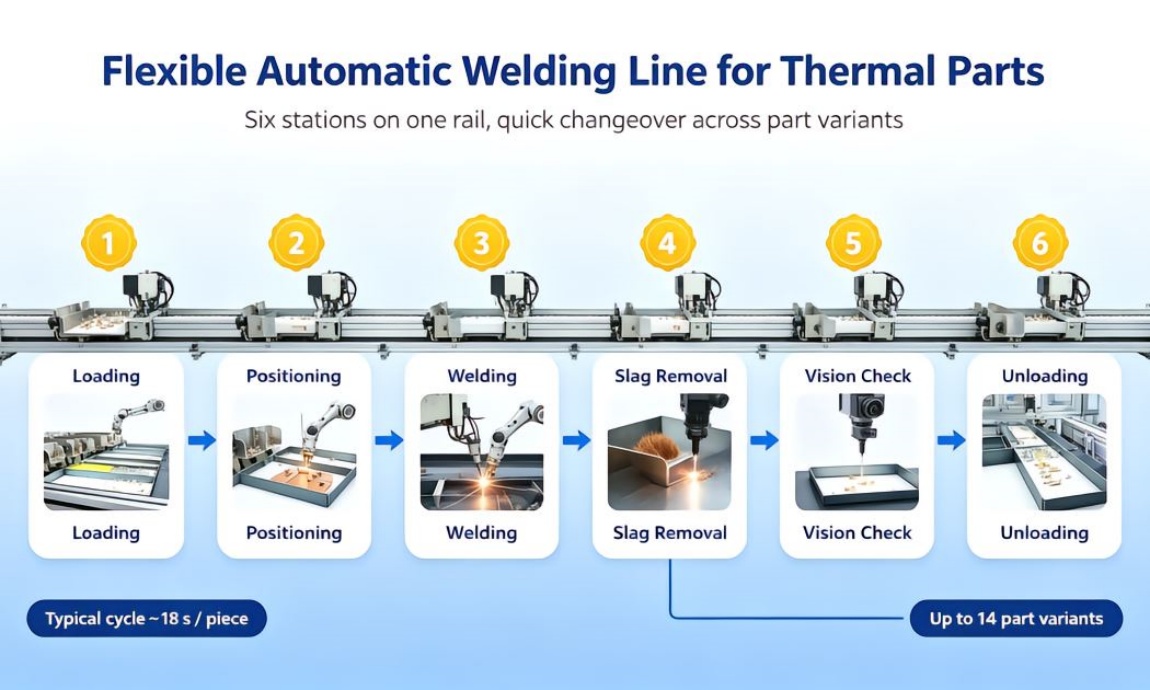
The rail runs about eleven metres and holds six unstaffed stations on one conveyor. Trays index from a bowl-fed loader, through a locating nest, the welding booth, a wire-brush slag station, a vision check, and out to an unloader. Positioning pulls each tray down on two locating pins to about +/-0.02 mm; the booth stays behind an interlocked door; the brush station sweeps spatter off the hot seam and blows it into a chute. On R-120 the torch runs about 185 A at 19 V with a 1.6 s dwell; the thermal parts flexible automatic welding equipment holds an 18 s beat and turns out roughly 1,600 pieces an hour - indicative, based on ACA shop-floor data. On this thermal parts flexible automatic welding equipment, no station waits on a person. The feeding end uses the same logic behind our flexible feeding systems page, tuned for tiny stamped parts that would jam a generic vibratory track.
How changeover actually works
Switching variants is where the design earns its name. At the HMI the operator calls up a recipe - R-110, R-120, R-130 and ten more live in the library - and the control reloads weld current, voltage, torch dwell, brush pressure and the vision reference in roughly four to six minutes, with no spanners and no drive re-programming. The only physical move is the fixture: each nest bolts to two hardened dowel pins with a quick-release clamp, and lifting one plate off to set the next takes about three minutes. For a workshop used to manual cells, watching the thermal parts flexible automatic welding equipment swap recipes in minutes is the part that surprises visitors. This is the changeover path ACA Automation designs around, which is why a thermal parts flexible automatic welding equipment line absorbs a mixed order book without stopping for a rebuild. When the schedule flips from R-110 to R-130 overnight, the thermal parts flexible automatic welding equipment is already set up by the time the first operator clocks on.

Keeping the right part in the right nest
A line carrying fourteen variants lives or dies on mistake-proofing. Before a recipe runs, the thermal parts flexible automatic welding equipment checks that the fitted fixture matches the program: each plate carries an RFID tag, read as the tray indexes. If the tag says R-110 but the operator called up R-130, the machine will not start. The loader adds a second gate - a weight sensor on the hopper and a vision camera that rejects an out-of-family shape on sight. Without these gates, a thermal parts flexible automatic welding equipment line running fourteen variants would sooner or later weld the wrong housing to the wrong contact. You can compare approaches on the wider automatic welding equipment page (welding-equipment).
Traceability beyond the arc
Each good part records its own result: operator ID, recipe number, actual weld current and voltage, timestamp, and the vision verdict, tied to the laser-marked serial. A line like this thermal parts flexible automatic welding equipment turns a weld into a logged event rather than a hand-written tick. The thermal parts flexible automatic welding equipment logs all of it, and ACA Automation delivers the line Industry 4.0-ready so the records roll up to the customer's MES rather than sitting on a local USB stick. Pull up any unit and you see which recipe ran it and what current it actually saw. That closed loop is what makes the thermal parts flexible automatic welding equipment usable inside a regulated thermostat and contactor build.
What this buys a mixed-part workshop
Put it together: one rail, fourteen semi-finished variants, a recipe change of minutes and a fixture swap of about three. Uptime across a two-shift week has held near the mid-90 percent range in indicative floor data, and the in-line check has cut the leak-test escape rate to a small single-digit fraction of the old manual bench. For thermal parts, that is what this thermal parts flexible automatic welding equipment is really for: keeping quality steady as the part keeps changing. The point is not that it welds faster than a dedicated cell. It is that one set of hardware replaces three benches and three operators - the exact mix problem we walked in on. A manual bench bends under this mix; the thermal parts flexible automatic welding equipment does not. The thermal parts flexible automatic welding equipment product page lists the footprint and ratings for sizing against your own parts.
How long does it take to change the line from one thermal part to another?
The recipe switch takes four to six minutes with no hardware change. The only physical swap is the fixture plate, about three minutes. A full variant change, recipe plus fixture, sits under ten minutes.
How many variants can one flexible welding line handle?
This thermal parts flexible automatic welding equipment supports up to fourteen semi-finished variant specs on a single rail, each with its own recipe and vision reference. Additional variants can be added as your range grows.
Is each weld traceable back to the part?
Yes. Each pallet records operator ID, recipe, actual weld current and voltage, timestamp and vision verdict, tied to the laser-marked part serial, and the records can feed your MES.
Send ACA Automation your part drawings and expected variant list for a feasibility study - from concept to completion.