Three years ago a customer walked back through our door after buying a magnetic components welding equipment from a lower-cost line. The demo had been spotless. On shift two the electrodes wore out in a quarter of the promised cycles, the traceability file would not open in their MES, and no one on the floor could change a tip in under forty minutes. The machine was not broken. They had simply never been told what to watch on the supplier floor.
That is the gap this list closes. Before we let a customer commit to a magnetic components welding equipment, we hand them five lines to carry onto the plant floor and tick while the cell runs - not a spec sheet to nod through, but things you verify with your own eyes. Here is how ACA Automation reads a weld line visit.

Electrode life: price per tip is not the real cost
On magnetic components welding equipment the electrode touches the part on each shot, and it is the wear item that most often decides uptime. Ask which alloy the supplier specifies - CuCrZr or dispersion-strengthened copper - and get the rated welds before dressing, measured at your current and force rather than the ideal sample. Then watch an actual tip change and time it. The cost you are buying is not the tip price; it is the dressing window, the first-off check, and the joints welded while the electrode drifts between changes. At ACA Automation we log cycle count per tip on our own lines; when life drops from 50,000 welds to 15,000, the lost uptime dwarfs the consumable. Get the spare-tip price and recommended stock in writing for the magnetic components welding equipment you are shortlisting.
Weld-strength verification: a neat bead is not proof
A clean weld bead tells you almost nothing about joint strength. Ask whether strength is checked destructively, in-line, or both, and at what sampling frequency. On a magnetic components welding equipment aimed at relays and contactors, in-line signature monitoring - weld current, voltage, force and displacement, shot by shot, with an upper and lower window and automatic reject - catches expulsion, missed contact and shunting before the parts leave the cell. Periodic destructive pull tests calibrate that monitor against a real strength number. Ask for a live pull on three consecutive production parts; if the supplier hesitates, that is your answer. The verification station belongs inside the magnetic components welding equipment, not bolted on later, the serial number should follow the joint into your testing equipment. That chain is standard on a magnetic components welding equipment built for traceability.
Changeover time: the hidden lost shift
For low-to-medium volume magnetic components welding equipment, switching between product specs costs more than the weld itself. Ask to watch a live change from Part A to Part B and time it from stop to first good part. Note whether recipes - electrode force, weld schedule, nest offsets - are stored by product and recalled, or re-entered by hand each time. A two-hour change on a machine that runs twelve batches a month eats a full shift; the gap between forty minutes and ninety is available output. Quick-change nests and a guided HMI checklist are what make a flexible cell genuinely flexible. A magnetic components welding equipment that needs a specialist on site for each spec change does not scale. Get the documented changeover time and ask who trains your operators after the magnetic components welding equipment arrives.
Power, air and water: size the room before delivery
Two cells that look identical on the floor can draw very different mains load, and this is the line we size first when we quote a magnetic components welding equipment. Ask for both the installed connected load and the real energy per weld cycle; on inverter welders those numbers diverge. Ask for compressed-air pressure and flow, plus cooling-water flow and temperature. Then look at the cabinet nameplate, the water manifold, and the flow switches - missing interlocks mean future downtime and scale. Marginal plant air makes repeatable force drift, and the welds drift with it. A written utility schedule for the magnetic components welding equipment lets your facilities team size the feeder, compressor and chiller before delivery week, not during commissioning.
Traceability data: an open export earns the MES
In automotive and new-energy magnetic components, a failed joint needs a record of its weld schedule. Ask what the magnetic components welding equipment logs per joint - timestamp, serial, current, voltage, force, displacement, verdict, electrode count - and how it exports: OPC UA, MQTT, SQL, or CSV. Open the HMI and export a real shift in front of you; ask for a demo export from a magnetic components welding equipment already in production, not a scripted sample. A machine that welds well but keeps its data in a proprietary format becomes an integration project you did not budget. This is where Industry 4.0 readiness is proven, and where ACA Automation builds the data dictionary before the order. Compare the approach across the wider automatic welding equipment category to feel the difference.
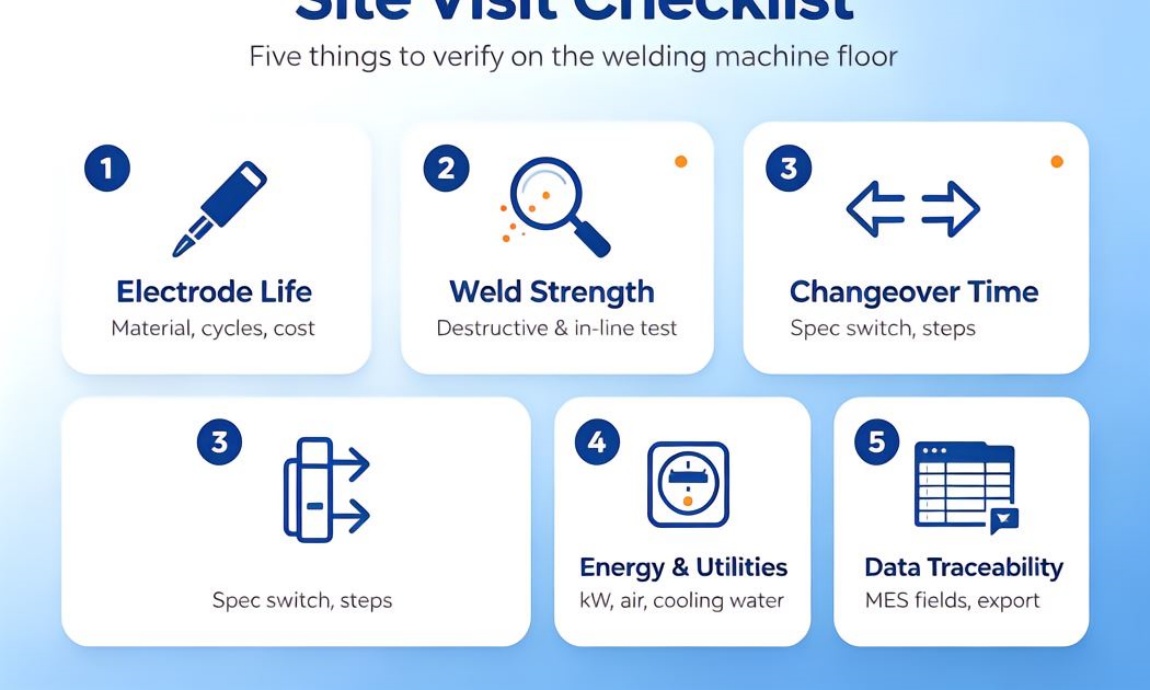
Carry these five lines to the floor. The supplier that welcomes a timed changeover, a pulled joint and an open data export is usually the one you want building your magnetic components welding equipment; the one that deflects those three is telling you what life after delivery will feel like. Used this way, a visit tells you more about a magnetic components welding equipment than any datasheet. You can review our magnetic components welding equipment page to see how the same questions land on a real cell.
Send ACA Automation your part drawings and target cycle time; we will scope the welding cell, the changeover logic and the data export before you commit.
Frequently asked questions
How long do electrodes typically last on magnetic components welding equipment?
Typical life depends on alloy and current. CuCrZr tips run tens of thousands of welds before dressing; dispersion-strengthened copper lasts longer on heavier current but costs more per tip. Ask for logged life on a part like yours, not the brochure figure.
Is in-line strength monitoring enough, or do I still need destructive tests?
You usually need both. In-line signature monitoring inspects each shot and diverts rejects automatically; periodic destructive pull or shear tests calibrate the monitor and prove the acceptance standard. The sampling frequency follows how critical the joint is to the end product.
What utilities does magnetic components welding equipment require?
Most resistance-welding cells need a dedicated supply, clean compressed air and cooling water. Confirm connected kVA, air flow and water temperature before layout so the feeder, compressor and chiller are sized ahead of installation.