Stand in front of a running MCCB assembly line and the numbers look simple: one finished breaker on a fixed 18-second beat. Ask how that 18 seconds is actually produced, and the answer lives between the stations, not inside them. On the ACA Automation line we installed last quarter, the customer's engineers kept asking why one station ran fast and the next stalled, and the takt never settled. The MCCB assembly line was not slow at any single station. The handover was.
How a takt number actually gets made
A takt is the slowest station plus the time lost moving parts between stations. On a five-station MCCB assembly line, each station may cycle in 12 seconds, yet the line ships a breaker on an 18-second beat. The missing six seconds are index time, sensor checks, and small buffers. Most line-balancing work is not speeding up a station; it is removing the dead handover between them. When we first measured that ACA Automation MCCB assembly line, the riveting station finished two seconds ahead of schedule and then sat idle for four, waiting for the pallet ahead of it to clear. A station that waits is not a slow station; it is a badly sequenced one. The fix was not a faster riveter. It was re-timing the index and adding a pallet buffer so the riveter could work while the test gate finished its longest check.
Loading, riveting, then the mechanism
The first station feeds MCCB cases from a tray onto a pallet. The pallet indexes, a sensor confirms the case is seated, and only then does the fixture clamp. Next comes riveting: contact and terminal rivets are set in one or two squeeze cycles, with current and force logged per joint. Then the mechanism station fits the tripping mechanism and the handle, the tightest mechanical fit on the whole MCCB assembly line. A mis-feed here stops the line, so ACA Automation uses a vision presence check before the rivet press fires. After test comes packaging, where the breaker is labeled, tied to its serial record, and boxed. Figure 1 shows the five stations in order.

The test station is the gate
Station four is where a part earns the right to move on. It runs the trip curve, contact resistance, and a dielectric check, and it stamps the serial number to that result. On an MCCB assembly line this is the longest cycle, typically 10 to 14 seconds, typical and indicative, which is exactly why the buffer ahead of it matters. A part that fails test is diverted, not reworked on the fly. If the test gate were starved by a quick upstream station, the line would throw away its longest, most valuable cycle waiting for parts. On an MCCB assembly line that runs around 200 breakers an hour, even a one-second index glitch compounds to several minutes of lost output per shift, which is why we size the test gate for peak flow rather than average.
What happens between two stations
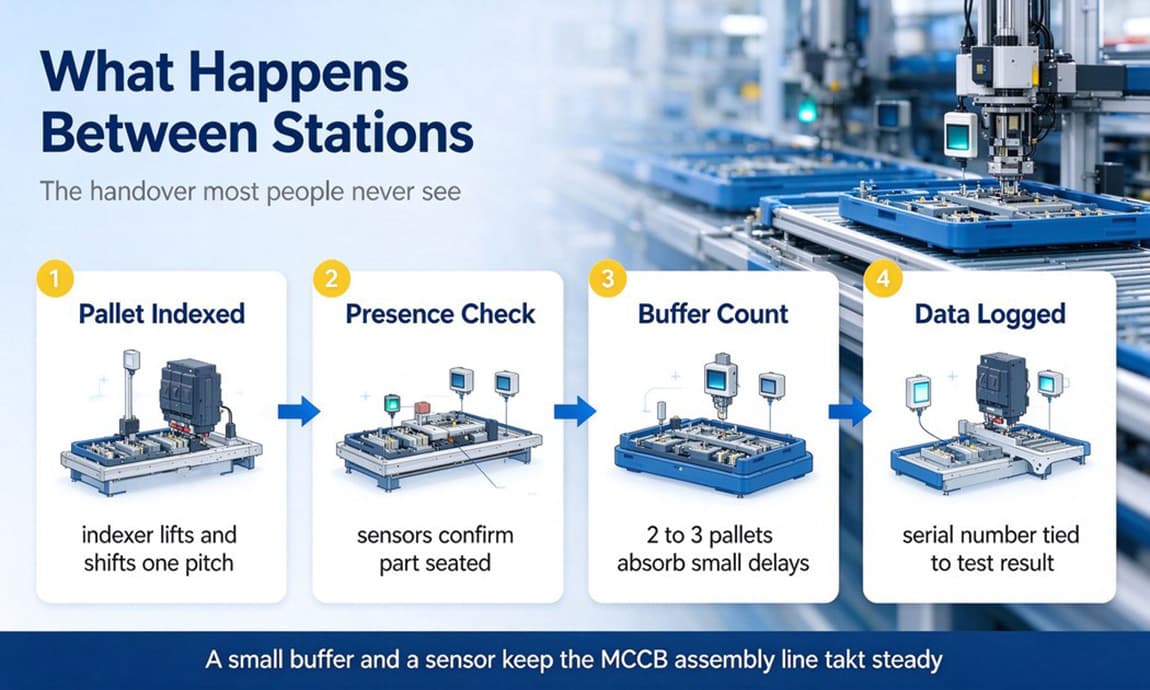
Between each station an indexer lifts the pallet, shifts it one pitch, and lowers it. Sensors confirm the part is seated before the next fixture closes. A buffer of two to three pallets absorbs small delays so a quick station does not block the one behind it. This is the handover we tuned on that line: raising the buffer from one pallet to three and adding a presence sensor cut the stalled-cycle rate from about 9% to under 2%, based on ACA shop-floor data. We also slowed the fastest station slightly so it matched the test gate instead of out-running it. Figure 2 walks through that handover.
Why buffers and traceability hold the line together
The buffer is not wasted floor space. On an MCCB assembly line it is the shock absorber for a 14-second test gate. Pair it with data logging, where the serial number carries its own test result, and a drift at riveting shows up as a rising fail count within an hour instead of at the final audit. On that customer line, adding the second buffer pallet and the presence sensor raised output from about 180 to 230 breakers an hour without changing a single actuator. When each station logs its own cycle time, the MES sees the bottleneck before the operator does, and the MCCB assembly line can be rebalanced from the control screen rather than from the shop floor. That is the difference between an MCCB assembly line that meets takt on a good day and one that holds it across a full shift. Our assembly equipment (assembly equipment) and testing equipment (testing equipment) are built around that feedback loop. For a semi-automatic starting point, see our MCCB assembly line offering (MCCB assembly line). When the handovers are tuned, that 18-second takt stops being a target and becomes the steady output of the MCCB assembly line.
Send ACA Automation your takt study and station cycle times; ACA Automation will map the handovers on your MCCB assembly line and tell you where the next six seconds are hiding.
FAQ
Why does my MCCB assembly line stall even though no single station looks slow?
Usually the handover. Index time, missing presence sensors, and a buffer of one pallet let a fast station block the one behind it. Measure the gap between station cycles on your MCCB assembly line before you buy faster actuators.
How many pallets should the buffer hold ahead of the test gate?
Start with two to three pallets ahead of the longest station and tune from the observed stalled-cycle rate on the MCCB assembly line. These values are typical and indicative for MCCB-class parts.
Where should traceability data be captured on the line?
At the test station, tied to the serial number, so any drift in riveting or mechanism assembly shows up as a rising fail count within an hour rather than at the end-of-line audit. Keep the log on the local controller and mirror it to the MES at the line level.