A plant manager asked me the other week whether he could stretch one automatic assembly line to build both his air circuit breaker (ACB) range and his vacuum circuit breaker (VCB) range, and buy back the floor space a second line would eat. The honest answer is no, and the reason is the same one that decides whether an ACB assembly and testing line pays back: the two products do not share their mechanism, their tests, or their cleanliness window. Trying to run both on one cell looks cheaper on paper, then leaks cycle time and escape defects on the shop floor. That is the honest cost any ACB assembly and testing line feasibility study has to price before the layout is drawn.
ACBs are large, draw-out power breakers with a four-bar over-center mechanism, spring charging and contacts measured in milliohms. VCBs are smaller, sealed vacuum poles potted in epoxy, where a few dust particles or an under-torqued bolt inside the interrupter means a failed power-frequency withstand. An ACB assembly and testing line built for one behaves like a dedicated cell, not a shared platform.
The two breakers are not scaled versions of each other
It is tempting to treat VCB as a smaller ACB, because both interrupt current and both carry a nameplate current rating. Physically they sit at opposite ends of the cabinet. An ACB assembly and testing line starts from a drawn-out chassis on wheels: wide frames, manual or motorised charging, clearances designed around air as the insulating medium. A VCB line starts from a closed vacuum bottle you must never touch directly. The loading nests, the robot grippers and the torque spindles an ACB assembly and testing line expects simply do not fit a potted pole without rebuilding almost each station. Re-tooling an ACB assembly and testing line for VCB work costs nearly as much as building the VCB line from scratch, and leaves you with a compromise on both.
Mechanism complexity is baked into the fixturing
Where the split bites first is mechanical. The ACB over-center linkage needs dozens of pivots, springs and latch pins seated in a defined order, each to a torque that holds for thousands of operations. An ACB assembly and testing line therefore spends most of its stations on mechanism sub-assembly, spring charging and mechanical endurance cycling. A VCB has almost no visible linkage: the vacuum bottle is sealed at the factory, and the assembler mostly fastens the pole into an operating mechanism and busbar. A single rail sized to swing a 40 kg ACB chassis around would be both overbuilt and clumsy for a 3 kg VCB pole. Mixing the two means either a slow, oversize line for the small part, or an under-built one for the heavy part. On the ACB side, a single ACB assembly and testing line may run several frame sizes on changeable nests; that flexibility already stretches the fixture design. Asking it to also hold a vacuum pole on the same conveyor is a different order of problem, not one more recipe.
The test list is where the split becomes hard
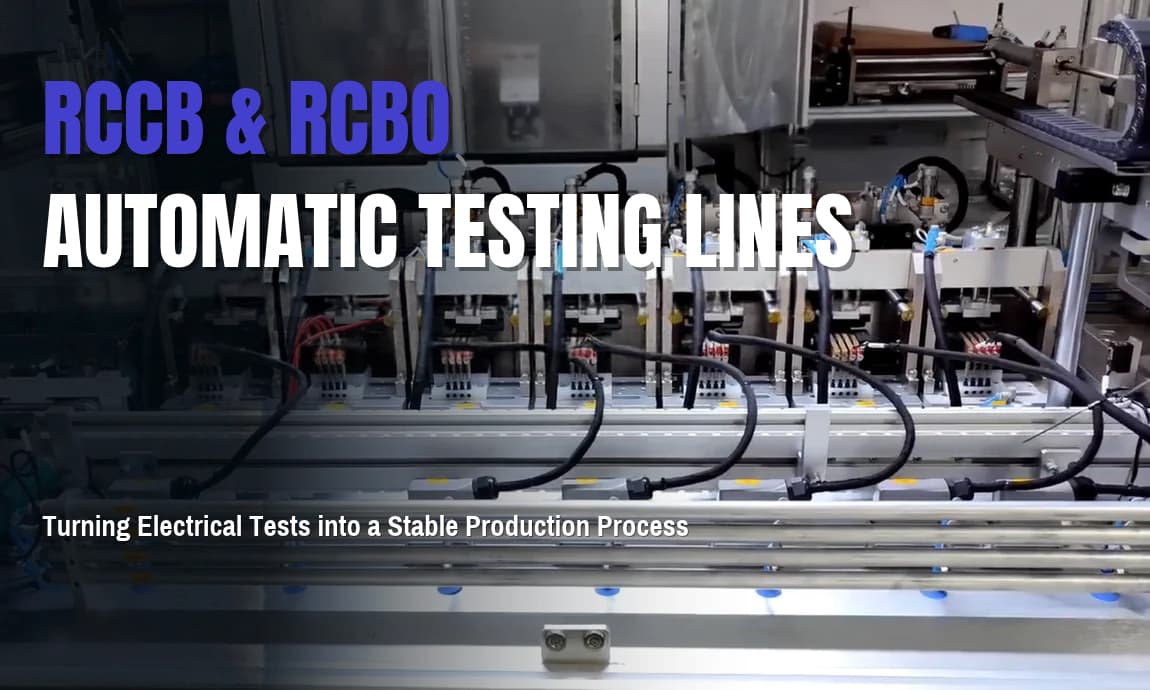
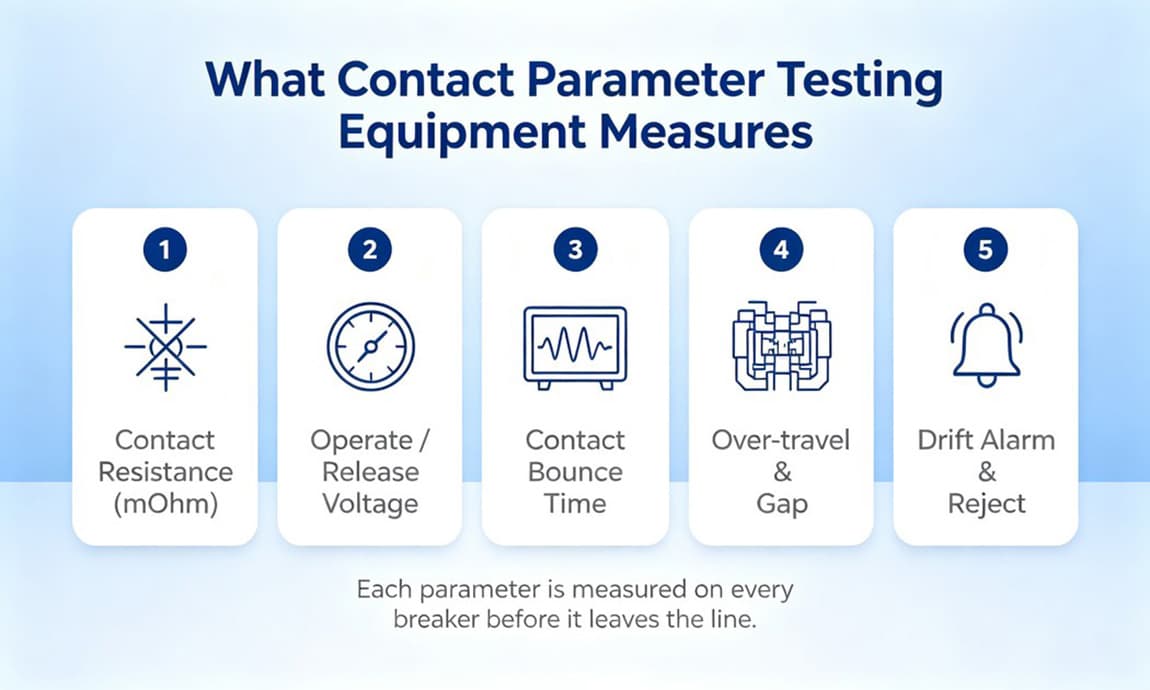
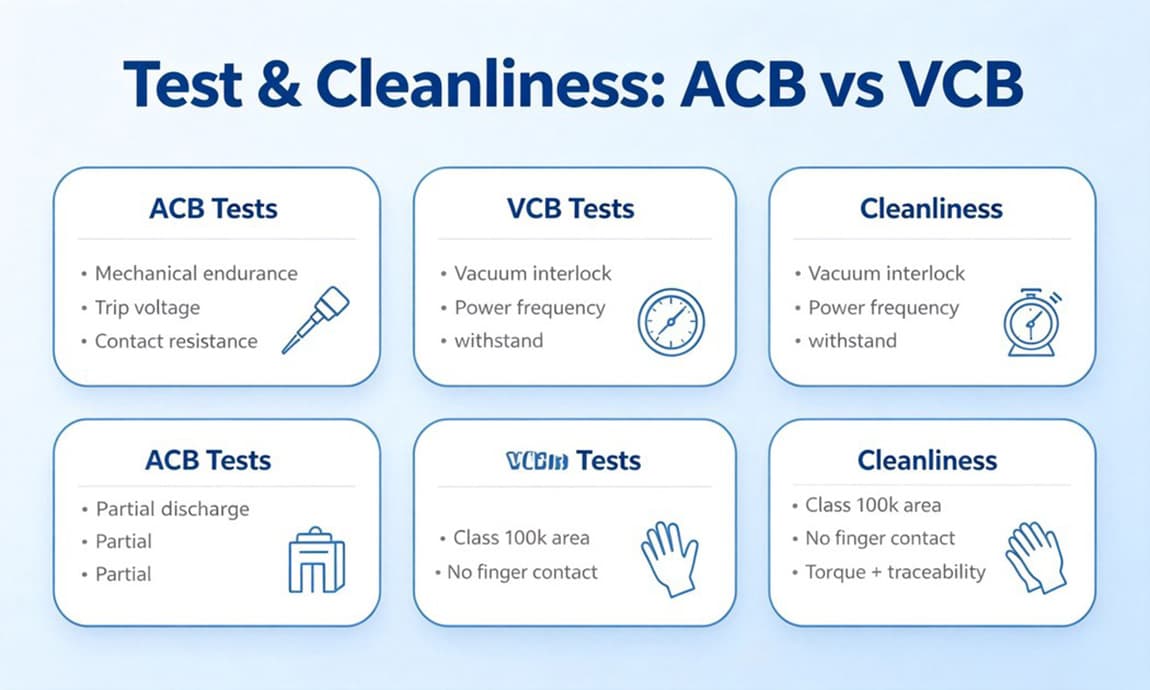
Assembly you might force to share; testing you cannot. An ACB assembly and testing line runs mechanical endurance, trip-voltage and contact-resistance checks on each unit, because the open contacts and exposed linkage degrade with wear. A VCB adds vacuum-interlock testing, partial-discharge measurement and power-frequency withstand at kilovolts, none of which an open-frame ACB bench is wired or shielded to run. Putting both test suites on one tester means one station standing idle while the other runs, plus interlock and safety changes for high-voltage cabling. The dedicated circuit breaker testing equipment on each side stays faster and safer. In practice an ACB assembly and testing line racks up throughput on mechanical cycling, while a VCB line spends its cycle on high-potential testing that needs shielding and interlocked doors. You cannot interleave those beat times on one tester without waiting.
Cleanliness and handling sit on different floors
The vacuum interrupter is the constraint. A VCB pole is assembled in a controlled, low-particulate area because one fibre inside the bottle can track under voltage. That gloves-and-torque-discipline environment is wasted on an ACB chassis, which is built on an open bench where operators bolt frames by hand. An ACB assembly and testing line that tried to serve both would either over-climate the ACB work or under-protect the VCB work. We treat the cleanliness cell as a separate island even inside the same plant, because the cost of cleaning an ACB assembly and testing line floor to VCB standard rarely pays back. Dust control, ESD wrist straps and sealed torque tools belong on the VCB side; on the ACB side, the same discipline slows an already bulky cycle to a crawl.
What ACA Automation recommends for a mixed breaker plant
For a plant that must build both, the recommendation is two dedicated cells, not one universal rail. Size an ACB assembly and testing line around the chassis and mechanism stations, and a separate VCB line around the sealed pole and high-voltage test bays, then tie both into one MES so recipe, torque and serial traceability roll up together. The payoff is that each ACB assembly and testing line keeps its own beat instead of waiting on the other product's cycle. You can see the automatic assembly equipment side on the products page (/products) and the test side under testing equipment (/testing-equipment). This keeps each cell fast, keeps the vacuum island clean, and still gives engineering one source of quality data. A well-scoped ACB assembly and testing line and its VCB twin are a pair, not a trade-off. Ask ACA Automation to review your breaker mix before you order floor space.
Can a single fixture changeover ever handle both ACB and VCB?
A shared base conveyor can be considered, but the nests, grippers, torque spindles and high-voltage test bays differ so much that the shared part is only the framework. The economic break-even usually still lands on two dedicated cells.
What is the biggest risk of forcing both onto one line?
The high-voltage and partial-discharge tests on the VCB side, and the cleanliness of the vacuum pole. Forcing an open ACB bench around a sealed interrupter tends to raise escape rates and leave one test station idle.
Does ACA Automation build both types of line?
Yes. ACA Automation designs an ACB assembly and testing line for draw-out breakers and a separate vacuum-pole line for VCB, with shared MES traceability linking the two. Treat the ACB assembly and testing line and its VCB twin as two cells planned together.
Send ACA Automation your breaker types and monthly volumes for a feasibility study - from concept to completion.