You send an RFQ for a new breaker line and three suppliers come back with quotes 40 percent apart. The drawings are the same, the volume is the same, yet the numbers barely overlap. As a buyer sourcing MCB automatic assembly equipment, that spread usually means the RFQ left out the details that actually drive the machine price. A thin RFQ forces each supplier to guess your cycle time, your yield bar and your traceability format, then price the guess. Thin data on an MCB automatic assembly equipment RFQ is the root cause. Our view at ACA Automation is that a tight RFQ does not slow the project down; it is the fastest route to comparable quotes. Below is the checklist we expect a serious MCB automatic assembly equipment buyer to attach. When the scope is thin, suppliers pad the unknowns into risk margin, and the quotes no longer compare. The fix is not more meetings; it is a tighter RFQ.
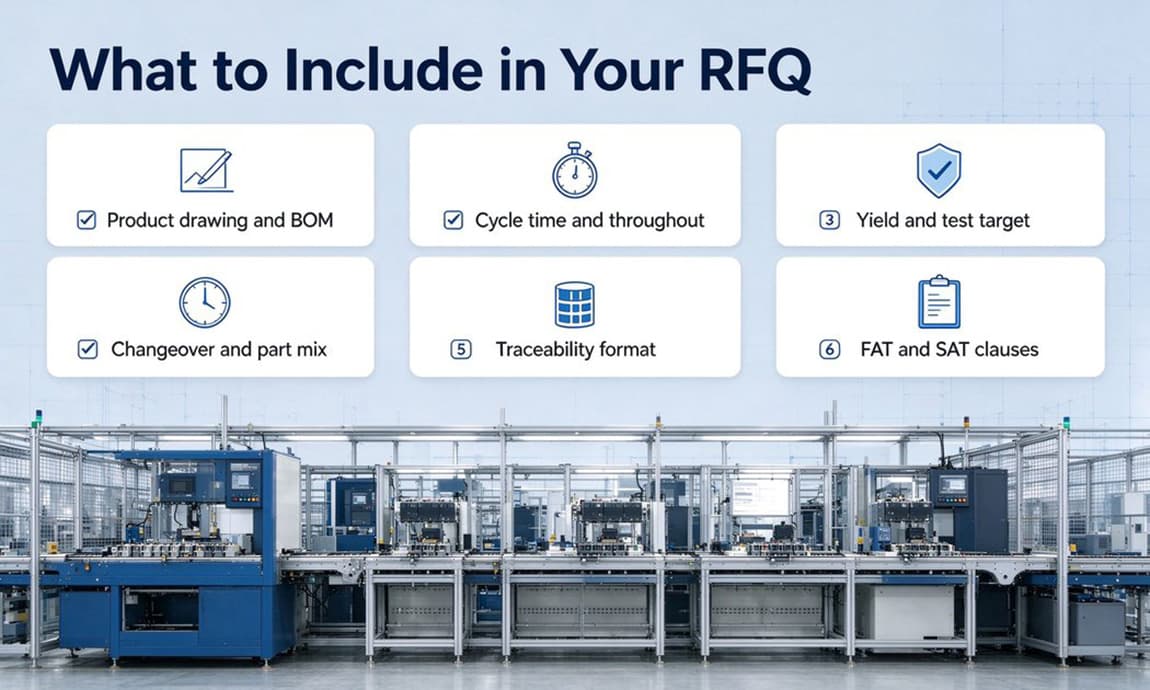
Product drawing, BOM and variants
Start with the part. Attach the assembly drawing, the BOM, and the list of variants the line must run, not just the hero part. A supplier quoting MCB automatic assembly equipment needs the contact bridge, the arc chute, the toggle linkage and the screw torque values, because each one changes the feeding and screwing stations. If the drawing is still settling, say so; an experienced MCB automatic assembly equipment supplier prices the pilot configuration and lists the engineering change allowance. Attach 2D drawings of the contact system, the operating mechanism and the enclosure, plus the tolerance bands on fit and finish. Suppliers who receive only a 3D model have to re-draw the feeding geometry, and that rework lands in the price. Browse our assembly equipment range.
Cycle time, throughput and available space
State the required cycle time per pole, the annual volume, and the floor footprint you can release. Cycle time is the single biggest lever on price: a 0.8-second station and a 1.2-second station are different machines. The MCB automatic assembly equipment line you buy for 0.8 s cannot hold a faster rate later without rework. An honest MCB automatic assembly equipment supplier will also ask for the available line length and height, because a tight cell may need an angled layout instead of a straight one. Include shift hours, planned uptime and the surge weeks you expect. A line sized for average volume will not survive a launch week, while one sized for peak volume sits idle the rest of the quarter. The MCB automatic assembly equipment layout should match both.
Yield target and test scope
Give a target first-pass yield and the test stations the line must carry inline, such as contact resistance, mechanical trip and high-potential. A supplier of MCB automatic assembly equipment prices testing equipment, a reject diverter and data logging as separate lines; leave them out and one quote quietly assumes manual test while another builds it in. That is why an MCB automatic assembly equipment quote without a test list is not comparable. State the yield number and the test scope, and the quotes start to line up. List the inline tests as required signals and tolerances: contact resistance upper limit, trip current window, dielectric withstand. State whether failed parts are auto-diverted or quarantined for retest. That lets suppliers price the testing equipment consistently.

Changeover and part-number mix
Say how many part numbers the line runs per year and the allowed changeover time. A dedicated MCB automatic assembly equipment line for one breaker size at high volume is cheaper than a flexible cell that swaps nests in 30 minutes. When a buyer asks ACA Automation for MCB automatic assembly equipment, we map the part-number mix first, because that decides whether you buy a dedicated line or a quick-change cell. Give the reorder batches per family and the changeover time production will accept between shifts. A line that needs a half-day to change a runner part will cost you output each week; specify 30-minute quick-change nests if that matters.
Traceability format, FAT and SAT clauses
Define the data each pallet must record, the barcode or MES interface, and the FAT and SAT acceptance criteria. A buyer who leaves traceability open on an MCB automatic assembly equipment RFQ gets three different data formats back. Specify the serial-number format, the fields logged per station, and the run rate the line must hold at FAT; that turns vague acceptance into a testable number. Define whether data goes to a customer MES, a local SQL database, or both, and the retention period. At FAT, agree on a two- or four-hour run at the quoted rate with the logged yield, so SAT is a repeat of the same test on your floor.
A complete RFQ for MCB automatic assembly equipment narrows the quote spread because each supplier prices the same assumptions. Send the drawing, the cycle time, the yield target, the part-number mix and the acceptance clauses together. Suppliers who understand MCB automatic assembly equipment respond with questions when the RFQ is thin, which is itself a signal; see our products for reference.
Q1: What is the single most overlooked item on an assembly-line RFQ?
A1: The allowed changeover time. It decides dedicated versus flexible and moves the price by a wide margin, yet it is the line buyers leave out.
Q2: Should I specify the test stations in the RFQ?
A2: Yes. List the inline tests you need, such as contact resistance and trip time, or one quote assumes manual test while another builds it in.
Q3: How detailed should the acceptance criteria be?
A3: Give a measurable run rate and yield at FAT, plus the data fields logged per pallet, so acceptance is a test rather than a handshake.
Send ACA Automation your breaker drawing and volume numbers, and we will return an RFQ checklist and a budget layout for your MCB automatic assembly equipment project.