Drop a 1600 A MCCB frame onto the same conveyor and gripper that handles a 100 A unit and the line stops in one cycle. The copper busbar alone weighs more, the arc chute is bulkier, and the operating mechanism needs a measured press. A small-frame MCCB automatic assembly and testing line cannot simply be widened; the whole layout has to be re-planned around the heavy parts. This is how an MCCB automatic assembly and testing line for 400, 630 and 1600 A frames is actually laid out.
A 100 A frame arrives as a light moulded case with small contacts; a 1600 A frame carries laminated copper, a heavy arc chute and a spring mechanism that stores real force. On a small-frame line each station runs a few seconds and parts flow in one file. On a high-current frame, the busbar and arc-chute stations run much longer, so a single serial line turns those stations into the bottleneck and the rest of the cells wait idle. The layout problem is not the number of stations but the mismatch between heavy takt and light takt, and that mismatch shows up as idle time and rework if the stations are not re-balanced for the large frames.
Order stations by frame weight, not by part count
ACA Automation sequences the line so the heaviest, longest operations sit where they can be duplicated, and the light fast stations sit single. The flow starts at frame and base load, moves to copper busbar insertion, then arc-chute assembly, then the operating mechanism, then screw and torque, and ends at electrical and mechanical test. On a high-current MCCB automatic assembly and testing line, station order follows the mass of the sub-assembly, because a heavy busbar that must be flipped or turned needs a dedicated pick-and-place that a light terminal does not. Getting the sequence right on an MCCB automatic assembly and testing line prevents a heavy busbar from being flipped twice, which is where time is usually lost. Figure 1 shows the station sequence with buffers between the heavy stations.
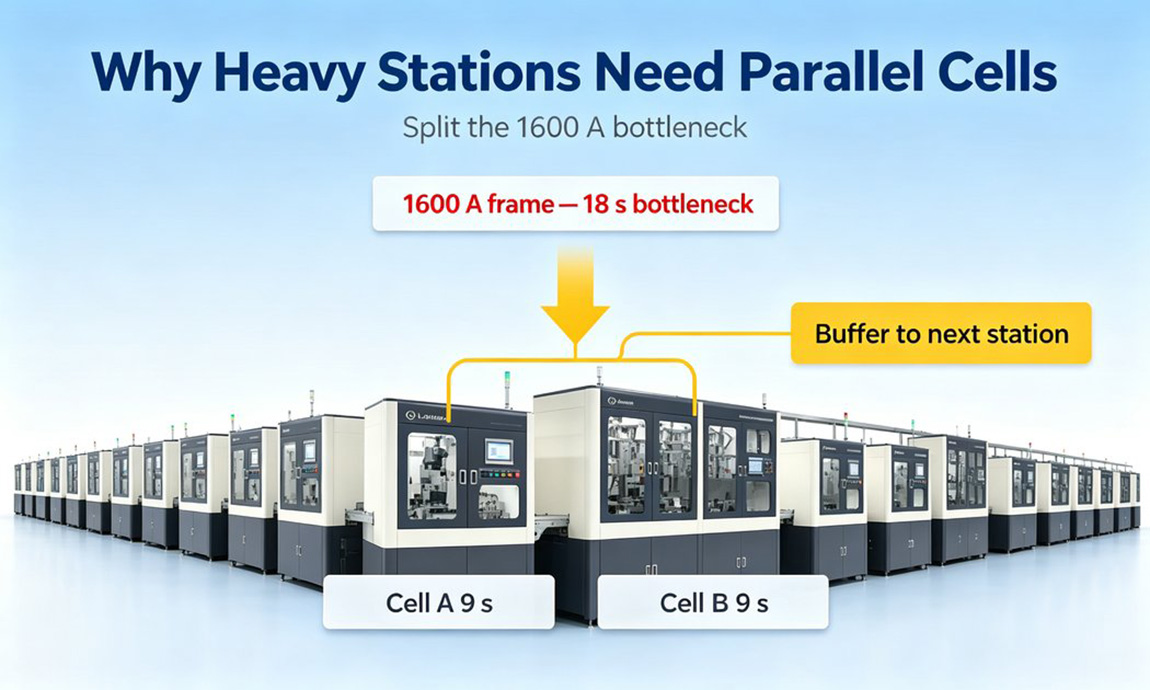
Figure 1. High-current MCCB assembly station sequence, ordered by frame weight, with buffers between the heavy busbar, arc-chute and mechanism stations.
Split the heavy stations into parallel cells
Where one station runs 18 seconds and the target takt is 9, ACA Automation builds two parallel cells rather than a faster machine. A 1600 A busbar station, for example, becomes Cell A and Cell B, each feeding the same downstream buffer. Duplicating the station is cheaper than chasing a higher press force or a more complex gripper, and it keeps the line flexible if one cell needs maintenance. This parallel-cell logic is what lets an MCCB automatic assembly and testing line cover 400 to 1600 A frames on one footprint; the light stations stay single, the heavy stations double. On this kind of MCCB automatic assembly and testing line, duplication is the standard response to a slow heavy station. Figure 2 shows the split.
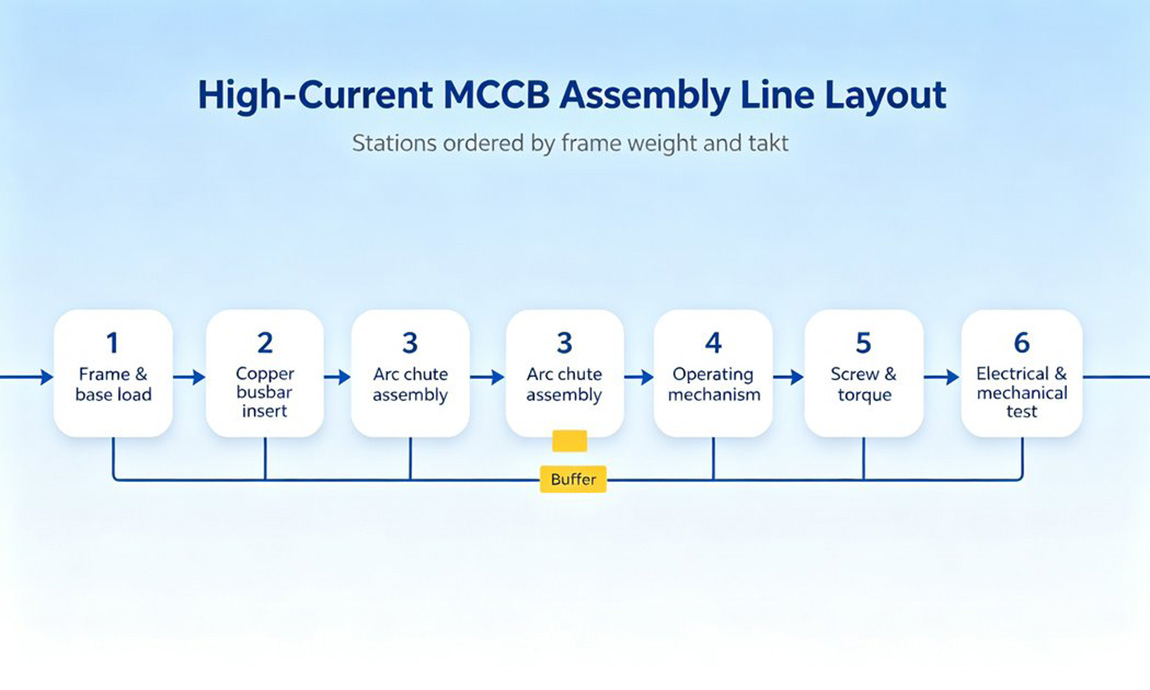
Figure 2. A 1600 A bottleneck station split into two parallel 9 s cells feeding a shared buffer.
Put buffers only where they protect the bottleneck
Buffers are placed in front of the heavy parallel cells, not behind them. A small accumulator before the busbar and arc-chute stations absorbs the stops of upstream feeding, so the bottleneck never waits for a part. After the bottleneck, extra buffer just builds work-in-progress and hides problems. On a running MCCB automatic assembly and testing line, the rule is one buffer upstream of each duplicated station and none downstream; that keeps takt honest and gives maintenance a place to pause without starving the next cell. A well-balanced MCCB automatic assembly and testing line therefore looks uneven at first, with paired heavy cells and single light ones.
How ACA Automation lays out the line
ACA Automation lays the line out from the heaviest station backward: identify the bottleneck frame, duplicate those stations, then fill the fast stations around them. The build uses standard assembly equipment modules so changeover between 400, 630 and 1600 A nests stays quick, and the test end ties back to the same data record. See the MCCB semi-automatic assembly line reference and our solutions for how this layout is adapted to a frame family. Any MCCB automatic assembly and testing line planned this way starts with the heavy parts, not the conveyor; that backward planning is the core of each MCCB automatic assembly and testing line we commission for a mixed frame family.
Send ACA Automation your frame drawings across the 400 to 1600 A range for a station-layout proposal and takt estimate; we will show how the MCCB automatic assembly and testing line balances the heavy stations against the light ones before any steel is cut or any nest is machined.
Frequently asked questions
Can one line handle 100 A and 1600 A frames together?
Not on the same nests without re-tooling. A high-current MCCB automatic assembly and testing line is sized around the heavy frames; the lighter frames run on quick-change nests on the common base. A mixed-family MCCB automatic assembly and testing line shares the conveyor, feeders and test end, while the heavy busbar and arc-chute stations stay dedicated to the large frames.
Why duplicate a station instead of buying a faster machine?
Because the bottleneck is a heavy assembly, not a slow motor. Two 9 s cells meet the takt at lower press force and simpler grippers, and if one cell is taken for maintenance the line keeps running. Chasing a single faster station raises stiffness and safety demands with little gain, and on a high-current MCCB automatic assembly and testing line the duplicated cells are the main capacity lever.
How much floor space does a high-current MCCB line need?
It depends on the number of parallel cells for the heavy stations. The footprint grows mainly where busbar and arc-chute assembly is duplicated, while the light stations add little. The layout is sized from the slowest frame first, then the fast stations are fitted around it; this is why a high-current MCCB automatic assembly and testing line takes more floor space than a small-frame line, which runs in a tight serial line with no parallel cells.