A line leader calls us with the same puzzle: the riveting station was dialed in at eight in the morning, the first hundred MCBs passed the bench test, yet by afternoon a batch of breakers trips off-value. The rivets look seated. The height gauge from last shift still reads the same. Something between good and bad has crept in, and nobody stopped the press when it moved. On an MCB automatic assembly line, riveting is where the trip value is physically set, and where a tuned-at-start station quietly drifts.
Loose or undersized rivets change contact force, and contact force is what sets the magnetic trip. This is not a raw-material story and it is not an operator story; it is a process-monitoring gap that the MCB automatic assembly line has to close inside the cell. Here is how ACA Automation reads the problem.
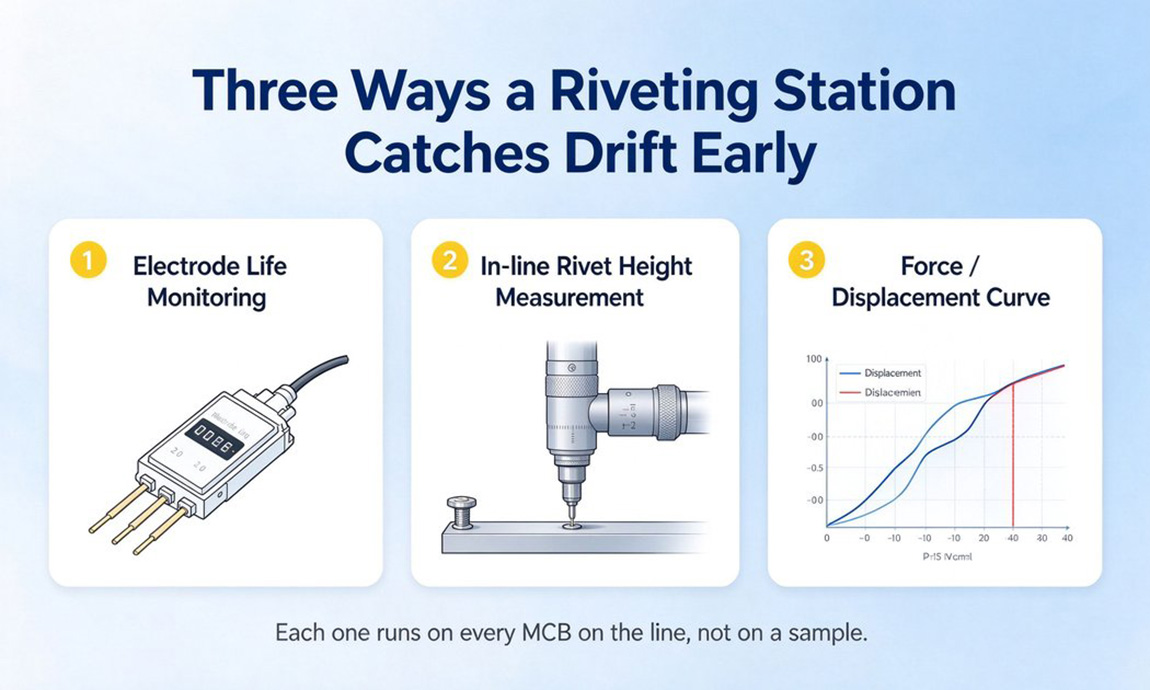
Figure 1. A riveting station on an MCB automatic assembly line, where the trip value is physically set.
The rivet that looked fine but loosened under load
Visual inspection sees a rivet head flush with the housing. It cannot see whether the joint carries the rated contact force. A weak rivet - from a worn electrode tip, a displaced part, or a too-short press stroke - holds the contact where it should, until temperature or vibration loosens it. On an MCB automatic assembly line that means a breaker leaves the cell passing a go/no-go height check and returns as a nuisance trip months later. The defect was invisible at the station that made it, and any MCB automatic assembly line that relies on the morning dial-in repeats the same risk.
What drift in the rivet does to the trip value
The rivet sets both the contact force and the fixed position of the moving contact. When the set height falls a few hundredths of a millimeter short, contact force drops and the contact resistance rises; the bimetal then heats and trips earlier than rated. When the set runs long, the mechanism binds and the breaker trips late. Same mold, same silver reel, same operator - the only difference is the rivet joint, and that is the measurement a basic MCB automatic assembly line usually does not make on each unit. Offline sampling catches a wide failure, not the slow creep toward the edge of the window, and the MCB automatic assembly line that samples once an hour never sees the creep at all. The MCB automatic assembly line that does not measure each joint has no way to tell the first good unit from the last drifting one.
Why a tuned-at-start riveting station still drifts
A station calibrated at shift start assumes nothing wears between units. Electrodes dull, tips pick up material, press oil thins, and the part nests warm up. Each unit shifts by a fraction; the first unit and the last unit of a thousand are not the same joint. Without feedback, the MCB automatic assembly line keeps pressing at a recipe that was right an hour ago, and the MCB automatic assembly line has no record of when that drift began. On any MCB automatic assembly line, the recipe is a starting point, not a guarantee, and this is the gap an automated welding and testing station is built to close - measure the process, not just the part.

Figure 2. Three in-line monitors that catch riveting drift on an MCB automatic assembly line.
Monitor electrode life before the joint weakens
The electrode is the wear item. Count shots per tip and watch for the force curve flattening or the current climbing as the tip grows dirty. A modern MCB automatic assembly line treats tip wear as a measured parameter, so the MCB automatic assembly line stops assuming the tip is new. It logs tip life and flags a dressing before joint strength drifts, instead of after a batch is quarantined. That loop is what separates a reliable MCB automatic assembly line from one that only runs the press. At ACA Automation we tie the tip counter to the serial number, so a weak batch can be traced to a specific tip hour rather than a whole day of production.
Measure rivet height and the force curve, unit by unit
Two in-line measurements catch what a dialed-in recipe misses. First, a height or displacement gauge after the press confirms each rivet set to the target band. Second, a force-versus-displacement window compares each press to a known-good curve and diverts anything outside it. Together they catch the short stroke, the missing part and the worn tip in real time. At ACA Automation the force window is set from your weakest acceptable joint, not from a nominal good one. A testing station on the MCB automatic assembly line records each result with the serial, so the trend - not the single bad part - becomes the alarm. This is the gap a well-built MCB automatic assembly line is supposed to close before the parts leave the cell.
Riveting quality does not fail loudly. It drifts a few microns a unit, then shows up as a batch of breakers that trip when they should hold. The MCB automatic assembly line that runs unmonitored ships that drift out the door as finished product. Watch the tip, measure the set height, and window the force curve; that turns a defect found in the field into an alarm found at the press. You can review our MCB semi-automatic assembly line page to see how these monitors sit on a real cell. Send ACA Automation your rivet drawing and target contact force; we will scope the monitoring stations and the limits before the line is built.
Frequently asked questions
How short a rivet height shift will move the trip value?
Often a few hundredths of a millimeter is enough. Because the rivet sets contact force, a small change in set height moves force and resistance together, which shifts the thermal and magnetic trip band. In-line height gauges resolve exactly that range.
Do we need a force sensor on every riveting press?
For breakers where the rivet sets the trip value, yes. A force-versus-displacement window catches the short stroke and the missing part that height alone can miss. On low-criticality rivets, height monitoring may be enough.
Can these monitors be added to an existing line?
Usually. Tip counters, a post-press height gauge and a force window can be retrofitted around the existing riveting station, provided the cell space and controller support a per-unit data record.