Twelve seconds per unit. That was the takt time one MCCB assembly line was stuck at, and the target was eight. The line ran six stations in sequence, but only one station mattered: the screw-drive cell took 11.8 seconds, while the others finished in under six. In a serial line, the slowest station sets the pace, so the other five stood idle for half the cycle. We are an assembly equipment manufacturer, and when this customer asked us how to lift output without adding a shift, the answer was not a faster screw gun. It was rebalancing the line around that one station, which is exactly the kind of bottleneck fix an assembly equipment manufacturer is called in to do.
Why a serial line lives or dies at one station
Takt time is set by the bottleneck, not by the average. If one station needs 12 seconds and the rest need 5, the line ships a unit once per 12 seconds, full stop. The assembly equipment manufacturer who only looks at total cycle time across the line will miss this; the useful number is the longest single station. On this MCCB line, the screw cell ate the cycle because it drove six screws in series, each at a fixed torque, with no parallelism. The feeder and test stations downstream had spare time they could not spend, because a serial transfer only moves when all stations are ready. An assembly equipment manufacturer's first job is to find that station before buying any extra hardware. When an assembly equipment manufacturer audits a line, the first read is a station-by-station time study, not a pitch for new iron; without that data, even a well-meaning assembly equipment manufacturer ends up speeding the wrong step.
Three levers we pulled to reach 8 seconds
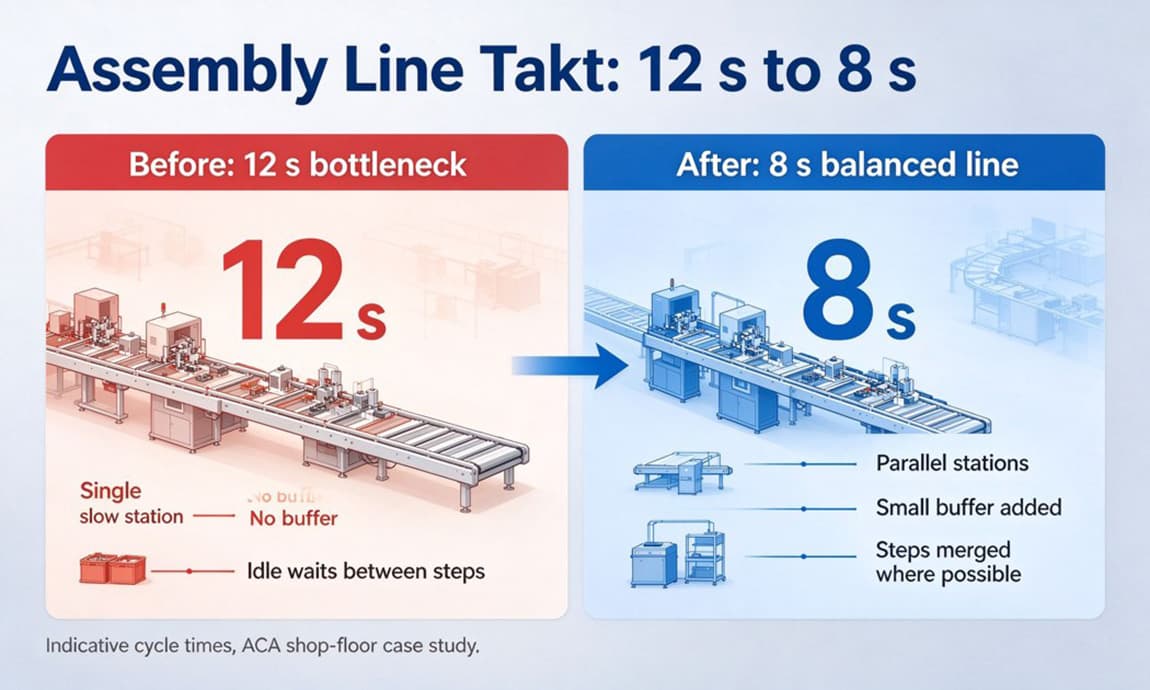
We worked the bottleneck from three directions. First, parallel stations: the six-screw job was split across two screw cells running in parallel, each driving three screws, so the effective time dropped toward six seconds instead of eleven. Second, a small buffer before the former bottleneck: a short accumulator absorbs the brief stops that used to stall the whole line, so one station's hiccup no longer costs the entire cycle. Third, merge small steps: two quick tasks that had sat on separate stations, each with its own transfer wait, were combined at one station, cutting the idle handoff between them. A careful assembly equipment manufacturer checks the buffer size against the line's real stop frequency, because too small a buffer does nothing and too large one just piles up work in progress. Figure 2 shows the three levers together.

None of these levers is exotic. The point of the rebuild was that the assembly equipment manufacturer balanced the work content across stations rather than speeding up the slowest tool. Parallelism removes the serial penalty, the buffer removes the ripple effect, and merging removes dead transfer time. That is the same approach we build into our assembly equipment lines and testing equipment integration for MCCB and MCB products, and it is why a well-balanced line meets an 8-second takt without running any single station near its limit. This is the work an assembly equipment manufacturer is measured on: not the biggest machine, but the shortest balanced cycle.
The result: 12 seconds down to 8
After the rebalance, the line's takt settled near 8 seconds. The screw station, once the 11.8-second bottleneck, was no longer the longest step; the cycle was now shared across stations that each ran around seven to eight seconds, with the buffer absorbing normal variation. Output rose by roughly 50 percent on the same footprint and the same head count. This is the kind of result an assembly equipment manufacturer targets on a rebalance rather than a new build. These figures are indicative for this specific MCCB product mix, not a universal target; your own gain depends on how unbalanced your stations are to begin with. An assembly equipment manufacturer should hand you the before-and-after station times, not just the headline 8-second figure, so you can see where the slack went. Figure 1 compares the two states.
How to apply this to your own line
Before spending on a faster machine, time each station individually and find the longest one. List the work content at that station and ask whether it can be split in parallel, buffered, or merged with a neighbor. ACA Automation starts each takt project with that station-by-station time study, because the assembly equipment manufacturer who skips it buys speed in the wrong place. If the longest station already sits near its mechanical limit, parallel duplication is the reliable lever; if it is just serial work, splitting it usually wins first. Ask any experienced assembly equipment manufacturer and they will say the same: measure the bottleneck before touching the budget.
Frequently asked questions
Do we need to buy a faster machine to cut takt time?
Usually no. Most takt loss comes from unbalanced work across stations, not from a tool at its speed limit. Splitting the slowest job in parallel, adding a small buffer, and merging small handoffs raises output more cheaply than replacing a station.
Where should the buffer go?
Put it in front of the bottleneck station. A small accumulator there lets a short stop upstream or downstream be absorbed without freezing the whole serial line. A buffer in the wrong place just adds WIP without helping takt.
How long does a takt rebalance take?
It depends on how much station layout changes. On a comparable MCCB line, the parallel-cell split and buffer were installed over a planned shutdown, followed by a short trial week. Ask ACA Automation for a plan based on your station times and product mix. Any assembly equipment manufacturer who quotes a takt gain without first timing your stations is guessing, not engineering.
Will faster tooling help on its own?
Only if the tool itself is the bottleneck. In most lines, the slowest step is serial work that can be split, not a tool at its speed limit. A good assembly equipment manufacturer measures before recommending new hardware; otherwise you pay for speed the line cannot use.
Send ACA Automation your station-by-station cycle times, and we will map where the bottleneck sits and which lever frees it fastest. As an experienced assembly equipment manufacturer, we balance the line before we quote the iron. See our assembly equipment, our integrated testing equipment, and the broader automation solutions we deliver for electrical component lines.