A factory owner we spoke to last year had 24 operators hand-assembling relay bases and a budget that would only fund one cell, not a line. He wanted automation but was afraid to commit two years of capex to a whole system before knowing which step actually paid back. His question was simple: can I start with one piece of automatic assembly equipment and grow from there? The answer is yes, and it is the route ACA Automation recommends to most first-time buyers. A single automatic assembly equipment cell is not a compromise; it is the lowest-risk way to learn what automation saves you before you bet the whole budget on a layout.
Why a whole line up front is a hard first step
Ordering a complete automated line on day one means committing the full budget before any process is proven. The takt you assumed, the defect rate you guessed, the labor saving you projected — all of them sit inside a design that is already milled and installed. When one station underperforms, the whole layout is affected, and retooling a committed line costs more than retooling one cell. For a buyer with a limited budget, that is a high-stakes bet. A single automatic assembly equipment cell removes most of that risk: you spend a fraction, prove the process in weeks, and decide the next step from measured data rather than a spreadsheet projection. This is why we steer buyers toward one automatic assembly equipment cell as the first purchase, not a turnkey line.
Pick the station that pays back first
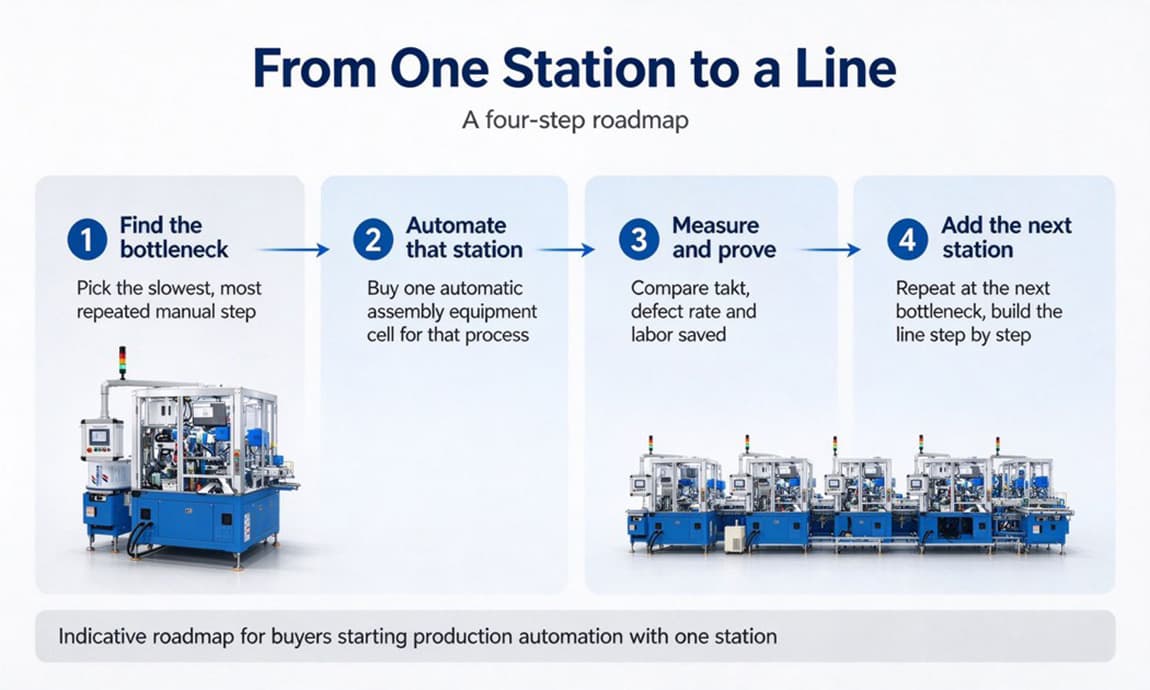
Start from the bottleneck, not from the most exciting machine. Walk the line and time each manual step. The station that pays back first is usually the slowest, most repetitive, highest-headcount step — often one where operators sit for eight hours pressing, screwing or inserting the same part. That is the step to automate first. ACA Automation tells buyers to pick the process with the highest annual volume and the longest manual cycle, because those are the two numbers that decide payback. A fast, low-volume step can wait; the slow, high-volume step is where one automatic assembly equipment cell returns its cost inside a short horizon. A well-chosen first automatic assembly equipment cell often pays back in under two years on such a step, an indicative figure based on our shop-floor data.

What a single starter cell should include
A first automatic assembly equipment cell should do one process well, and it should test as it goes. Choose one automatic assembly equipment cell around a single action rather than a cluster, because a focused cell is easier to debug and easier to prove. A practical starter cell combines the automated action — screw driving, press fitting, feeding — with the checks that prove the part is good: torque verification, a force or displacement monitor, a quick vision check, and a reject gate. Add a simple data record so you can compare before and after. Feeding is where first-time buyers stumble; messy, hard-to-orient parts are better handled with flexible feeding systems than with expensive dedicated bowls. Before you size the cell, browse our assembly equipment range and our flexible feeding systems, and check the full product lineup for what fits your part. When in doubt, the safest first automatic assembly equipment cell is the one that automates a single repeatable action and measures the result, not the one that tries to handle the whole process at once.
If you are scoping that first cell, our assembly equipment line and our flexible feeding systems cover the common starter processes; see the full set under products.
The four-step path from one station to a line
Once the first cell is running, the path repeats. Find the next bottleneck, automate it, measure, then add the station beside the first one. Within two or three rounds the cells connect into a line, and each addition is funded by the saving the previous cell already proved. This staged route is how a budget-conscious buyer ends up with a line without ever betting the whole capex on one guess. Figure 2 shows the loop, and it is why we steer first-time buyers toward a single automatic assembly equipment cell rather than a grand layout. Each added automatic assembly equipment cell should carry the same test and data habits as the first one, so the savings keep stacking.
What ACA Automation recommends for first-time buyers
For a first-time buyer, ACA Automation recommends one well-instrumented cell on the worst bottleneck, a before-and-after measurement on takt and defect rate, and a rough plan for the next two stations. Do not over-specify the first cell; leave room to adapt the fixture as you learn. The goal of the first purchase is information as much as throughput: it tells you whether automation works on your parts, at your volumes, with your people. That evidence is worth more than a polished-looking line built on assumptions. A single automatic assembly equipment cell on the bottleneck gives you that readout without the risk of a full-line commitment.
Frequently asked questions
How much does a single automatic assembly equipment cell cost compared with a line?
Indicative figures: one cell is a fraction of a full line, often one fifth to one third of the cost, and installs in weeks rather than months. The exact number depends on the process, the test content and the feeding method. The point is that you prove the saving on a small automatic assembly equipment budget before you scale.
Which process should I automate first?
The slowest, most repetitive, highest-volume manual step. Time each station on the floor; the bottleneck with the longest cycle and the largest annual volume is where payback comes fastest. A fast, low-volume station can wait for a later round. That slow step is the right candidate for your first automatic assembly equipment cell.
Can a single cell later connect to a full line?
Yes, when it is specified that way. Modular cells with a common conveyor, control and data interface can be linked station by station later. Tell the supplier your growth plan at the start so the first cell is built to expand rather than being a stand-alone island. That way the first automatic assembly equipment cell becomes the first station of a future line.
Send ACA Automation your slowest manual step and your annual volume, and we will scope the first automatic assembly equipment cell that pays you back.