Open a faulty MCB from a reject bin and the cause is almost never the case or the contacts. It is the trip mechanism. On the MCB automatic assembly line we built last spring, a batch came off the test bench with 4% of breakers tripping late, and all the parts had been assembled to nominal. The MCB automatic assembly line had the right pieces in the right places. What it did not have was the right timing between them.
hy the trip station is the hardest one to buil
Most stations on an MCB automatic assembly line add one part. The trip station adds four parts that have to cooperate: the bimetal strip for the thermal trip, the solenoid plunger for the magnetic trip, the latch, and the trip lever. A misplaced rivet elsewhere is a visual defect. A misplaced latch on the MCB automatic assembly line is a breaker that does not open when it should, and that only shows up on the trip-curve test. That is why this station sets the line's takt and its first-pass yield. It also decides whether the end-of-line trip-curve test passes, because the test can only catch a bad mechanism; it cannot repair one. The parts are small, the clearances are tight, and each one sits on top of a previous part, so a tolerance error compounds instead of staying local. Operators can set up the contact welder in an afternoon; getting the mechanism station right takes days of offset checks and trip-curve tuning, and it is the station new builders of the MCB automatic assembly line underestimate the most.
our parts, one sequenc
The bimetal strip is pre-bent to a set offset before it is placed, because its resting angle decides how fast it heats and bends under overload. The solenoid plunger sits on a fixed bore with a small air gap; if the gap drifts, the magnetic trip threshold drifts with it, and the breaker trips early or late on short-circuit current. The latch and trip lever share a pivot, and the spring that loads them has to be hooked without changing pivot friction, because extra friction is the silent cause of a mechanism that hangs. None of these parts is hard on its own. The trouble is that they share one pivot axis, so the order in which they are stacked changes the final geometry. Figure 1 shows the four parts and how they hand motion to one another.
ow the line sequences those four part
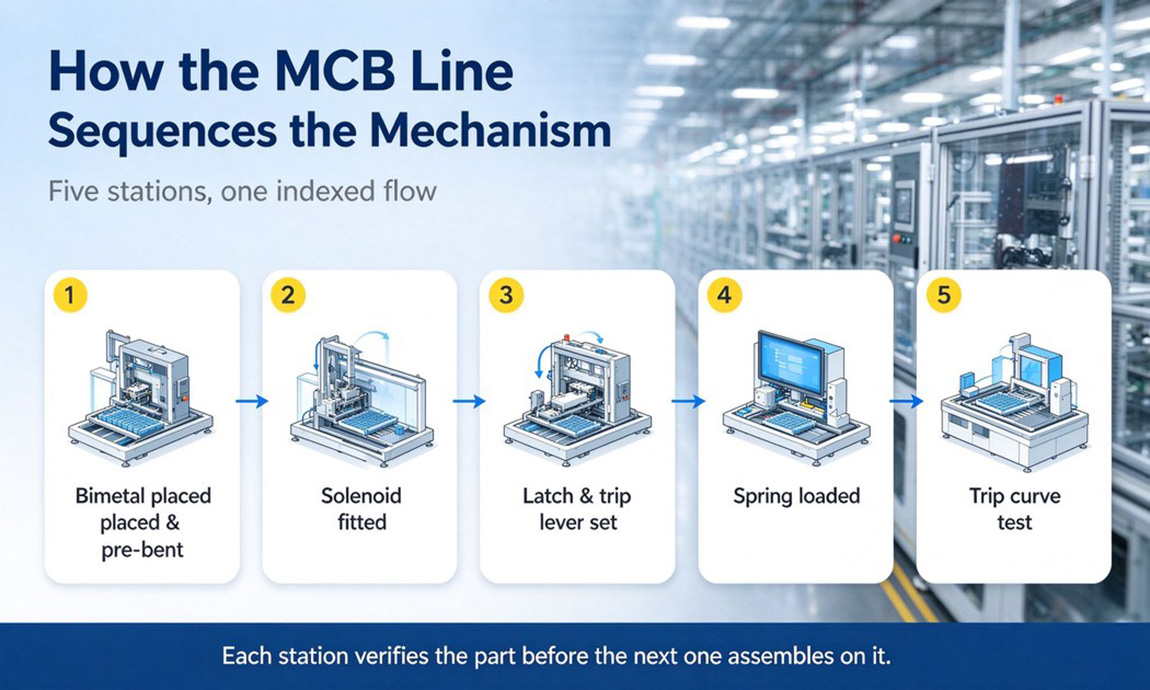
We lay the mechanism out as five indexed stations rather than one complex head. The first places and pre-bends the bimetal, the second fits the solenoid, the third sets the latch and trip lever, the fourth loads the spring, and the fifth runs the trip curve. Each station verifies the part before the next one builds on it, so a bent bimetal is rejected at station one instead of reaching the end of the MCB automatic assembly line. A single head that fires all four placements at once would be faster on paper, but it would give us no idea which placement caused a late trip. Indexing isolates the fault. Figure 2 walks through that sequence.

hat we measure before the next station touches i
Between stations, an MCB automatic assembly line that runs well checks the things a human eye cannot: bimetal offset with a vision probe, solenoid air gap with a feeler-gauge reading, and spring load with a small force check. On the line from last spring, adding the bimetal offset check after station one cut the late-trip batch from 4% to under 0.6%, based on ACA shop-floor data. The fix was not a tighter bolt. It was measuring the offset before the latch was set on top of it. We also tie each serial number to the measured offset and air gap, so when a drift appears the MCB automatic assembly line points to the exact station and the hour it started. Without that traceability, the MCB automatic assembly line operator would see a rising late-trip count and have to guess whether the bimetal, the solenoid, or the spring had shifted. With it, the answer is on the screen. Our assembly equipment (assembly equipment) and testing equipment (testing equipment) are built to close that loop on the MCB automatic assembly line. For a semi-automatic starting point, see our MCB semi-automatic assembly line (MCB semi-automatic assembly line). The MCB automatic assembly line that handles the mechanism well is the one that measures before it stacks, not the one that builds faster.
Send ACA Automation a sketch of your trip mechanism; ACA Automation will tell you which station on the MCB automatic assembly line needs the offset check before the next part goes on, and where the buffer should sit.
A
Why does the trip mechanism only fail at the end-of-line test?
Because the defect is a timing error between four parts, not a missing part. A bent bimetal or a drifting air gap looks assembled-correct until the breaker has to trip on curve, which is why the MCB automatic assembly line checks offsets between stations rather than trusting the final test alone.
Should the trip station be one head or several indexed stations?
Several indexed stations. One head that places four parts at once hides which part caused a reject. Indexed stations isolate the bimetal, solenoid, latch and spring so the failing step is identifiable, which is how ACA Automation keeps the MCB automatic assembly line yield above 99% on this station.
What tolerance on bimetal offset is typical?
Treat it as a few hundredths of a millimeter, typical and indicative, and confirm against your own trip-curve spec. The offset is set on the MCB automatic assembly line before the latch is fitted, not after, because correcting it later means unstacking the pivot and re-running the spring load.