Last month a relay manufacturer sent us a short email: their manual line builds twelve magnetic SKUs at 3,000 to 8,000 pieces a month each, changeover takes two operators half a day, and a quote for flexible magnetic components assembly equipment came back at nearly double the dedicated manual fixture they expected. Their question: isn't flexible magnetic components assembly equipment only for high-volume factories with deep pockets? We hear this at least once a week. The answer is no, but only if you judge it by the right number. The price tag is the wrong number to look at first.
The payoff of flexible magnetic components assembly equipment is decided by changeover economics: how many variants you run, how often you switch between them, and what a lost day of changeover actually costs the plant. On a single-product factory, a dedicated line still wins. On a multi-variety shop, the math often flips, and the breakeven arrives much earlier than buyers expect. The mistake is comparing the sticker price of magnetic components assembly equipment against a manual bench and stopping there. That gap is what a well-chosen magnetic components assembly equipment cell closes: you stop paying for changeover and start paying for running parts.
The real number is changeover cost, not machine price
A manual magnetic components assembly line looks cheap because the fixturing is simple. What it hides is the changeover. When a transformer maker switches from a small relay core to a bobbin-wound inductor, operators rebuild nests, re-set screwdrivers, re-learn their hand positions, and the first hour after restart produces mostly trial parts. In one typical shop we measured, each changeover burned about 3.5 productive hours between two operators, and quality held at 91% for the first fifty parts. Flexible magnetic components assembly equipment removes most of that: the program recalls the variant, the feeder stations swap tooling in minutes, and the nest gauges stay unchanged. On a line that switches three times a week, those hours add up to more than the annual depreciation of a magnetic components assembly equipment cell. The old manual bench also kept a whole second set of fixtures per variant, sitting in cabinets most of the year. A flexible magnetic components assembly equipment cell replaces that fixture inventory with program memory.

Where the balance tips: volume, variety and labor rate
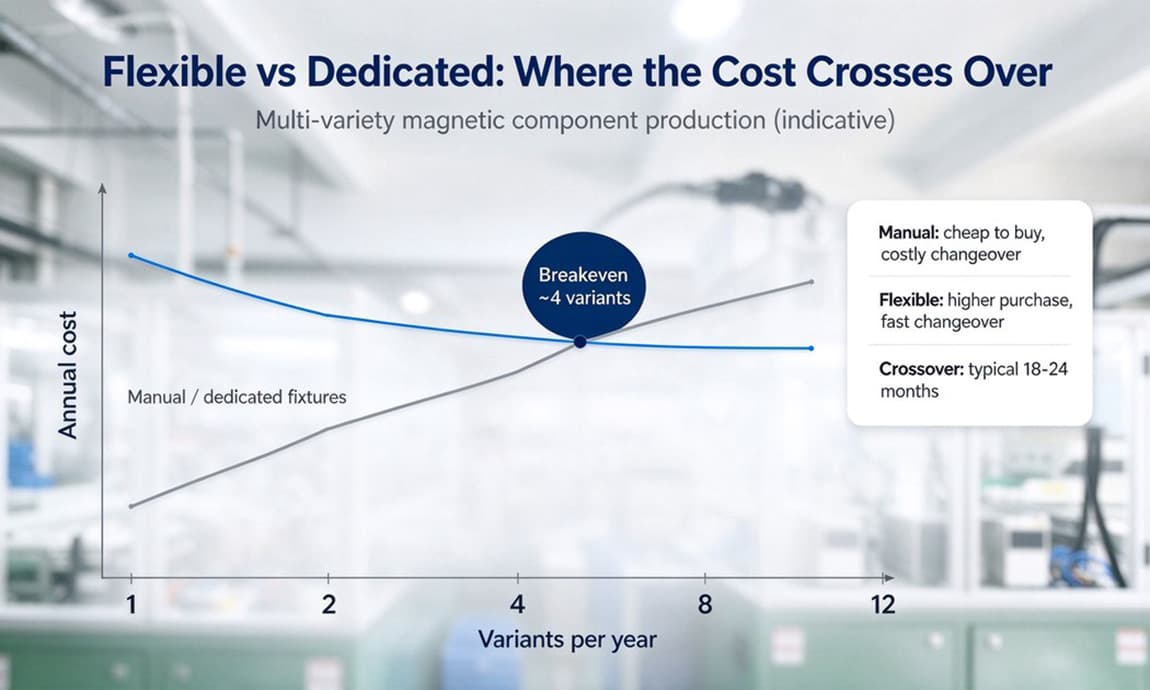
Three variables decide whether flexible magnetic components assembly equipment pays off. First, variant count: one or two products a year argues for dedicated fixturing; eight or more regularly scheduled variants argue for flexibility. Second, batch size: when batches shrink below a few thousand pieces, the changeover cost per part climbs faster than the machine-rate saving of a dedicated cell. Third, labor rate and floor space: where an operator costs a solid wage and the shop floor is already crowded, automating even a moderate volume pays back quickly. Our indicative rule, based on ACA Automation shop-floor references: at three or more recurring variants with batches under five thousand pieces, flexible magnetic components assembly equipment usually reaches breakeven inside eighteen to twenty-four months. Figure 2 shows the two cost paths crossing.
What the payback actually counts
Buyers usually price only the machine. The payback of magnetic components assembly equipment should count four more lines before anyone says it is expensive. Changeover hours saved are the first line. Defect rate is the second: a controlled nest and automatic torque cut the hand-placement defects that a manual line quietly absorbs into rework. Traceability is the third: one serial number per part, logged to MES, which stops field-quality arguments before they start. Floor space is the fourth: one flexible cell replacing two manual benches frees the area for the next project. A magnetic components assembly equipment line priced on purchase cost alone always looks steep; priced on annual running cost, it often looks cheap. We once quoted a customer who had priced the machine against a manual bench alone; once we added the changeover hours and the first-hour defect rate, the flexible magnetic components assembly equipment cell paid back in fourteen months.
Our rule of thumb
At ACA Automation we size a project by a simple test. We take the customer's last twelve months: number of variants, batches per variant, measured changeover time, current defect rate, and labor cost. Then we compare the annual manual cost against the annual cost of a flexible magnetic components assembly equipment cell, including depreciation. If the crossover sits inside about two years, we recommend the flexible cell; if it sits beyond four years, we tell the customer to keep the manual line and automate only the worst station. A magnetic components assembly equipment line that never breaks even is a bad purchase, and we say so on the quote rather than selling a bigger machine than the order book supports. That honesty keeps the quote small, and the payback real.
If you run several magnetic component variants and wonder where the crossover sits, ask ACA Automation to run the numbers against your last twelve months of orders. Start from our magnetic components assembly equipment page, and pair the cell with our flexible feeding systems and standard assembly equipment modules. We come back with the breakeven point, not a sales pitch.
Frequently asked questions
Doesn't flexible magnetic components assembly equipment cost far more than manual fixtures?
The sticker price is higher, but the comparison has to be annualized. A manual line is cheap to buy and expensive to run: changeover labor, trial parts, hand-placement defects and rework each batch. When batches are small and frequent, those running costs overtake the machine-rate saving within about two years. We give customers the crossover year on the quote, built from their own order history rather than a catalogue assumption. A magnetic components assembly equipment cell turns those repeated changeover costs into a fixed annual number you can plan against.
What if we only run two magnetic products?
Then dedicated fixturing usually wins. Flexible magnetic components assembly equipment pays off when variants multiply. Our practical threshold is three or more recurring variants with batches under five thousand pieces; below that, we recommend automating the single worst station rather than building a whole flexible line. We have built cells for two-product shops, but only where changeover pain was already costing a shift a week.