An MCB maker came to us last quarter with a line that assembled breakers fine but kept failing its IEC 60898 type-retest: samples tripped outside the B-curve window, and a few units leaked current at the dielectric step. The question they brought was simple - which test stations does an MCB automatic assembly and testing line actually need built in, so that type compliance stops being a surprise at the notified body? The answer changes the line layout, not just a bench at the end of it. Designing an MCB automatic assembly and testing line this way moves the type-test windows onto the production floor, where drift is caught early.
IEC 60898 sets the windows - overload trip times, instantaneous trip thresholds, a power-frequency withstand and a minimum mechanical life. A bench that tests a few samples once a week cannot catch drift batch by batch. A production MCB automatic assembly and testing line closes that gap by gating each unit on the line against the same windows the type test uses. For a product range of B and C curves, that means the MCB automatic assembly and testing line carries each curve's recipe rather than one fixed limit. The difference matters: off-line sampling tells you a batch was bad after you packed it, while on-line gating stops the bad unit before it leaves the cell.
Starting with the trip-characteristic station
The first gate is the one that failed them. Each breaker passes a current source that steps through the overload and instantaneous bands: for a B-curve device, no trip below about 3 In and a fast trip between 3 and 5 In; for C-curve, between 5 and 10 In. An MCB automatic assembly and testing line runs this on each pallet, not on samples, and rejects a unit before it travels further. If the bi-metal is slightly off or the magnet gap drifted, the station flags it on the spot. For a B-curve product, an MCB automatic assembly and testing line that does not gate the instantaneous band on each unit will lose the type certificate before the next audit. This is the station that keeps the production MCB automatic assembly and testing line honest against the type curve. The current source has to be stable across the run, because a wobbling supply would misread good and drifted units. That stability is a core part of what makes an MCB automatic assembly and testing line trustworthy to the notified body.
Contact resistance before the arc is trusted
Before the breaker can carry rated current, the contact interface has to be clean and seated. A four-wire milliohm station measures the voltage drop at a fixed test current and compares it to a set threshold. A worn contact, a missed wipe or a stray fibre in the terminal pushes the reading up, and the pallet diverts. On an MCB automatic assembly and testing line this sits right after mechanism assembly, because reworking a high-resistance terminal after the dielectric test wastes a high-voltage cycle. The milliohm reading also feeds the traceability record, so a rising trend across the shift points to a contact-insertion problem before the trip window starts to move. On a well-instrumented MCB automatic assembly and testing line, that contact reading is the earliest warning you get.
Dielectric withstand behind the interlocked door
The hipot station is the one buyers ask about last but should size first. It applies a power-frequency test voltage, typically around 2 kV for one second, between the live parts and the accessible cover, and trips on any leakage above the limit. Because this is mains-frequency high voltage, the station needs its own interlocked guard, earth monitoring and an isolated transformer. Pair it with the circuit breaker testing equipment you would use off-line, and you can run the same proof tests on the line. A well-built MCB automatic assembly and testing line treats the hipot bay as a safety island: the conveyor locks, the guard closes, and the result cannot be skipped. Figure 2 shows the trip windows and the dielectric pass band.

Mechanical life and the final appearance check
Type approval also demands endurance - thousands of no-load and on-load operations. On the line, a reduced mechanical-cycle station samples a share of units to confirm the handle and linkage still stroke, while a final vision station checks the shell, the terminal torque and the printed rating label. Appearance is easy to dismiss, but a crooked label or an unmarked curve class is a type-compliance defect at the audit bench, not just a cosmetic one. Sampling endurance rather than running it on each unit keeps the beat reasonable: a device that cycles ten thousand times off-line is checked statistically, while the safety-critical electrical tests stay 100 percent on the MCB automatic assembly and testing line. That split between sampled endurance and full electrical gating is how an MCB automatic assembly and testing line stays fast without giving up compliance.
How ACA Automation sequences the stations
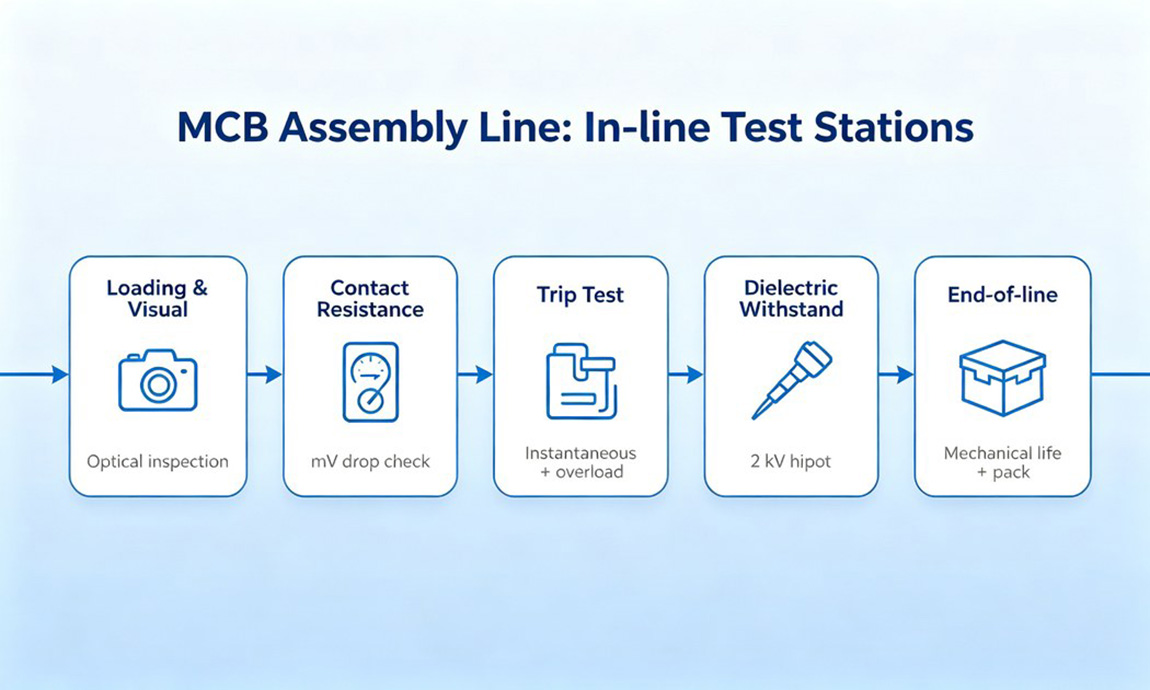
ACA Automation lays the stations in the order that saves cycle time: load and optical check, contact resistance, trip test, dielectric, then mechanical sample and pack. Each result ties to the laser-marked serial and rolls up to the MES, so a drift in the trip window shows as a trend, not a surprise retest failure. You can see the assembly side on the MCB semi-automatic assembly line page, the build side under assembly equipment, and the test side under testing equipment. That sequencing is what turns an MCB automatic assembly and testing line from an assembly bench into a compliance-tracking system. A line that skips the hipot bay, or leaves it to a manual off-line bench, is still gambling that the next retest will pass; the MCB automatic assembly and testing line removes that gamble one serial at a time.
FAQ
Which test stations are mandatory on an MCB line?
At minimum: trip-characteristic (overload and instantaneous), contact resistance, dielectric withstand, and a mechanical-life sample plus final appearance check. Anything less risks finding the defect at the notified body instead of on the line.
Should each unit be tested or just samples?
Gate each unit on trip, contact resistance and dielectric, since those drift with assembly. Mechanical life is usually sampled per shift, because it cycles a device thousands of times and would dominate the beat.
Can the line adapt to B and C curves on one cell?
Yes. The trip station loads the curve window from a recipe, so a single MCB automatic assembly and testing line can run B, C and D curves by switching the program, with the limits logged per serial.
Send ACA Automation your target curve classes and monthly output for a station layout study - from concept to completion.